
Why Chlorine Is More Apt to Exist as an Anion Than Sodium
- Q&A Chlorine
- 11/09/2026
The statement “chlorine is much more apt to exist as an anion than is sodium” may sound complicated, but it describes one of the most fundamental ideas in chemistry: different elements have different tendencies to gain or lose electrons.
Chlorine and sodium are excellent elements for illustrating this principle because they sit on opposite sides of the periodic table and behave very differently when chemical bonds are formed.
A chlorine atom usually gains an electron and becomes a negatively charged chloride ion, Cl−. Sodium, in contrast, usually loses an electron and becomes the positively charged sodium ion, Na+.
This difference explains why common table salt has the formula NaCl and why sodium and chlorine behave so differently before and after ionic bonding.
The chemistry behind this behavior is also relevant to industrial chlorine compounds, disinfection, and professional water treatment. Chlorine chemistry is widely applied in products and solutions such as vi chlorine, where chlorine-based compounds are used in carefully controlled water-treatment and sanitation applications.
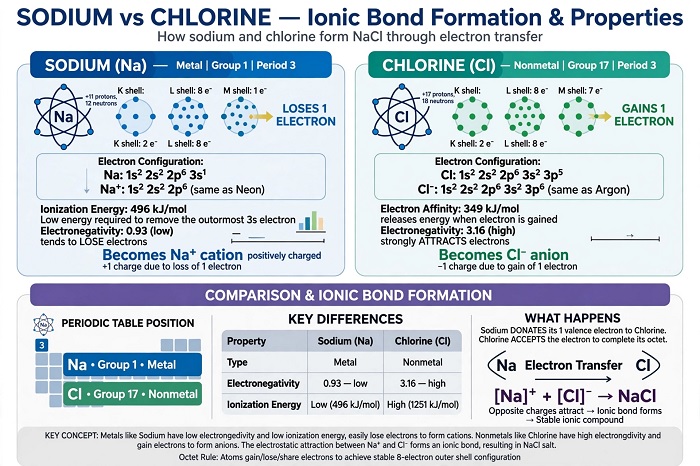
Why Chlorine Is Much More Apt to Exist as an Anion Than Is Sodium
The simplest explanation is based on valence electrons.
Chlorine has atomic number 17. Its electron configuration can be written as: 1s2 2s2 2p6 3s2 3p5
This means chlorine has seven electrons in its outermost shell.
Only one additional electron is needed to achieve a stable outer-shell configuration similar to the noble gas argon.
When chlorine gains an electron: Cl + e− → Cl−
The resulting chloride ion has 18 electrons and a stable electron configuration.
Sodium has atomic number 11 and the electron configuration: 1s2 2s2 2p6 3s1
Sodium has only one electron in its outermost shell. Instead of gaining seven additional electrons, it is energetically much easier for sodium to lose its single 3s electron.
The reaction can be represented as: Na → Na+ + e−
After losing this electron, sodium has the same stable electron configuration as neon.
This is the fundamental reason chlorine favors an anionic state while sodium favors a cationic state.
Chlorine Is Much More Apt to Exist as an Anion Than Is Sodium Because of Valence Electrons
Valence electrons are the electrons located in the outermost occupied shell of an atom. They largely determine how an element participates in chemical reactions.
Sodium belongs to Group 1 of the periodic table. Group 1 elements contain one valence electron and typically form +1 ions.
Chlorine belongs to Group 17, known as the halogens. Halogens contain seven valence electrons and commonly form −1 ions.
The contrast can be summarized as follows:
| Property | Sodium | Chlorine |
|---|---|---|
| Symbol | Na | Cl |
| Atomic number | 11 | 17 |
| Valence electrons | 1 | 7 |
| Typical electron behavior | Loses 1 electron | Gains 1 electron |
| Common ion | Na+ | Cl− |
| Ion type | Cation | Anion |
The tendency of these two elements to form ions is therefore closely connected to their positions in the periodic table.
Chlorine Is Much More Apt to Exist as an Anion Than Is Sodium Because of Electron Affinity
Electron affinity describes the energy change associated with adding an electron to a neutral atom in the gas phase.
Chlorine has a strong tendency to accept an electron. Adding an electron to chlorine produces a particularly favorable energy change because the additional electron completes its outer p subshell.
This helps explain why the formation of chloride, Cl−, is favorable in many chemical environments.
Sodium behaves differently. Adding an electron to neutral sodium would not give it the especially stable noble-gas configuration that sodium achieves by losing its outermost electron.
Instead, sodium generally favors: Na → Na+ + e−
while chlorine favors: Cl + e− → Cl−
These opposing tendencies are exactly what make sodium and chlorine such a classic pair for teaching ionic bonding.
In commercial water-treatment systems, understanding how chlorine-containing compounds behave in water is critical because different chlorine species participate in different chemical equilibria. Professional products such as vi chlorine 45kg are intended for controlled large-scale disinfection and water-treatment applications.
Chlorine Is Much More Apt to Exist as an Anion Than Is Sodium Because of Electronegativity
Electronegativity is the tendency of an atom to attract shared electrons toward itself when it forms a chemical bond.
Chlorine is highly electronegative. Sodium has a relatively low electronegativity.
When sodium and chlorine interact, chlorine attracts electron density much more strongly than sodium.
In the simplified ionic model, the outer electron from sodium is transferred to chlorine:
Na → Na+ + e−
Cl + e− → Cl−
The resulting oppositely charged ions attract one another electrostatically and form sodium chloride:
Na+ + Cl− → NaCl
Because chlorine strongly attracts electrons, it is far more likely than sodium to occur as a negatively charged ion in typical ionic compounds.
Chlorine Is Much More Apt to Exist as an Anion Than Is Sodium Because Sodium Has Low Ionization Energy
Ionization energy is the energy required to remove an electron from an atom.
Sodium has a relatively low first ionization energy because its outermost electron is comparatively far from the nucleus and is shielded by inner-shell electrons.
As a result, the 3s electron can be removed relatively easily.
Once sodium loses this electron, it forms Na+, which has a stable noble-gas-like electronic structure.
By contrast, removing an electron from chlorine is less favorable because chlorine strongly holds its valence electrons and is already only one electron short of completing its valence shell.
Therefore:
- Sodium strongly favors electron loss.
- Chlorine strongly favors electron gain.
- Sodium commonly forms Na+.
- Chlorine commonly forms Cl−.
This combination of ionization energy and electron affinity provides a more complete explanation than simply memorizing that metals form cations and nonmetals form anions.
Why Chlorine Is Much More Apt to Exist as an Anion Than Is Sodium in the Periodic Table
The periodic table is organized in a way that reveals predictable trends in chemical behavior.
Sodium is located toward the left side of the periodic table in Group 1. Chlorine is located near the right side in Group 17.
Moving generally from left to right across a period:
- Effective nuclear charge increases.
- Atomic radius tends to decrease.
- Ionization energy generally increases.
- Electronegativity generally increases.
- The tendency to attract electrons becomes stronger.
Sodium and chlorine are both in Period 3, which makes their comparison especially useful.
Sodium lies near the beginning of Period 3 and strongly tends to lose an electron. Chlorine lies near the end and strongly tends to gain an electron.
Industry applications of chlorine chemistry depend on these fundamental properties, even when the chemistry involved is more complex than simple chloride formation. Practical field experience with chlorine-based water management can be explored in What Do Local Farmers Say About Vi-CHLORiNE.
Chlorine Is Much More Apt to Exist as an Anion Than Is Sodium in Sodium Chloride
Sodium chloride is probably the easiest real-world example of this chemical principle.
When sodium and chlorine form an ionic compound, sodium becomes Na+ and chlorine becomes Cl−.
The compound is electrically neutral because the charges balance:
Na+ + Cl− → NaCl
The crystal does not consist of individual NaCl molecules in the same sense as a molecular compound. Instead, solid sodium chloride consists of a repeating three-dimensional ionic lattice containing sodium and chloride ions.
When sodium chloride dissolves in water, the ions become hydrated:
NaCl(s) → Na+(aq) + Cl−(aq)
Water molecules surround the ions and stabilize them in solution.
This is why ordinary salt water contains sodium cations and chloride anions rather than neutral sodium and chlorine atoms.
Does “Chlorine Is Much More Apt to Exist as an Anion Than Is Sodium” Mean Chlorine Is Always Cl−?
No. This is an important distinction.
Although chlorine commonly exists as chloride, Cl−, chlorine can occur in several oxidation states and in many different chemical species.
Examples include:
- Chloride: Cl−
- Elemental chlorine: Cl2
- Hypochlorous acid: HClO or HOCl
- Hypochlorite: ClO−
- Chlorate: ClO3−
- Perchlorate: ClO4−
Therefore, saying that chlorine is more apt to exist as an anion than sodium does not mean every chlorine atom in every compound carries a −1 charge.
It means chlorine has a much greater tendency than sodium to accept electron density and form negatively charged species under appropriate conditions.
Chlorine Is Much More Apt to Exist as an Anion Than Is Sodium in Water Chemistry
Water chemistry provides an important practical example.
Chloride ions are highly common in natural water, seawater, groundwater, food, biological fluids, and industrial process water.
In water, chloride exists as hydrated Cl− ions.
Sodium likewise commonly occurs as hydrated Na+ ions.
These two ions frequently occur together because many natural salts contain sodium chloride.
However, chloride should not be confused with the active chlorine species used for disinfection.
For example, hypochlorous acid and hypochlorite are active chlorine species involved in many chlorination systems:
HOCl ⇌ H+ + OCl−
The relative proportions depend strongly on pH.
This distinction is essential because ordinary chloride ions do not provide the same disinfecting activity as hypochlorous acid or hypochlorite.
Commercial products are selected according to water volume and operational scale. For example, Vi chlorine 25kg provides a professional packaging option for water-treatment and biosecurity operations.
Chlorine Is Much More Apt to Exist as an Anion Than Is Sodium: Anion vs Cation Explained
An anion is an ion with a negative electrical charge. It forms when an atom or group of atoms gains one or more electrons.
A cation is an ion with a positive charge. It forms when electrons are lost.
For chlorine:
17 protons + 18 electrons → Cl−
The ion contains one more electron than proton, giving it a net charge of −1.
For sodium:
11 protons + 10 electrons → Na+
The ion contains one fewer electron than proton, giving it a net charge of +1.
A useful memory rule is:
- Gain electrons → negative ion → anion
- Lose electrons → positive ion → cation
Chlorine therefore fits naturally into the first category, while sodium fits into the second.
Why Chlorine Is Much More Apt to Exist as an Anion Than Is Sodium but Sodium Does Not Form Na− Easily
Students sometimes ask why sodium cannot simply gain one electron and become Na−.
In principle, unusual negative sodium species can exist under specialized conditions, but Na− is not the ordinary chemically favored ionic form of sodium.
The reason is energetic stability.
Sodium's electronic structure makes losing the single 3s valence electron much more favorable than gaining an additional electron.
By losing one electron, sodium immediately obtains a noble-gas configuration.
Chlorine faces the opposite situation. Gaining one electron completes its valence shell.
Thus, the common ions are:
Na+ and Cl−
rather than:
Na− and Cl+
Why Chlorine Is Much More Apt to Exist as an Anion Than Is Sodium Matters in Real Chemistry
This concept is not only useful for classroom chemistry. It helps explain:
- Ionic bonding
- Salt formation
- Electrolytes in water
- Solubility behavior
- Electrochemical reactions
- Water treatment
- Industrial chlorine chemistry
- Biological ion balance
Knowing whether an element tends to gain or lose electrons also helps predict the formulas of ionic compounds.
For example:
Na+ + Cl− → NaCl
Ca2+ + 2Cl− → CaCl2
2Al3+ + 6Cl− → 2AlCl3
These patterns emerge naturally once ionic charges are understood.
The same need for understanding water chemistry is important in rapidly developing sectors such as aquaculture. Global Shrimp Market Outlook 2025: A Golden Opportunity for Asia discusses market developments that increase the importance of effective biosecurity and water-management practices.
Chlorine Is Much More Apt to Exist as an Anion Than Is Sodium: Common Misconceptions
Several misconceptions frequently appear when this topic is discussed.
Misconception 1: Chlorine and chloride are the same thing
They are related but not identical.
Chlorine may refer to the element or chlorine-containing species, while chloride specifically refers to Cl−.
Misconception 2: Sodium chloride contains metallic sodium
It does not. Sodium in sodium chloride exists as Na+, not as neutral metallic sodium.
Misconception 3: Chloride acts like chlorine disinfectant
It does not. Chloride is a relatively stable ion and should not be confused with active chlorine species used for disinfection.
Misconception 4: Atoms form ions simply because they “want eight electrons”
The octet concept is a useful introductory model, but actual chemical behavior is governed by energetics, electronic structure, electrostatic interactions, and the chemical environment.
Misconception 5: Chlorine is always negatively charged
Chlorine can exist in multiple oxidation states. Chloride is one important chlorine species, but it is not the only one.
Chlorine Is Much More Apt to Exist as an Anion Than Is Sodium: Simple Summary
The entire concept can be summarized in five points:
- Sodium has one valence electron. Losing it gives sodium a stable electron configuration.
- Chlorine has seven valence electrons. Gaining one completes its outer shell.
- Sodium has relatively low ionization energy. It readily forms Na+.
- Chlorine has strong electron affinity and high electronegativity. It readily forms Cl−.
- Therefore, chlorine is much more likely than sodium to exist as an anion.
This is why sodium chloride contains Na+ and Cl−, one of the most familiar examples of ionic bonding.
Chlorine Is Much More Apt to Exist as an Anion Than Is Sodium and Its Link to Water Treatment
Understanding chlorine's electron chemistry also provides a foundation for understanding more advanced chlorine reactions.
In professional water treatment, chlorine-containing compounds may generate active species that participate in disinfection reactions. Treatment efficiency is affected by several factors, including:
- Chlorine concentration
- pH
- Water temperature
- Organic load
- Contact time
- Water quality
- Target microorganisms
This is why professional chlorination should never be reduced to simply “adding chlorine.” The chemical form of chlorine and the treatment conditions matter significantly.
Modern aquaculture biosecurity applies these principles at operational scale. The role of chlorine-based treatment in biosecurity systems can also be seen in AQUADELTA - Dr.Tom Accompanies Vietshrimp 2025: Vi-CHLORiNE Solution Enhancing Biosecurity in Aquaculture.
Vi-CHLORiNE and the Practical Chemistry Behind Chlorine Anions
The statement “chlorine is much more apt to exist as an anion than is sodium” begins as a fundamental chemistry concept, but understanding chlorine chemistry has important practical value in water treatment, sanitation, and aquaculture.
Vi-CHLORiNE provides chlorine-based solutions for professional applications including:
- Water disinfection
- Aquaculture pond preparation
- Biosecurity programs
- Equipment sanitation
- Environmental disinfection
- Professional water-treatment processes
Effective chlorine treatment requires appropriate dosage, water-volume calculation, water-quality evaluation, and sufficient contact time. Professional users should always follow technical specifications, product documentation, and applicable safety requirements.
It is also important to distinguish the chloride ion, Cl−, from active chlorine species used in disinfection. Chloride itself is not equivalent to hypochlorous acid or hypochlorite and does not provide the same disinfecting function.
Explore Vi-CHLORiNE solutions developed for professional disinfection, water management, sanitation, and aquaculture applications.
Discover Vi-CHLORiNEFAQ: Why Chlorine Is Much More Apt to Exist as an Anion Than Is Sodium
1. Why is chlorine more likely to form an anion than sodium?
Chlorine has seven valence electrons and needs only one additional electron to complete its outer electron shell. Its relatively high electronegativity and favorable electron affinity make electron gain favorable. Sodium, in contrast, has one valence electron and more readily loses it to form Na+.
2. What ion does chlorine normally form?
Chlorine commonly gains one electron to form the chloride ion, Cl−. This ion has one more electron than the neutral chlorine atom and carries a −1 electrical charge.
3. Why does sodium form Na+ instead of Na−?
Sodium has one loosely held valence electron. Losing that electron gives it the stable electronic configuration of neon. Gaining an electron does not provide the same energetic advantage, so Na+ is overwhelmingly more common than Na− under ordinary chemical conditions.
4. Is chloride the same as chlorine used for disinfection?
No. Chloride, Cl−, is a relatively stable ion commonly found in salts such as NaCl. Active chlorine used for disinfection involves other chemical species, such as hypochlorous acid and hypochlorite. These species have very different chemical behavior from ordinary chloride.
5. How does electron affinity explain why chlorine forms an anion?
Electron affinity describes the energy change when an atom gains an electron. Chlorine has a strong tendency to accept an additional electron because doing so completes its valence shell. This contributes to the stability of Cl− and explains why chlorine is much more apt to exist as an anion than sodium.
Conclusion: Chlorine is much more apt to exist as an anion than is sodium because the two elements have fundamentally different electronic structures. Chlorine has seven valence electrons, high electronegativity, and a strong tendency to accept one electron, producing Cl−. Sodium has one valence electron and relatively low first ionization energy, making electron loss and Na+ formation much more favorable. This simple comparison explains ionic bonding in sodium chloride and provides a useful foundation for understanding chlorine chemistry in water treatment, industry, and environmental applications.