In the context of a rapidly developing economy, advancing industrial sectors, and booming agriculture, ensuring water quality, environmental sanitation, and disease control has become a vital necessity. Whether in aquaculture, industrial wastewater treatment, or the provision of clean domestic water, the presence of a powerful, safe, and effective disinfecting chemical is indispensable. To meet this urgent demand, Viet Tri Chemical Joint Stock Company, backed by over 65 years of profound experience in the chemical manufacturing industry, has meticulously researched, produced, and launched the Vi Chlorine product line. This is not merely an ordinary chemical product but a significant breakthrough that affirms the position and quality of domestic chemicals on the map of Vietnam and the world, providing an optimal solution for millions of farming households and thousands of enterprises across the country.
1. Product Information
Vi-Chlorine, also widely known internationally as Bleaching Powder, is one of the most popular and highly effective solid disinfecting chemicals currently available on the market. With Calcium hypochlorite as its primary active ingredient, this compound delivers an extremely powerful oxidizing capability, playing a pivotal role in eradicating harmful microorganisms, bacteria, fungi, and various types of algae existing in natural environments.
- Common Name: Vi-CHLORiNE
- International Name: Bleaching Powder / Calcium hypochlorite
- Main Chemical Composition: Calcium hypochlorite (accounting for the largest proportion and determining the product's primary functions).
- Chemical Formula: Ca(ClO)₂
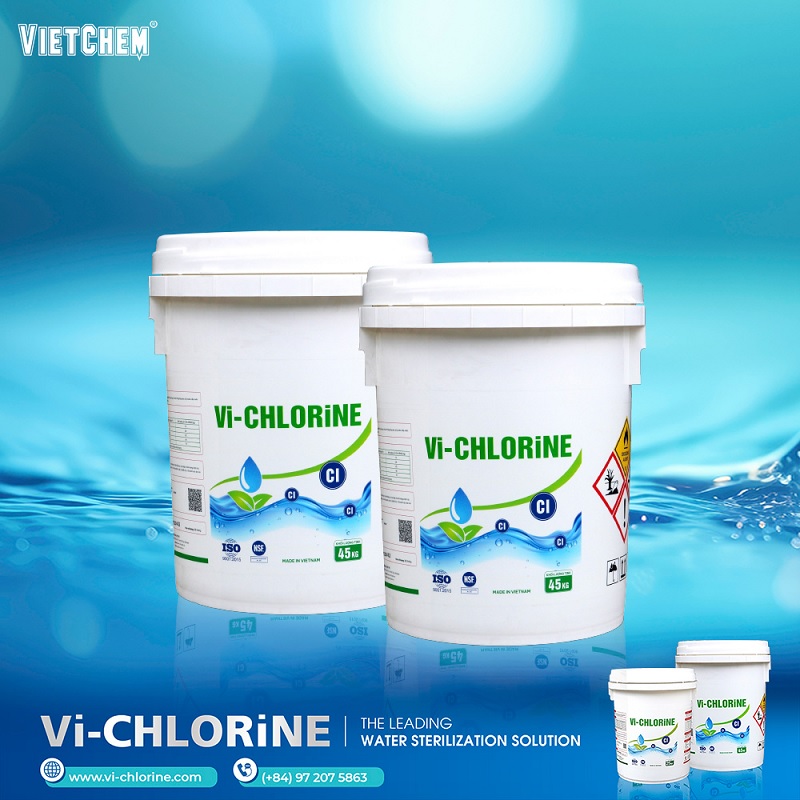
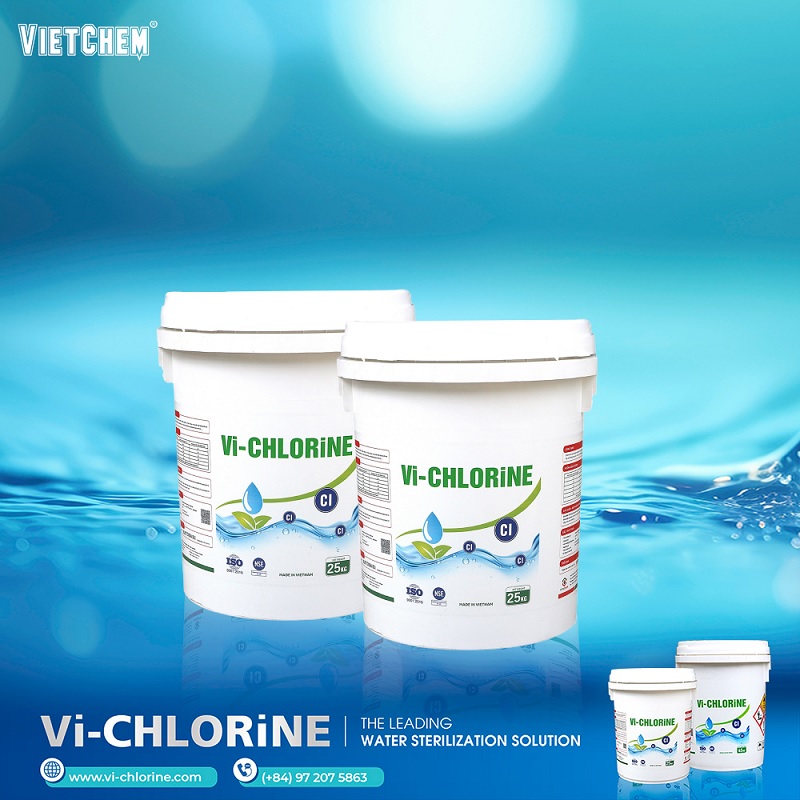
- Packaging Specifications: The most popular and preferred format is the 25kg/Pav plastic drum. The cylindrical Pav (Pavillon) drum design, made from high-quality virgin plastic, provides absolute protection for the product against external environmental moisture. Simultaneously, it is highly convenient for loading, unloading, transportation, and warehousing. Additionally, the product is available in 45kg drums tailored for factories and enterprises requiring large-volume usage.
- Form and Color: Vi-Chlorine exists in a solid state, either as a fine powder or small granules. The product features a characteristic opaque white or ivory white color.
- Odor: Upon opening the lid or coming into close contact, users will easily notice the distinct, pungent smell of chlorine gas. This is a natural identifying sign of compounds with high active chlorine content.
- Manufacturer: Viet Tri Chemical Joint Stock Company (Phu Tho, Vietnam) - A leading pioneer in the production of basic inorganic chemicals in Vietnam.
Positioned as a high-quality Vietnamese product, Vi-Chlorine 25kg/Pav undergoes rigorous quality control from the selection of raw materials, through an automated closed-loop production system, down to the final packaging stage. All these steps aim to ensure a final product with consistently stable active chlorine content, minimal impurities, and maximum safety for users.
2. Outstanding Characteristics of Chlorine
There are numerous antibacterial and sanitizing chemical products on the market today, but Calcium Hypochlorite in general, and Vi-Chlorine in particular, consistently maintain a leading position thanks to their superior physical and chemical properties. Below are the outstanding characteristics that form the core value of this product:
Superior Solubility: The first and most noticeable strength of Vi-Chlorine is its rapid dissolution rate in water. Vi-Chlorine powder or granules are manufactured with uniform sizing and a porous structure, allowing them to dissolve extremely fast and almost completely in water. The dissolution process leaves no suspended inorganic residue, helping the water source maintain its natural transparency and preventing any blockages in filtration systems or water pipelines in factories.
Powerful Microbial Eradication Mechanism: When dissolved in an aqueous environment, Vi-Chlorine immediately dissociates and reacts with H₂O to generate two exceptionally strong oxidizing agents: Hypochlorous acid (HClO) and hypochlorite ion (OCl⁻). The basic chemical reaction is as follows:
Ca(ClO)₂ + 2H₂O → Ca(OH)₂ + 2HClO
Both HClO and OCl⁻ possess immediate bactericidal capabilities. Their mechanism of action involves rapid penetration through the cell membranes and cell walls of various microorganisms (bacteria, viruses, fungi, etc.). Once inside the cell, these oxidizing agents directly attack and disrupt the genetic material structures (DNA and RNA), paralyzing and entirely confusing the microorganisms' metabolic processes. As a result, the microorganisms are completely destroyed, losing their ability to reproduce or cause harm.
The Impact of pH on Disinfection Efficiency: A crucial characteristic that users must note is that the effectiveness of Chlorine is heavily dependent on the pH level of the water environment. Although both HClO and OCl⁻ have bactericidal properties, HClO has an oxidizing and antibacterial capacity dozens of times stronger than OCl⁻ (because HClO carries no electrical charge, it can easily penetrate bacterial cell membranes). The ratio between HClO and OCl⁻ in the water is entirely determined by the pH level. When the water's pH is low (acidic or neutral environment), HClO will account for a larger proportion, delivering maximum disinfection efficiency. Conversely, when the pH is high (alkaline environment), the OCl⁻ ion becomes dominant, somewhat reducing the solution's sanitizing ability. Therefore, controlling the water's pH level to an optimal range (typically between 6.5 and 7.5) before applying Chlorine is a vital secret to saving chemicals and achieving the highest efficiency.
High Purity, Dust-Free: Unlike many low-quality floating products on the market that often have a high proportion of fine dust—causing loss and toxicity when inhaled—Vi-Chlorine granules from Viet Tri Chemical are carefully selected through a modern automated screening system. The product features uniform granules, minimizing the generation of fine dust, thereby protecting the respiratory health of directly operating workers while making precise dosing easier during preparation.
3. Quality Indicator Requirements for Chlorine
To ensure disinfection effectiveness, biosecurity, and compliance with the strict standards of industrial production and aquaculture, the Vi-Chlorine 25kg/Pav product is verified through a rigorous quality management system. The table below illustrates the national standard quality indicators and internal benchmarks that the product must achieve:
| No. | Indicator Name | Unit | Required Quality Level |
|---|---|---|---|
| 1 | Active Chlorine (Available Chlorine Content) | % | ≥ 70 |
| 2 | Arsenic (As) Content | mg/kg | ≤ 5 |
| 3 | Lead (Pb) Content | mg/kg | ≤ 30 |
| 4 | Moisture | % | 4 ÷ 10 |
In-depth Analysis of Quality Indicators:
- Active Chlorine Content ≥ 70%: This is the golden standard for premium Calcium Hypochlorite lines. The 70% content ensures a highly concentrated reactant level, allowing users to apply a smaller quantity of chemicals while still achieving widespread bactericidal efficacy. Compared to standard Javel solutions that only reach 8-12% concentration, Vi-Chlorine 70% significantly saves on transportation costs, storage space, and preparation labor.
- Heavy Metal Control (Arsenic and Lead): This is a point of immense pride for domestic manufacturers. Arsenic and Lead are heavy metals with extremely high toxicity, capable of bioaccumulating in water environments, seeping into the bodies of aquatic animals (like shrimp and fish), and subsequently entering the human food chain. Controlling Arsenic at ≤ 5 mg/kg and Lead at ≤ 30 mg/kg ensures that Vi-Chlorine fully complies with the strictest food safety and hygiene standards as well as chemical residue certifications. This is especially vital for shrimp farming enterprises exporting to demanding markets such as the US, EU, or Japan, where technical barriers regarding heavy metals are exceptionally stringent.
- Optimal Moisture (4% - 10%): The excess water content present in the chemical granules must be maintained within this safe margin to minimize the natural decomposition of the chemical during warehousing, thereby extending the product's shelf life up to several years.
4. Applications of Chlorine
Thanks to its incredibly powerful oxidizing properties, Chlorine is a versatile chemical with a scope of application spanning heavy industry, light industry, agriculture, and daily civilian life. The immense popularity of this chemical is clearly demonstrated through the following 9 key application areas:
Application of Chlorine in Aquaculture
In the multi-billion-dollar aquaculture industry, particularly in brackish water shrimp farming, Vibrio bacteria, white spot syndrome virus, acute hepatopancreatic necrosis disease (AHPND), and various parasites are always nightmares for farmers. Chlorine is likened to a "shield" protecting the ponds from all biological pathogen risks.
During the initial pond preparation phase, farmers use Vi-Chlorine to eliminate toxic algae, eradicate miscellaneous species (wild fish, snails, and intermediate host organisms carrying pathogens), and thoroughly destroy residual bacteria from previous crops. Treating the water at the beginning of the season with Chlorine creates an absolutely sterile and clean environment before stocking shrimp larvae.
Reference Application Dosages:
- Pond bottom disinfection (for lined earthen ponds): 50 – 100 ppm, to destroy pathogens hiding in the bottom mud and sand layer.
- Settling pond water treatment (supply water): 20 – 30 ppm. After applying Chlorine, it is mandatory to run strong aerators for 3-5 days, combined with sun exposure to allow the residual chlorine gas to evaporate completely before pumping the water into the main rearing pond. Farmers can use residual chlorine test kits to confidently verify the safety threshold.
- Disease control during the farming cycle: Applied at extremely low doses. To treat diseases related to external adhering bacteria, a dose of 1 - 3 ppm can be used for a short duration (10 - 15 minutes), or a dose of 0.1 - 0.2 ppm can be used to kill parasites.
- Pond water maintenance: A dose of 0.05 - 0.1 ppm is used periodically to inhibit bacterial outbreaks and control the overgrowth of algae (water blooming phenomenon).
An important point to strictly note: Never apply agricultural lime to the pond immediately before using Chlorine. Lime will sharply increase the water's pH (above 8.5), thereby drastically reducing the chemical's efficiency in generating HClO. Shrimp farming in Vietnam is currently facing massive opportunities in the international market, especially regarding export trends in the coming years. If you are interested in this economic potential, do not miss the in-depth analytical article: Global Shrimp Market Outlook 2025: A Golden Opportunity for Asia.
Application in Industrial and Domestic Wastewater Treatment
For industrial clusters and urban residential areas, wastewater must meet Column A or Column B standards according to the regulations of the Ministry of Natural Resources and Environment before being discharged into the natural environment (rivers, lakes, canals). In wastewater treatment systems, the final disinfection step commonly utilizes Chlorine. After the wastewater has passed through mechanical treatment stages (trash screens, grit chambers) and biological treatment (aerobic and anaerobic activated sludge tanks), Vi-Chlorine is dosed into the contact chamber. This permanently destroys remaining intestinal pathogens (such as E. Coli, Coliform), viruses, and helminths, while simultaneously helping to oxidize hard-to-degrade organic substances, decolorizing, and eliminating the characteristic foul odors of wastewater.
Application in Swimming Pool Water Treatment
Any commercial swimming pool system, resort, or family pool requires the assistance of Chlorine to maintain cool, crystal-clear water. Swimming pool water is an ideal environment for bacteria, moss, algae, and mold to thrive due to continuous exposure to human sweat, dead skin, and cosmetics.
Using soluble Chlorine powder dosed periodically or implementing the "Shocking the pool" method at night helps thoroughly oxidize organic impurities (Chloramines – the primary cause of foul pool odors and eye irritation). Controlling and maintaining the free chlorine concentration between 1.0 - 3.0 ppm ensures the pool is always sterile, prevents the appearance of moss adhering to ceramic tiles, and protects the dermatological health of swimmers.
Application in Water Supply Disinfection
Water supplied for domestic purposes (tap water) serves as the foundation for public health. Clean water treatment plants nationwide use Chlorine as the most classic and reliable solution to disinfect groundwater or surface water after the coagulation, flocculation, and sand filtration processes.
An unparalleled advantage of Chlorine compared to other disinfection methods (like UV radiation or Ozone) is its ability to create "Residual Chlorine". Water plants will adjust the chemical dosing system so that the residual chlorine concentration in the water leaving the plant and flowing through the pipelines to households is consistently maintained at a safe threshold of 0.3 ÷ 0.5 ppm. This residual chlorine acts as a permanent protective layer, preventing recontamination over tens of kilometers of the domestic water supply network, guaranteeing that the water flowing from the tap is always safe for cooking and consumption.
Application in Disinfecting Livestock and Poultry Farms, and Farming Equipment
Biosecurity is the factor that determines the success or failure of industrial-scale pig, chicken, and cattle farms. Especially in the face of threats from African Swine Fever (ASF), Foot-and-Mouth Disease, or H5N1 Avian Influenza, establishing strict disinfection barriers is absolutely mandatory.
Vi-Chlorine is diluted into a solution with a concentration of 0.5 - 1% for broad-area spraying. This solution is used to spray on workshop floors, walkways, barn partitions, manure collection areas, and the wheel systems of transport vehicles before they enter the farm premises. For farming tools, feeding troughs, drinking troughs, and buckets, soaking them in a Chlorine solution with a concentration of 100 - 200 ppm for about 30 minutes will completely eradicate the agents of cross-infection among the animal herds, forging a disease-free growth environment.
Application in Sanitation and Disinfection of Food Processing Factories
The food processing, frozen seafood, canning, and beverage industries demand extremely rigorous aseptic standards (GMP, HACCP, ISO 22000). Any presence of Salmonella, Listeria, or E. Coli bacteria on contact surfaces can lead to severe food poisoning incidents, resulting in product recalls and destroying brand reputation.
Chlorine is the leading sanitizing chemical choice in CIP (Cleaning in Place) and COP (Cleaning out of Place) systems. By using a Chlorine solution with a concentration of 0.5 - 1%, sanitation staff can spray and wash conveyor systems, slicing machines, mincers, wall tiles, factory floors, and drainage trenches. The broad-spectrum antibacterial nature of the chemical helps eliminate stubborn bacterial biofilms adhering to stainless steel surfaces and processing equipment.
Application in Floor and Yard Sanitation, Algae, Moss, and Mold Removal
The tropical monsoon climate with high humidity in Vietnam provides an ideal condition for mold, moss, and algae to proliferate on wet surfaces such as brick yards, concrete grounds, steps, or wall bases. These layers of moss not only ruin architectural aesthetics but also create extremely dangerous slippery conditions for pedestrians.
Using Chlorine powder is the most effective and inexpensive method to eliminate algae and moss. Simply mix a concentrated Chlorine solution from 5 - 10%, then use a spray bottle to evenly coat the invaded brick walls and yards. Let the chemical penetrate for about 15-30 minutes; the entire cellular structure of the algae and mold will be burned by the oxidation reaction, turning yellowish-white and dying off. Finally, just use a high-pressure water hose to rinse once, and the surface will return to being sparkling clean and as good as new.
Application in Disinfecting Fresh Fruits, Fish, and Seafood
For fresh agricultural produce after harvesting, the preliminary processing stage plays a decisive role in shelf-life preservation. Fresh fruits, vegetables, as well as caught fish and seafood, often carry a multitude of fungal spores, putrefactive bacteria, and mud from the natural environment.
In preliminary processing workshops, produce is passed through washing tanks containing a dilute Chlorine solution at a concentration of about 0.5% (or from 50-200 ppm depending on the type). This rinsing process acts as an incredibly effective surface disinfectant, killing rot-causing microorganisms without altering the natural flavor, structure, or color of the food. This solution helps keep fruits fresh longer, preserves the firmness of seafood, and meets the rigorous quarantine standards of importing countries.
Application in the Paper Industry
In the paper and pulp manufacturing industry, the original brown color of cellulose fibers (due to high lignin content) must be removed to produce bright white printing and writing paper. Chlorine has long been the core chemical applied in the pulp bleaching stage. The chemical's oxidation process helps break the color-forming molecular structures, eliminates lignin and other unwanted impurities, thereby visibly improving the brightness, smoothness, and luminance of the finished paper.
Furthermore, as modern paper mills strive to close the water circulation loop, Chlorine is also dosed into the recovery water system to prevent the growth of slime-forming bacteria. Without Chlorine control, this bacterial slime layer would adhere to the wire mesh rolls, causing black spots on the paper and reducing the productivity of paper machines.
5. Guidelines for Safe Use of Chlorine Chemicals
Despite providing countless benefits, the essence of Chlorine remains a highly corrosive and powerfully oxidizing chemical. To maximize the product's functional capacity while ensuring absolute health protection for direct handlers, compliance with occupational safety and protective regulations is mandatory:
- Personal Protective Equipment (PPE): When opening drum lids, measuring, or mixing chemicals, workers must wear long-sleeved protective clothing, thick rubber gloves, and chemical-resistant boots. It is strictly required to wear splash-proof safety goggles and a gas mask (or high-grade activated carbon respirator) to avoid inhaling vaporized chlorine gas, which causes severe irritation to the respiratory mucosa.
- Standard Chemical Mixing Principles: Always adhere to the principle: "Add chemicals into water, NEVER do the reverse." Prepare a container with a sufficient amount of water, then slowly pour the Vi-Chlorine powder/granules into the tank and stir steadily. If water is poured into a container holding Chlorine powder, a strong exothermic reaction can occur, splashing chemicals around and causing severe burns to the operator.
- Emergency Response for Exposure:
- Skin contact: Immediately remove chemically contaminated clothing and flush the affected skin under continuous running clean water for at least 15 minutes.
- Eye contact: Keep the eyelids wide open and flush gently under a stream of clean water for 15-20 minutes, then immediately transport the victim to the nearest medical facility. Absolutely do not rub the eyes.
- Inhalation of large amounts of chlorine gas: Move the victim to an area with fresh, well-ventilated air, keep the victim in a comfortable resting position for breathing, and call for emergency medical assistance.
- No Arbitrary Mixing: Never directly mix Chlorine compounds with any other water treatment chemicals. It is strictly forbidden to let Chlorine powder come into contact with acidic solutions (such as Hydrochloric Acid HCl, Sulfuric Acid H2SO4), as this reaction will instantaneously release free Chlorine gas (Cl2) in the form of a yellow-green fog - an extremely dangerous toxic gas that can be fatal.
6. Storage and Transportation of Chlorine
The stability and lifespan of Chlorine chemicals depend entirely on the storage conditions at the warehouse. The transportation and warehousing processes must meet the following technical standards:
- Packaging Specifications: Vi-Chlorine products are standardly packaged in 25kg/Pav or 45kg virgin plastic drums. The shell material is usually high-density PP or PE plastic to resist corrosion. Once the drum is opened for use, the inner nylon film seal must be tightly closed after each chemical extraction to completely isolate the remaining chemical from atmospheric moisture.
- Warehouse Conditions: Chemical drums must be placed on pallets (plastic or wooden pallets), elevated from the ground, and kept at least 20cm away from the walls. The warehouse space must have a good ventilation system, be completely dry, and always maintain a cool ambient temperature, ideally not exceeding 35°C. Absolutely do not leave the product in outdoor areas where there is direct solar radiation, as UV rays and high temperatures will accelerate the photochemical decomposition rate, causing a significant loss of active chlorine content.
- Isolated Storage Zones: The golden rule in chemical warehouse management is segregation. Chlorine powder must be stored in a separate, isolated zone. It must not be stored together with or near areas containing inorganic reducing agents, flammable fuels (gasoline, oil, grease), paints, solvents, or any inorganic/organic acids. The chemical storage area must be clearly marked with Hazardous Material Warning signs (GHS).
- Notes on Equipment and Tools: Avoid letting powder or concentrated Chlorine solutions stay in contact for long periods with metal equipment that lacks an anti-corrosion coating, as the strong oxidizing nature of chlorine will rapidly cause rusting and destroy the metal structures.
7. VIETCHEM EXPORT - A Reputable and High-Quality Chlorine Supplier
Currently on the market, the fierce competition between imported goods and domestically produced items is an ongoing reality. However, the Vi-Chlorine product from Viet Tri Chemical Joint Stock Company, globally distributed by the VIETCHEM EXPORT network, has firmly established its position and become the top choice, clearly proving Vietnam's autonomous capability in chemical technology.
Recently, top technical experts from Viet Tri Chemical conducted a series of rigorous experiments, rolling out practical product trials across high-tech shrimp farming pond systems in the Mekong Delta region - the nation's largest shrimp basin. The trial batches were directly compared against a highly renowned imported product, Aquafit (originating from India). The analytical results regarding water quality and shrimp larvae survival rates brought a massive surprise: The disinfection efficiency, Vibrio bacteria eradication capability, and water quality stabilization time of Vi-Chlorine were entirely equivalent, and even superior in some solubility indices compared to the famous Aquafit line.
The immense economic benefits that farmers and enterprises reap when switching to Vi-Chlorine include:
- Saving Input Costs: Although the quality and usage performance match foreign products, the actual retail price of Vi-Chlorine is significantly lower (by 5% to 10%) compared to products in the same segment like Aquafit. This helps farming facilities alleviate their monthly operational cost burdens.
- Continuous and Stable Supply: Being manufactured right on the S-shaped land strip, the Vi-Chlorine supply chain never suffers disruptions due to broken global logistics networks, or influences from customs exchange rates and import taxes. Users always receive goods with the freshest production dates.
- Say No to Counterfeits and Replicas: The product is distributed directly from the factory through Vietchem's authorized official dealers, securely packed with multi-layer tamper-evident seals, strictly guaranteeing 100% purity.
- Dedicated Technical Expert Team: Going beyond just selling products, Vietchem delivers added value through an accompanying team of engineers. Whenever farmers need consultations on mixing formulas or disease treatment, we are always available to provide timely support. To listen to authentic sharing from the very farmers who have experienced successful crops, we invite readers to watch our real-life reportage at: What Do Local Farmers Say About Vi-CHLORiNE?.
Protect Water Sources - Elevate Productivity With Vi-Chlorine
Are you a seafood enterprise, a water treatment plant, or a farming household seeking a reliable, cost-effective sanitizing chemical solution backed by a national brand's quality assurance? Let our experts help you design the most optimal treatment process.
To receive the best wholesale quotation or request test samples, please leave your consultation information via the online form or call our hotline right now!