
What Type of Chlorine Is Used in Water Treatment?
- NEWS
- Q&A Chlorine
- 18/09/2026
Chlorination has been used for decades as an important method of controlling microorganisms in drinking water, wastewater, industrial water, swimming pools, and other water-management systems. However, the word “chlorine” does not refer to only one treatment product.
Water-treatment operators can generate or introduce active chlorine using several chemical forms. Once added to water, many of these products ultimately produce hypochlorous acid (HOCl), one of the principal active species responsible for disinfection.
Understanding the differences between chlorine gas, sodium hypochlorite, calcium hypochlorite, and chloramines is important because each has different handling, storage, dosing, safety, and operational characteristics.
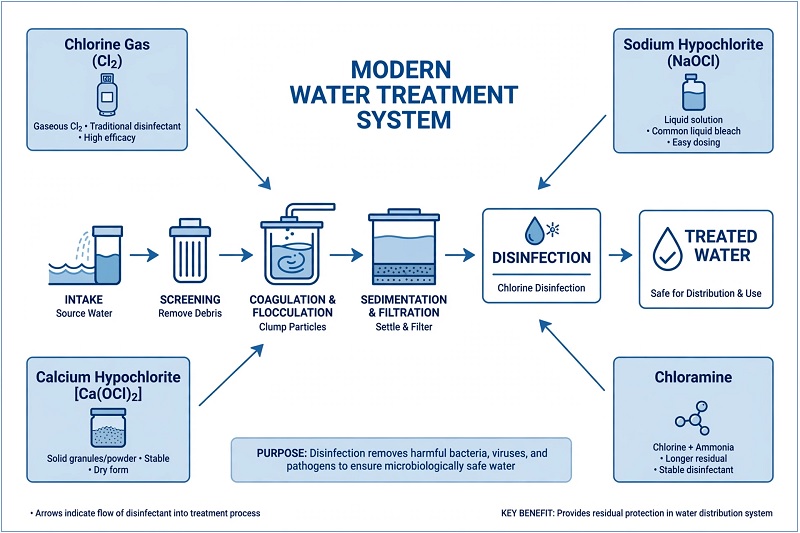
What Type of Chlorine Is Used in Water Treatment?
The three major chlorine sources commonly associated with water treatment are chlorine gas, sodium hypochlorite, and calcium hypochlorite. Chloramines are another important chlorine-based disinfectant used in certain drinking-water systems.
| Chlorine Type | Form | Typical Use | Key Characteristic |
|---|---|---|---|
| Chlorine gas | Compressed gas | Large treatment facilities | Effective but requires strict safety controls |
| Sodium hypochlorite | Liquid solution | Municipal, industrial and smaller systems | Easy to meter as a liquid |
| Calcium hypochlorite | Solid granules/tablets/powder depending on product | Water treatment, sanitation, pools and other applications | High available chlorine and convenient solid storage |
| Chloramines | Formed through chlorine-ammonia chemistry | Drinking-water distribution | Longer-lasting residual than free chlorine |
There is no single chlorine form that is automatically suitable for every facility. A large municipal treatment plant has very different operational requirements from a small industrial water system, aquaculture facility, or remote treatment site.
For users researching chlorine-based solutions for water management, information about vi chlorine provides additional context on chlorine products and their applications.
How Does Chlorine Used in Water Treatment Work?
Regardless of the chlorine source, the objective of chlorination is generally to produce active chlorine species capable of reacting with microorganisms and other chlorine-demanding substances in water.
When chlorine gas is introduced into water, the simplified reaction can be written as:
Cl2 + H2O ⇌ HOCl + H+ + Cl−
Hypochlorous acid can then dissociate:
HOCl ⇌ H+ + OCl−
Both hypochlorous acid and hypochlorite ion contribute to disinfection, although their effectiveness differs. The balance between them is strongly influenced by pH.
This is why chlorine dosage alone does not determine treatment effectiveness. Water chemistry, pH, temperature, contact time, organic matter, ammonia, turbidity, and other factors can all influence chlorine performance.
Chlorine Gas Used in Water Treatment
Chlorine gas (Cl2) has historically been used by many large municipal and industrial treatment facilities. It can provide efficient chlorination where large quantities of water must be treated continuously.
Once chlorine gas dissolves in water, it forms hypochlorous acid and other chlorine species responsible for microbial inactivation.
Advantages of chlorine gas
- Suitable for large treatment capacities;
- Effective for continuous chlorination;
- Does not require transporting large volumes of dilute hypochlorite solution;
- Can be economically attractive in certain large-scale applications.
Limitations of chlorine gas
The major consideration is safety. Chlorine gas is hazardous when released and therefore requires specialized storage, leak detection, ventilation, dosing equipment, emergency procedures, trained operators, and appropriate regulatory controls.
For these reasons, some facilities choose hypochlorite-based alternatives where they offer a more suitable risk profile and operational arrangement.
Sodium Hypochlorite as a Type of Chlorine Used in Water Treatment
Sodium hypochlorite (NaOCl) is a liquid chlorine-releasing chemical widely associated with water disinfection and sanitation. Commercial concentrations vary according to product and intended application.
When sodium hypochlorite is added to water, it contributes hypochlorite species and establishes an equilibrium involving hypochlorous acid.
One of its major operational advantages is that it is a liquid. This makes it relatively straightforward to meter using chemical dosing pumps and automated control systems.
Advantages of sodium hypochlorite
- Liquid dosing is convenient;
- No pressurized chlorine-gas system is required;
- Suitable for many small and medium-sized installations;
- Can be integrated into automated dosing systems.
Limitations of sodium hypochlorite
Sodium hypochlorite solutions degrade during storage. Decomposition can be accelerated by factors such as heat, light, time, concentration, and contamination. Proper storage conditions are therefore important.
Liquid hypochlorite also contains significant water compared with more concentrated solid chlorine products, which can affect transportation and storage requirements.
Facilities with substantial chlorine consumption may compare liquid hypochlorite against solid alternatives such as vi chlorine 45kg when assessing storage space, chemical handling, consumption rate, and treatment requirements.
Calcium Hypochlorite Used in Water Treatment
Calcium hypochlorite [Ca(OCl)2] is a solid chlorine-releasing compound commonly supplied in forms such as granules, powder, or tablets depending on the manufacturer and application.
It is valued for its relatively high available chlorine content and the convenience of storing a solid product compared with bulk liquid solutions.
When dissolved and properly dosed, calcium hypochlorite provides active chlorine that can be used for disinfection and oxidation.
Advantages of calcium hypochlorite
- High available chlorine relative to many liquid hypochlorite solutions;
- Solid format can simplify transportation in some applications;
- Useful where bulk chlorine gas infrastructure is impractical;
- Suitable for various water-treatment and sanitation applications;
- Can provide relatively compact chemical storage.
Limitations of calcium hypochlorite
Calcium hypochlorite is a strong oxidizing chemical and requires appropriate storage and handling. It should be kept away from incompatible materials, contamination, excessive heat, moisture, acids, and other substances specified as incompatible by the product manufacturer.
Operators should always follow the Safety Data Sheet and product instructions.
Chloramines as a Type of Chlorine Used in Drinking Water Treatment
Chloramines are formed when chlorine reacts with ammonia under controlled conditions. Monochloramine is particularly important in drinking-water treatment.
Unlike free chlorine, chloramine is generally a weaker disinfectant but can persist longer in a distribution system. This makes it useful for maintaining a disinfectant residual as treated water travels through long pipe networks.
The choice between free chlorine and chloramine depends on the objectives of the treatment utility, source-water characteristics, distribution-system conditions, applicable regulations, and disinfection strategy.
It is important not to treat chloramination as simply “adding more chlorine.” The chlorine-to-ammonia relationship, pH, contact time, temperature, and other parameters must be carefully controlled.
Which Type of Chlorine Is Best for Water Treatment?
There is no universal answer. The most appropriate chlorine source depends on the application.
Chlorine gas may be practical for large facilities with trained operators and comprehensive gas-safety infrastructure.
Sodium hypochlorite is often attractive where liquid dosing and simpler chemical feed systems are preferred.
Calcium hypochlorite can be advantageous where a concentrated solid chlorine source, easier transport, or compact storage is important.
Chloramines may be selected where maintaining a longer-lasting disinfectant residual through a drinking-water distribution network is a major objective.
The correct decision should therefore be based on lifecycle considerations rather than product price alone.
Real-world perspectives on chlorine use in water-intensive environments can also be explored through What Do Local Farmers Say About Vi-CHLORiNE.
How to Choose the Right Type of Chlorine for Water Treatment
Before choosing a chlorine product, operators should evaluate both water chemistry and facility requirements.
1. Treatment capacity
A plant treating millions of liters per day has different chemical-storage and dosing requirements from a small treatment system. Consumption volume can strongly influence which chlorine form is practical.
2. Water quality
Raw water should be characterized before a chlorine dose is established. Important parameters may include:
- pH;
- temperature;
- turbidity;
- organic matter;
- ammonia;
- iron and manganese;
- sulfides;
- microbial loading;
- chlorine demand.
3. Required contact time
Effective disinfection depends on both disinfectant concentration and contact time, along with organism susceptibility and water conditions. Treatment systems therefore require appropriate contact tanks or hydraulic retention.
4. Chemical storage
The facility should consider available storage space, ventilation, temperature, humidity, chemical compatibility, inventory turnover, and emergency arrangements.
5. Operator capability
Some chlorine systems require more specialized training and safety infrastructure than others. Chemical selection should reflect the facility's ability to operate and maintain the system safely.
6. Total operating cost
The purchase price per kilogram does not show the full cost of chlorination. Transportation, available chlorine concentration, storage, dosing equipment, maintenance, chemical degradation, labor, safety systems, and waste should all be considered.
What Type of Chlorine Is Used for Drinking Water Treatment?
Drinking-water treatment may use chlorine gas, sodium hypochlorite, or other approved chlorine-based disinfectants depending on the jurisdiction and treatment facility. Some systems subsequently use chloramine to maintain residual disinfection throughout the distribution network.
The selected disinfectant must comply with applicable drinking-water regulations and treatment requirements.
In a typical treatment process, chlorine may be introduced after clarification and filtration because removing turbidity and organic matter first can reduce chlorine demand and improve disinfection efficiency.
However, chlorine may also be used at other stages for specific oxidation or process-control objectives.
What Type of Chlorine Is Used for Wastewater Treatment?
Wastewater treatment facilities can also use chlorine gas or hypochlorite products for disinfection. Chlorination is generally applied after major solids and organic loads have been reduced, although process configurations vary.
Wastewater presents particular challenges because ammonia, organic matter, suspended solids, and other compounds can consume chlorine.
Overdosing should be avoided. Excess chlorine can increase chemical consumption and may require dechlorination before discharge depending on applicable environmental requirements.
Where a facility needs a more manageable package size for treatment operations, Vi chlorine 25kg provides another packaging option for consideration according to the product specification and intended application.
What Type of Chlorine Is Used in Aquaculture Water Treatment?
Chlorine-based products may also be incorporated into aquaculture water-management and biosecurity programs. Their use differs substantially from continuous drinking-water disinfection because living aquatic organisms can be sensitive to residual chlorine.
Applications may involve pond preparation, sanitation of selected equipment, treatment of incoming water, or biosecurity procedures before stocking, depending on the farming system and product instructions.
Any residual chlorine must be managed appropriately before treated water is exposed to sensitive aquatic organisms.
Water quality and disease prevention have become increasingly important as aquaculture production develops. Broader industry context is available in Global Shrimp Market Outlook 2025: A Golden Opportunity for Asia.
Free Chlorine vs Combined Chlorine in Water Treatment
Another useful distinction is between free chlorine and combined chlorine.
Free available chlorine generally refers to chlorine present primarily as hypochlorous acid and hypochlorite ion. These species are important for rapid disinfection.
Combined chlorine refers largely to chlorine that has reacted with ammonia or nitrogen-containing compounds to form chloramines.
The distinction matters because free chlorine and chloramines have different disinfection characteristics and persistence.
| Characteristic | Free Chlorine | Chloramine |
|---|---|---|
| Disinfection action | Generally faster | Generally slower |
| Residual persistence | Shorter | Longer |
| Common role | Primary disinfection | Distribution residual |
| Main active species | HOCl/OCl− | Primarily monochloramine in controlled systems |
How Much Chlorine Is Used in Water Treatment?
There is no single chlorine dosage suitable for all water-treatment applications.
The required dose depends on the amount of chlorine consumed by substances in the water and the residual required to achieve the treatment objective.
A simplified operational concept is:
Chlorine Dose = Chlorine Demand + Desired Residual
This relationship is useful conceptually, but actual treatment design requires measurements and consideration of contact time, pH, temperature, microbial targets, water quality, and applicable standards.
Operators should therefore avoid copying a dosage from an unrelated facility. Testing and process monitoring are essential.
Safety When Using Different Types of Chlorine in Water Treatment
All chlorine products require appropriate safety controls, although the specific hazards differ by product form.
Chlorine gas requires specialized systems to prevent and respond to toxic gas releases. Hypochlorite products are strong oxidizers and can react dangerously with incompatible substances.
General good practices include:
- Following the product Safety Data Sheet;
- Using suitable personal protective equipment;
- Maintaining adequate ventilation;
- Keeping chlorine products away from incompatible chemicals;
- Using chemically compatible storage and dosing equipment;
- Preventing contamination of containers;
- Training personnel in chemical handling;
- Maintaining emergency response procedures.
Chlorine-releasing products should never be casually mixed with acids. Acidification of hypochlorite can release hazardous chlorine gas.
Calcium Hypochlorite and Vi-CHLORiNE for Water Treatment
For applications where a solid chlorine product is appropriate, calcium hypochlorite can offer advantages in transportation, storage, and active-chlorine concentration compared with some dilute liquid products.
Vi-CHLORiNE provides chlorine-based product formats intended for water-management applications such as sanitation, water treatment, microbial control, and aquaculture biosecurity, subject to the product specifications and recommended application procedures.
Before selecting any chlorine product, users should determine the treatment volume, water chemistry, target organisms or contaminants, chlorine demand, dosing method, contact time, storage conditions, and required residual.
Vi-CHLORiNE is available in different packaging formats, enabling facilities to evaluate an option appropriate to their chemical-consumption and storage requirements.
An example of the brand's involvement in aquaculture biosecurity can be found in AQUADELTA - Dr.Tom Accompanies Vietshrimp 2025: Vi-CHLORiNE Solution Enhancing Biosecurity in Aquaculture.
Vi-CHLORiNE offers practical chlorine product formats for water treatment, sanitation, microbial control, aquaculture biosecurity, and selected industrial and wastewater applications.
Contact the Vi-CHLORiNE team for product specifications, packaging information, storage recommendations, and application guidance based on your water-treatment requirements.
FAQ: What Type of Chlorine Is Used in Water Treatment?
1. What type of chlorine is most commonly used in water treatment?
Common chlorine sources include chlorine gas, sodium hypochlorite, and calcium hypochlorite. Chloramines are also used in some drinking-water systems, particularly for maintaining a longer-lasting disinfectant residual in distribution networks. The appropriate choice depends on treatment scale, water quality, safety infrastructure, dosing requirements, and regulations.
2. Is calcium hypochlorite used for water treatment?
Yes. Calcium hypochlorite is a chlorine-releasing solid used in various water-treatment and sanitation applications. When properly dissolved and dosed, it provides active chlorine for microbial control and oxidation. The exact application and dose should follow product specifications and relevant treatment requirements.
3. What is the difference between sodium hypochlorite and calcium hypochlorite?
Sodium hypochlorite is commonly supplied as a liquid solution, while calcium hypochlorite is typically a solid. Liquid sodium hypochlorite can be convenient for direct pump dosing, while calcium hypochlorite can offer higher available chlorine in a compact solid format. Storage, handling, chemical compatibility, and dosing-system requirements also differ.
4. Is chlorine gas better than hypochlorite for water treatment?
Neither option is universally preferable. Chlorine gas can be suitable for large facilities with specialized safety infrastructure, while hypochlorite products may offer operational advantages where gas handling is undesirable. Selection should consider treatment capacity, lifecycle cost, storage, safety, operator capability, and water chemistry.
5. How do I choose the right chlorine product for water treatment?
Evaluate the water source, treatment volume, pH, chlorine demand, target microorganisms, required residual, contact time, chemical-storage conditions, dosing equipment, safety requirements, and applicable regulations. For critical applications such as drinking water or aquaculture, product selection and dosing should follow the relevant technical and regulatory requirements.
Conclusion: Choosing the Right Type of Chlorine for Water Treatment
So, what type of chlorine is used in water treatment? The main options are chlorine gas, sodium hypochlorite, and calcium hypochlorite, while chloramines are used in certain drinking-water distribution systems.
Each option has distinct advantages and limitations. Chlorine gas can support high-capacity treatment but requires stringent safety controls. Sodium hypochlorite provides convenient liquid dosing but gradually degrades during storage. Calcium hypochlorite offers a concentrated solid chlorine source that can be advantageous for transportation and storage in suitable applications. Chloramines provide a more persistent residual for specific drinking-water systems.
The correct chlorine source should therefore be selected according to the water chemistry, treatment objective, facility size, storage capability, dosing equipment, safety requirements, operating cost, and applicable standards.
Regardless of which chlorine product is selected, effective water treatment depends on more than simply adding a chemical. Correct dosage, contact time, pH control, residual monitoring, safe handling, and ongoing water-quality testing are essential for reliable chlorination.