
What is Total Chlorine? Free vs Combined & How to Clarify Water
- Internal news
- 21/08/2026
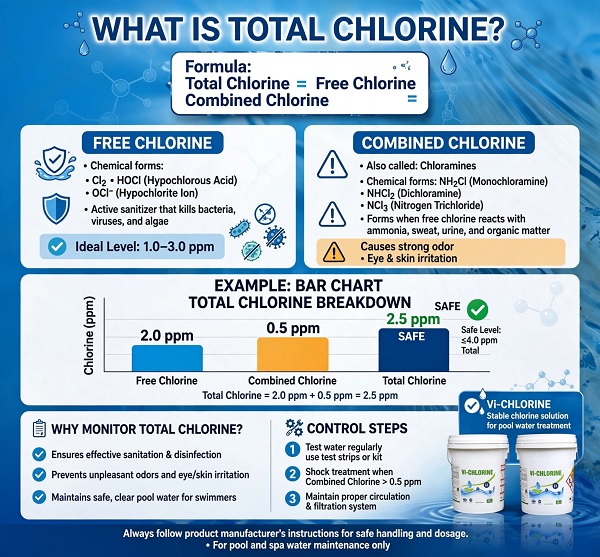
Total chlorine is the sum of all the chlorine present in a body of water. It is mathematically defined by the formula: Total Chlorine = Free Chlorine + Combined Chlorine. While free chlorine is the active chemical actively killing pathogens, combined chlorine represents the portion that has already reacted with organic contaminants (forming chloramines). Measuring total chlorine alone is not enough to determine water safety; it must be compared against free chlorine to assess the true disinfection power and clarity of the water system.
Whether you are managing a backyard swimming pool, operating a municipal water treatment facility, or ensuring biosecurity in a commercial shrimp farm, testing your water chemistry is a daily necessity. When you dip a test strip or read a digital photometer, you will often see various metrics, but one of the most frequently misunderstood terms is total chlorine. Many people assume that a high total reading means their water is perfectly sanitized and safe, but the reality of water chemistry is far more complex.
To truly understand how to maintain crystal-clear, biologically safe water, you must look beyond the surface number. In this comprehensive guide, we will break down exactly what total chlorine is, how it functions within the chemical balancing act of your water, and why understanding the relationship between its components is the key to preventing cloudy water, foul odors, and dangerous pathogen outbreaks.
1. What is Total Chlorine? The Fundamental Chemistry
To answer the question "what is total chlorine?", we must first look at the components that make it up. When you introduce a high-quality sanitizing agent into water, it does not just sit there; it immediately begins a series of chemical reactions. Total chlorine is simply the umbrella term for the total measurement of two distinct states of chlorine existing in your water simultaneously:
- Free Chlorine (The Active Killer): This is the portion of the chlorine that is completely fresh, unbound, and readily available to attack and destroy invading bacteria, viruses, algae, and other dangerous pathogens. Hypochlorous acid (HOCl) and the hypochlorite ion (OCl-) make up this category. This is the good chlorine that keeps your water safe.
- Combined Chlorine (The Exhausted Byproduct): As free chlorine does its job and oxidizes organic matter (such as sweat, urine, body oils in pools, or biological waste in aquaculture), it chemically binds with nitrogen and ammonia compounds. This reaction creates chloramines. Combined chlorine is weak, nearly ineffective at sanitizing, and is directly responsible for the harsh "chemical smell" and eye irritation often associated with poorly managed water.
Therefore, the golden rule and standard formula used by water quality professionals worldwide is:
Total Chlorine = Free Chlorine + Combined Chlorine
2. Why Measuring Total Chlorine is Critical for Water Clarity
If free chlorine is the active ingredient, why do we even care about the total number? The answer lies in diagnosing water problems. By measuring total chlorine alongside free chlorine, you can determine your combined chlorine level (Total - Free = Combined). If your combined chlorine level is above 0.2 ppm in a swimming pool, or elevated in an industrial setting, it indicates a severe buildup of contaminants.
High combined chlorine is the primary culprit behind cloudy, murky, and dull water. The chloramines bind to microscopic organic particles, suspending them in the water column and scattering light, which ruins water transparency. To resolve this, operators must utilize an aggressive oxidation process. By using a premium, fast-dissolving product like vi chlorine, you can rapidly oxidize these suspended organic compounds. This high-grade calcium hypochlorite acts as a powerful clarifying agent, breaking the chemical bonds of chloramines and allowing the filtration system to restore the water to a brilliant, sparkling clear state.
3. Total Chlorine vs. Free Chlorine: The Danger of Misinterpretation
A very common and potentially dangerous mistake made by amateur pool owners and inexperienced facility managers is relying solely on a total chlorine test to determine if their water is safe. Let us look at a practical, real-world example to illustrate why this is a recipe for disaster.
Imagine you use a basic test kit and get a Total Chlorine reading of 3.0 ppm. On the surface, 3.0 ppm sounds like a fantastic, highly sanitized environment. However, if you then perform a DPD1 test and find that your Free Chlorine is only 0.5 ppm, the math reveals a grim reality: you have 2.5 ppm of Combined Chlorine.
In this scenario, despite having a high total number, your water has almost no active sanitizer left (only 0.5 ppm). The vast majority of your chlorine is locked up as useless chloramines. Your water is practically unprotected against a sudden influx of bacteria, and anyone swimming in that water will likely experience severe red eyes, skin irritation, and respiratory discomfort from the off-gassing chloramines. This is exactly why answering "what is total chlorine" means understanding that it is a diagnostic tool, not a measure of safety.
4. Managing Total Chlorine in Pools and Industrial Systems
When your total chlorine is significantly higher than your free chlorine, you have reached a state called "Chlorine Demand" or "Chlorine Lock." The only way to fix this and eliminate the foul-smelling chloramines is to perform a procedure known as Breakpoint Chlorination.
Breakpoint chlorination requires adding a massive, overwhelming dose of active chlorine to the water—usually 10 times the amount of the combined chlorine present. This massive spike in oxidation completely shatters the molecular bonds of the chloramines, converting them into harmless nitrogen gas that escapes into the atmosphere. Once the breakpoint is achieved, your total and free chlorine levels will align, and the water will be safe and clear again.
The scale of this treatment depends entirely on your facility. For medium-sized hotel swimming pools, public spas, or seasonal water treatment setups, utilizing a Vi chlorine 25kg package provides the perfect balance of volume and easy manual handling for maintenance staff to execute a successful shock treatment. However, for massive industrial applications, municipal wastewater plants, or heavy-duty commercial facilities where the volume of water requires immense oxidizing power, upgrading to the vi chlorine 45kg drum is the most cost-effective and efficient way to ensure you always have enough chemical on hand to reach breakpoint chlorination.
5. The Role of Total Chlorine in Aquaculture and Biosecurity
While swimming pools focus on swimmer comfort, the commercial aquaculture industry operates on a completely different level of risk. In modern shrimp farming, maintaining strict biosecurity is a matter of economic survival. Pathogens like Vibrio bacteria, which cause devastating diseases such as Early Mortality Syndrome (EMS) and White Feces Disease (WFD), can wipe out an entire crop in days.
During the critical pond preparation phase, farmers use high doses of calcium hypochlorite to sterilize the water and the pond bottom. Here, measuring total chlorine is vital for a different reason: toxicity management. While a massive chlorine spike is needed to kill pathogens, absolutely zero chlorine (neither free nor combined) can remain in the water when the fragile shrimp post-larvae are stocked. Even trace amounts of chloramines can severely damage the gills of marine life.
The global demand for high-quality seafood is skyrocketing, and the Global Shrimp Market Outlook 2025: A Golden Opportunity for Asia emphasizes that disease prevention through rigorous water chemistry management is the key to dominating the export market. To achieve this, industry leaders continuously educate farmers on proper disinfection protocols.
At major industry events, such as when AQUADELTA - Dr.Tom Accompanies Vietshrimp 2025: Vi-CHLORiNE Solution Enhancing Biosecurity in Aquaculture, experts highlight the necessity of using high-purity oxidizers that do not leave harmful byproducts, ensuring total chlorine completely dissipates naturally under sunlight before stocking.
The transition from traditional, risky farming methods to scientific, biosecure models is already happening. If you want to see how precise management of water chemistry is transforming livelihoods, you can read What Do Local Farmers Say About Vi-CHLORiNE, which details real-world success stories from the Mekong Delta where farmers have drastically reduced disease outbreaks by mastering their chlorine applications.
6. Testing Total Chlorine: Professional Methods and Best Practices
To accurately assess what total chlorine levels exist in your water system, you must use reliable testing equipment. Test strips are convenient for quick, rough estimates, but they lack the precision required for professional water management.
The gold standard for testing is the DPD (N,N-Diethyl-p-phenylenediamine) method. This method uses specific chemical reagents that turn the water varying shades of pink, which is then measured visually against a color chart or digitally using a photometer.
- DPD1 Reagent: This tablet or liquid drops specifically react ONLY with Free Chlorine.
- DPD3 Reagent: After taking the DPD1 reading, you add the DPD3 reagent into the exact same vial. This triggers a reaction with the chloramines. The resulting color change gives you the Total Chlorine reading.
By subtracting the DPD1 result from the DPD3 result, you finally discover your exact combined chlorine level. For municipal drinking water, total chlorine is often monitored continuously using advanced online amperometric sensors to ensure the water remains safe as it travels through miles of distribution pipes without exceeding safe consumption limits (usually capped at 4.0 mg/L by the WHO and EPA).
7. FAQ: 5 Common Questions About Total Chlorine
- Q1: What is the ideal total chlorine level for a swimming pool?
Ideally, your total chlorine should be exactly the same as your free chlorine (typically between 1.0 and 3.0 ppm). This means you have zero combined chlorine. In reality, a total chlorine reading up to 0.2 ppm higher than your free chlorine is considered acceptable. - Q2: Can high total chlorine make you sick?
High total chlorine isn't inherently the issue; it is high combined chlorine that causes problems. Chloramines can cause severe eye redness, skin irritation, and respiratory issues like "swimmer's asthma" in indoor pools with poor ventilation. - Q3: Does total chlorine kill algae?
Only the free chlorine portion of your total chlorine kills algae. If your total chlorine is 5.0 ppm, but it is entirely made of combined chlorine, algae will continue to grow and turn your water green. - Q4: How do I lower my total chlorine if it is too high?
If your total chlorine consists mostly of free chlorine and is simply over-dosed, you can lower it by exposing the water to UV sunlight, adding a chlorine neutralizer like Sodium Thiosulfate, or partially draining and replacing the water. - Q5: Why does my pool smell strongly of chlorine when the test says total chlorine is low?
The "chlorine smell" is actually the smell of chloramines (combined chlorine) off-gassing into the air. Paradoxically, a strong smell means your water is dirty and lacks enough active free chlorine to destroy the contaminants. You need to shock the pool to break the chloramines and raise the free chlorine level.
Need Expert Advice on Water Clarification & Biosecurity?
Don't let cloudy water, high chloramines, or biosecurity threats disrupt your operations. Our team of chemical experts at Vi-Chlorine is ready to help you calculate the perfect dosage, reach breakpoint chlorination, and ensure your water is perfectly balanced and safe.
Contact Us for a Free Consultation Today