
What is Free Chlorine? The Complete Guide
- Internal news
- 21/08/2026
What is Free Chlorine?
Free chlorine is the amount of active, uncombined chlorine dissolved in water that is fully available to disinfect and destroy harmful bacteria, viruses, and algae. Unlike combined chlorine (which has already bonded with contaminants) or total chlorine (the sum of both), free chlorine is the active chemical agent sanitizing the water. Maintaining optimal free chlorine levels (typically 1.0–3.0 ppm in swimming pools and 0.2–0.5 ppm in drinking water) is critical for ensuring biosecurity, destroying pathogens, and achieving crystal-clear water.
Whether you are managing a backyard swimming pool, operating a commercial water treatment facility, or running a large-scale shrimp farm, you have likely encountered the term "chlorine." However, simply tossing chlorine into water is not the end of the story. To truly understand how water is kept clean and safe, you must answer the fundamental question: What is free chlorine?
In this comprehensive, long-form guide, we will break down the complex chemistry of free chlorine, explain how it differs from total and combined chlorine, explore its critical applications across various industries, and introduce the premium vi chlorine products that professionals rely on to maintain impeccable water clarity and hygiene.
1. The Chemistry of Chlorine: Unpacking the Terminology
To understand what free chlorine is, it is essential to look at what happens when a chlorine-based product (such as calcium hypochlorite) is introduced into water. When chlorine dissolves, it undergoes a chemical reaction that creates two primary compounds:
- Hypochlorous Acid (HOCl): This is the highly active, fast-acting killing agent. It carries no electrical charge, allowing it to easily penetrate the cell walls of bacteria and pathogens.
- Hypochlorite Ion (OCl-): This is a slower-acting, less effective form of chlorine. It carries a negative charge, which causes it to be repelled by the negatively charged cell walls of bacteria.
The combination of Hypochlorous Acid and Hypochlorite Ions constitutes what we call Free Chlorine. It is "free" because it has not yet reacted with any contaminants and is fully available to attack new microorganisms that enter the water.
The Big Three: Free, Combined, and Total Chlorine
A common point of confusion for many facility operators and pool owners is the difference between the three types of chlorine measurements:
- Free Chlorine: As discussed, this is the active chlorine ready to sanitize. This is the most crucial metric to monitor.
- Combined Chlorine (Chloramines): As free chlorine attacks organic matter (such as sweat, urine, oils, or fish/shrimp waste), it binds with ammonia and nitrogen compounds to form chloramines. Combined chlorine is a very weak disinfectant and is responsible for the strong "chlorine smell" and eye irritation often experienced in poorly managed pools. Ideally, combined chlorine levels should be as close to zero as possible.
- Total Chlorine: This is simply the sum of free chlorine and combined chlorine. Testing for total chlorine alone is insufficient because it does not tell you how much of that chlorine is actually active and available for disinfection.
2. Why is Free Chlorine So Important?
The presence of an adequate free chlorine residual is the defining factor between a safe, sanitary aquatic environment and a hazardous one. Here is why maintaining it is absolutely non-negotiable:
A. Immediate Pathogen Destruction
Free chlorine is incredibly aggressive against a wide spectrum of waterborne pathogens, including E. coli, Salmonella, Vibrio species, and various viruses. In an aquaculture setting or a public pool, new pathogens are constantly introduced. A stable free chlorine residual acts as an invisible shield, neutralizing these threats on contact before they can cause massive disease outbreaks or human infections.
B. Exceptional Water Clarity
Cloudy, murky water is often a sign of suspended organic matter, algae blooms, or a severe lack of active sanitizer. Free chlorine chemically oxidizes these microscopic particles, breaking them down so they can be effectively removed by the filtration system. If you are struggling with murky water, introducing a high-quality product can rapidly oxidize contaminants, helping to clarify the water and restore its sparkling appearance in a matter of hours.
C. Prevention of Algae Growth
Algae spores are ubiquitous, carried into water by wind and rain. Once they settle, they can bloom rapidly, turning a pristine pool or pond into a green swamp. Free chlorine disrupts the cellular processes of algae, preventing spores from maturing and reproducing. Consistent free chlorine levels ensure that algae never gets a foothold in your water system.
3. Factors That Influence Free Chlorine Efficacy
Simply maintaining a specific parts-per-million (ppm) reading on a test kit does not guarantee maximum disinfection. Several environmental and chemical factors can dramatically impact how effective your free chlorine actually is.
The Critical Role of pH
The pH level of your water is the single most important factor affecting free chlorine. Remember the two components of free chlorine: Hypochlorous Acid (HOCl) and the Hypochlorite Ion (OCl-)? The ratio of these two compounds is strictly dictated by pH.
- At a pH of 7.2, free chlorine is about 66% highly active HOCl and 34% slower OCl-.
- At a pH of 7.5, the ratio drops to about 50% HOCl and 50% OCl-.
- At a pH of 8.0, free chlorine is only about 22% HOCl and 78% OCl-.
This means that if your pH is too high, your free chlorine is essentially "lazy" and highly ineffective, even if your test kit shows a reading of 3.0 ppm. To maximize the clarifying and sanitizing power of your chlorine, always maintain your water's pH between 7.2 and 7.6.
Temperature and Sunlight (UV Degradation)
Free chlorine is highly susceptible to degradation from ultraviolet (UV) rays from the sun. On a hot, sunny day, an outdoor pool or uncovered aquaculture pond can lose up to 90% of its free chlorine residual in just two hours if it is not protected. Additionally, higher water temperatures accelerate chemical reactions, causing chlorine to be consumed much faster as it aggressively attacks organic matter. This necessitates more frequent testing and dosing during summer months.
4. Industrial and Aquaculture Applications
While the fundamentals of free chlorine remain the same, its application varies vastly depending on the industry.
Swimming Pools and Spas
In recreational water, the goal is to protect human health while providing a comfortable swimming experience. The ideal free chlorine level is generally accepted to be between 1.0 and 3.0 ppm. When bather loads are high, organic contaminants spike, rapidly depleting free chlorine and forming chloramines. This requires periodic "shocking"—super-chlorinating the water to reach the "breakpoint" where chloramines are destroyed and a healthy free chlorine residual is re-established.
Aquaculture and Shrimp Farming
In the high-stakes world of commercial aquaculture, biosecurity is paramount. Shrimp farming, in particular, relies heavily on precise water treatment to prevent devastating diseases like Early Mortality Syndrome (EMS) or White Spot Syndrome Virus (WSSV), which are often linked to Vibrio bacteria.
During the pond preparation phase (before stocking post-larvae shrimp), farmers use high doses of calcium hypochlorite to achieve a massive free chlorine spike (often 20-30 ppm). This effectively sterilizes the pond bottom and water column. However, it is critical that this free chlorine completely dissipates (drops to 0 ppm) before the fragile shrimp are introduced, as residual chlorine is highly toxic to marine life.
The industry is rapidly recognizing the importance of premium disinfection solutions. At recent major industry events, such as when AQUADELTA - Dr.Tom Accompanies Vietshrimp 2025: Vi-CHLORiNE Solution Enhancing Biosecurity in Aquaculture, the focus was heavily on how high-purity calcium hypochlorite formulations can drastically reduce disease risks and improve crop yields.
Furthermore, as Asia positions itself as a dominant force in seafood production, adopting rigorous biosecurity protocols involving precise free chlorine management is non-negotiable. To understand the economic implications, one need only look at the Global Shrimp Market Outlook 2025: A Golden Opportunity for Asia, which highlights how disease prevention through effective water treatment is the key to capitalizing on growing global demand.
Don't just take the industry experts' word for it; the end-users on the ground see the difference. If you are curious about real-world results, you can read What Do Local Farmers Say About Vi-CHLORiNE, detailing how consistent free chlorine performance has saved harvests and improved water clarity in the Mekong Delta.
5. How to Introduce and Maintain Free Chlorine
To achieve the perfect free chlorine residual, you need a reliable, high-quality chemical source. Calcium Hypochlorite (Ca(ClO)2) is one of the most effective, stable, and widely used methods for delivering free chlorine to large bodies of water.
When selecting a product, purity and solubility are key. Inferior chlorine products contain excessive binders and insoluble materials that leave behind a cloudy calcium residue, defeating the purpose of trying to clarify the water. Premium products dissolve rapidly and completely, immediately releasing hypochlorous acid to sanitize the water without leaving a mess.
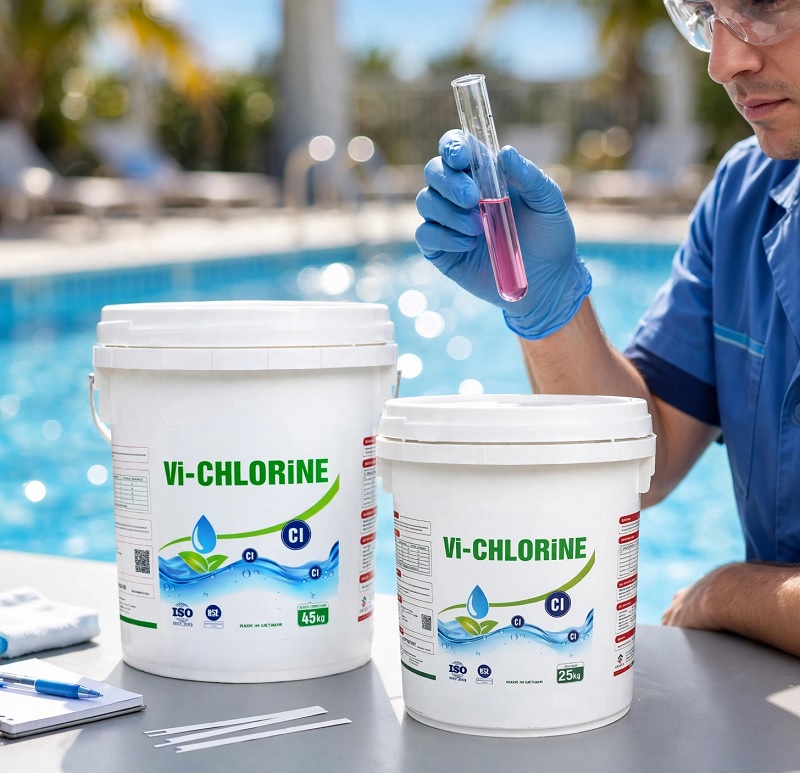
For commercial operators, water parks, and large aquaculture farms, managing inventory efficiently is critical. That is why industry leaders opt for bulk packaging that ensures a steady supply of high-grade disinfectant. Depending on the scale of your operation, you might require different volumes. For medium-sized facilities or seasonal prep, the Vi chlorine 25kg pack offers an excellent balance of quantity and ease of handling. For massive industrial applications, wastewater treatment plants, or massive multi-hectare shrimp farms, upgrading to the vi chlorine 45kg drum ensures you have the necessary oxidizing power on hand for heavy-duty shock treatments and continuous dosing systems.
These products are specifically formulated to help clarify the water by rapidly oxidizing suspended organic compounds, making them a dual-threat against both invisible pathogens and visible murkiness.
6. Testing for Free Chlorine: Accuracy is Everything
You cannot manage what you cannot measure. Because free chlorine is constantly being consumed by UV light and organic matter, regular testing is the only way to ensure your water remains safe. There are several ways to measure free chlorine:
| Testing Method | How It Works | Accuracy | Best Use Case |
|---|---|---|---|
| DPD Test Kits (Liquid/Powder) | Uses N,N-Diethyl-p-phenylenediamine (DPD) which turns pink in the presence of free chlorine. The intensity of the color indicates the ppm. | High | Commercial pools, aquaculture, municipal water. The gold standard for manual testing. |
| Test Strips | Small paper strips with chemical pads that change color when dipped in water. | Low to Medium | Quick daily checks for residential pools. Not recommended for precise industrial dosing. |
| Electronic Photometers | Uses DPD reagents but reads the color change digitally using light transmission, eliminating human error in color matching. | Very High | Health inspectors, large aquatic facilities, and rigorous aquaculture biosecurity protocols. |
| ORP Sensors (Online) | Measures the Oxidation-Reduction Potential (in millivolts). It doesn't measure ppm directly, but measures the actual oxidizing power of the water in real-time. | High (for trend monitoring) | Automated dosing systems in large commercial operations. |
When using a DPD kit, it is crucial to understand that DPD #1 tests specifically for Free Chlorine, while DPD #3 tests for Total Chlorine. The difference between the two readings gives you your Combined Chlorine level.
7. Troubleshooting Free Chlorine Issues
Even with the best products, operators sometimes struggle to maintain free chlorine. Here are the most common issues and how to solve them:
Problem: "I keep adding chlorine, but I get no free chlorine reading."
This phenomenon is known as Chlorine Demand or "Chlorine Lock." The water has such a massive load of organic contaminants, bacteria, or ammonia that every drop of chlorine you add is instantly consumed (converted into combined chlorine).
Solution: You must reach "Breakpoint Chlorination." This requires adding a massive dose of chlorine (usually 10 times the amount of combined chlorine present) to completely shatter the molecular bonds of the contaminants. Only after this breakpoint is reached will a free chlorine residual begin to build.
Problem: "My free chlorine disappears as soon as the sun comes out."
Solution: If you are operating an outdoor pool, you need Cyanuric Acid (CYA), also known as chlorine stabilizer. CYA acts like sunscreen for your chlorine, protecting it from UV degradation. However, be careful—too much CYA can over-stabilize the chlorine, rendering it sluggish and ineffective. The ideal CYA range is typically 30-50 ppm. (Note: CYA is generally not used in aquaculture pond prep, as rapid dissipation is actually desired before stocking).
Problem: "The water smells strongly of chlorine and makes eyes red."
Solution: Counterintuitively, a strong "chlorine smell" means you do not have enough free chlorine. That smell is off-gassing chloramines (combined chlorine). To get rid of the smell and the eye irritation, you must add a large dose of free chlorine to oxidize the chloramines and reach breakpoint.
8. Frequently Asked Questions (FAQ)
9. Conclusion
Understanding "what is free chlorine" is the foundational knowledge required for effective water management. It is not just about dumping chemicals into a pool or a pond; it is about managing the delicate balance of chemistry to ensure maximum disinfection power, safety, and visual clarity.
Whether you are trying to keep a hotel swimming pool crystal clear and safe for guests, or preparing a multi-hectare aquaculture facility for a new, highly profitable crop cycle, maintaining the correct free chlorine residual is your first line of defense against pathogens and organic pollution.
By monitoring your pH, understanding the difference between free and combined chlorine, and choosing a premium, fast-acting oxidizer, you can master your water quality. When clarity and biosecurity are on the line, professionals choose products that deliver consistent, powerful results.
Need Expert Advice on Water Treatment?
Don't leave your water quality to chance. Whether you need to clarify a cloudy pool or implement rigorous biosecurity protocols for your aquaculture farm, our team of chemical experts is here to help you calculate the perfect dosage and select the right products.
Contact the Vi-Chlorine Team TodayRelated Search Terms:
- Free chlorine vs total chlorine
- How to raise free chlorine in pool
- Breakpoint chlorination calculation
- Calcium hypochlorite 70% applications
- Aquaculture biosecurity chemicals
- How to clear cloudy pool water fast
- DPD testing for residual chlorine