
Understanding Residual Chlorine: What Level is Safe for Drinking Water?
- Q&A Chlorine
- 14/07/2026
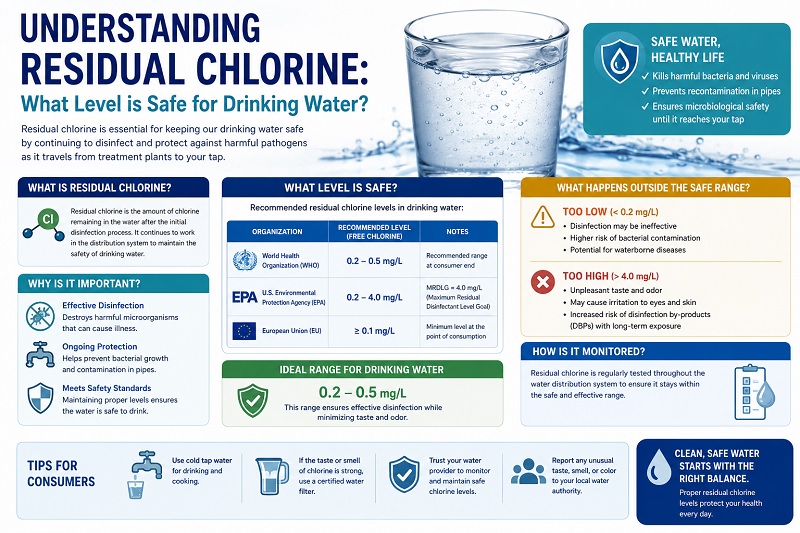
According to the World Health Organization (WHO) and the U.S. Environmental Protection Agency (EPA), the safe level of residual chlorine in drinking water is between 0.2 mg/L and 4.0 mg/L (ppm). A detectable free residual chlorine level of at least 0.2 mg/L at the point of consumption ensures that water remains protected against microbial contamination during distribution, while levels strictly below 4.0 mg/L prevent adverse health effects and unpleasant tastes or odors.
1. What is Residual Chlorine and Why Does It Matter?
When municipal water treatment plants or private well owners add chlorine to a water supply, their primary goal is disinfection—killing dangerous pathogens, bacteria, and viruses that cause waterborne diseases like cholera, typhoid, and dysentery. However, simply adding chlorine is not enough; the water must remain safe as it travels through miles of pipes to reach your tap.
This is where residual chlorine comes in. Residual chlorine is the low level of chlorine remaining in the water after the initial disinfection process is complete. Think of it as a microbiological security guard. As water moves through distribution networks, it may encounter leaks, cross-connections, or biofilm growth. The residual chlorine acts as a continuous shield, neutralizing any newly introduced contaminants before the water reaches your glass.
Without adequate residual chlorine, water that was perfectly clean at the treatment facility could become highly dangerous by the time it flows from a kitchen faucet.
2. The Difference Between Free, Combined, and Total Chlorine
To truly understand drinking water safety, it is essential to distinguish between the three different measurements of chlorine. Not all chlorine in water does the same job.
- Free Chlorine: This is the active, available chlorine (hypochlorous acid and hypochlorite ion) that has not yet reacted with contaminants. It is the most effective form of chlorine for sanitizing water. When guidelines refer to "residual chlorine," they are usually talking about free chlorine.
- Combined Chlorine (Chloramines): When free chlorine reacts with organic matter, ammonia, or nitrogenous compounds in the water, it forms combined chlorine. While combined chlorine still has some weak disinfecting properties, it is much less effective. Moreover, high levels of combined chlorine are responsible for the strong, pungent "pool smell" and can cause eye or skin irritation.
- Total Chlorine: This is simply the sum of free chlorine and combined chlorine. Knowing the total chlorine alone is not enough; you must know how much of it is free and available to actively protect the water.
3. What Level of Residual Chlorine is Safe for Drinking Water?
Determining the exact safe level requires a delicate balancing act. Too little chlorine leaves the water vulnerable to microbial outbreaks. Too much chlorine can create harmful disinfection byproducts (DBPs) like Trihalomethanes (THMs) and cause the water to taste or smell terrible.
Global health organizations have established strict parameters:
| Organization / Standard | Minimum Required Level | Maximum Contaminant Level (MCL) |
|---|---|---|
| World Health Organization (WHO) | 0.2 mg/L (at the tap) | 5.0 mg/L |
| U.S. EPA (Environmental Protection Agency) | 0.2 mg/L (in distribution systems) | 4.0 mg/L (MCLG and MCL) |
| CDC Recommendations | 0.2 - 0.5 mg/L (Routine) | Max 4.0 mg/L |
For municipal water treatment facilities that process massive volumes of water daily, maintaining this precise balance across vast networks requires industrial-grade solutions. Many large-scale treatment plants rely on robust chemical agents like vi chlorine 45kg to ensure consistent, stable dosing and long-lasting residual protection throughout city-wide distribution systems.
4. Signs Your Water Has Too Much or Too Little Chlorine
Consumers often wonder how they can tell if their tap water falls outside the safe parameters without using chemical testing kits. While laboratory testing is the only definitive method, human senses can detect extreme imbalances.
Signs of Too Much Chlorine (Above 4.0 mg/L)
- Strong Chemical Odor: Water that smells overwhelmingly like bleach or a public swimming pool.
- Bitter or Metallic Taste: A distinct, unpleasant taste that makes it difficult to drink directly from the tap.
- Skin and Hair Issues: Showering in heavily chlorinated water can strip natural oils, leading to dry, itchy skin and brittle hair.
- Fading Clothes: Washing clothes in highly chlorinated water can cause fabrics to fade prematurely.
Signs of Too Little Chlorine (Below 0.2 mg/L)
- Cloudy or Murky Water: A lack of disinfectant allows bacteria and algae to multiply, often resulting in turbidity (cloudiness).
- Earthy or Musty Smell: Unchlorinated water may develop a swampy or moldy odor due to unchecked organic growth.
- Health Risks: The most dangerous sign is invisible; recurrent gastrointestinal issues, stomach cramps, or diarrhea can indicate that pathogens are surviving in the water supply.
5. The Chemistry: Factors Affecting Chlorine Levels
Maintaining a residual chlorine level of 0.2 to 4.0 mg/L is not as simple as adding a fixed amount of chemical. The "Chlorine Demand" of the water dictates how much chemical is consumed before a residual is established. Several factors influence this demand:
- pH Levels: Chlorine is highly pH-dependent. It is most effective at a pH range of 6.5 to 7.5. If the pH rises above 8.0, the chlorine rapidly loses its disinfecting power.
- Temperature: Warm water accelerates chemical reactions. In summer months or tropical climates, chlorine dissipates much faster, requiring higher initial dosing to maintain the same residual level at the tap.
- Organic Matter: High levels of dirt, leaves, iron, or manganese will quickly consume free chlorine.
- UV Exposure: Sunlight rapidly degrades chlorine. This is why water stored in open reservoirs requires constant re-chlorination.
6. How High-Quality Calcium Hypochlorite Helps Achieve Crystal Clear Water
To achieve the perfect balance of effective disinfection, optimal residual levels, and crystal-clear water, the quality of the chlorinating agent is paramount. Using low-grade chemicals often introduces excessive insoluble matter, leading to cloudy water, scale buildup, and unpredictable chlorine degradation.
This is where premium solutions like vi chlorine (Calcium Hypochlorite 70%) make a profound difference. Known for its high concentration of active available chlorine (70%), it dissolves rapidly and leaves minimal residue. This high purity ensures that operators can calculate their dosing accurately, achieving the exact breakpoint chlorination needed without overshooting into dangerous territory.
Furthermore, for medium-sized operations, rural water treatment stations, or large commercial pools that need flexible dosing, utilizing packaging like Vi chlorine 25kg provides the perfect balance of professional-grade chemical strength and manageable handling. High-quality calcium hypochlorite not only purifies the water but actively oxidizes iron and manganese, transforming murky, mineral-heavy water into a crystal-clear, safe drinking source.
7. Beyond Drinking Water: Residual Chlorine in Aquaculture and Biosecurity
While strict residual chlorine control is a matter of public health in drinking water, it is equally critical in global food production—particularly in aquaculture. In the commercial shrimp farming industry, disease outbreaks (like White Spot Syndrome or Early Mortality Syndrome) can devastate an entire harvest.
To ensure absolute biosecurity, farmers use high-concentration chlorine to aggressively sterilize pond water before stocking shrimp. However, unlike drinking water, the residual chlorine in an aquaculture pond must be completely eliminated (brought to 0 ppm) before the shrimp post-larvae (PL) are introduced, as aquatic life is highly sensitive to even trace amounts of chlorine.
The scale of this requirement is massive. As detailed in the Global Shrimp Market Outlook 2025: A Golden Opportunity for Asia, the expanding aquaculture sector demands reliable, high-potency sanitizers to maintain international export standards.
Leading industry experts recognize this necessity. During major industry events, such as when AQUADELTA - Dr.Tom Accompanies Vietshrimp 2025: Vi-CHLORiNE Solution Enhancing Biosecurity in Aquaculture, the emphasis is heavily placed on using premium Calcium Hypochlorite to manage water quality, eradicate pathogens during pond preparation, and secure the supply chain.
8. Real-World Applications and Community Trust
Theoretical knowledge of chlorine levels must translate into practical, reliable results for end-users, whether they are municipal engineers, pool operators, or agricultural farm owners. Consistency is the key to trust. When a product reliably delivers the expected residual parts per million (PPM) without causing turbidity or leaving heavy sediment, it builds a loyal user base.
To understand the real-world impact of using high-grade disinfection products, you can read firsthand accounts and case studies in our article: What Do Local Farmers Say About Vi-CHLORiNE. Their experiences highlight how crucial accurate chlorine dosing is for both water clarity and operational success.
9. How to Accurately Test Residual Chlorine
Guessing is never acceptable when it comes to water safety. To ensure your water falls within the 0.2 to 4.0 mg/L range, regular testing is required. There are three primary methods:
- DPD Colorimetric Test Kits: The most common method. DPD (N,N-Diethyl-p-phenylenediamine) tablets or liquid drops are added to a water sample. The water turns a shade of pink—the darker the pink, the higher the chlorine concentration. The color is then matched against a standardized visual chart.
- Digital Colorimeters/Photometers: Used by professionals, these electronic devices read the color change of the DPD reaction optically, providing a highly accurate digital PPM reading and removing human visual error.
- Test Strips: The fastest and most affordable method for home users, though the least precise. A chemically treated paper strip is dipped into the water and changes color, which is compared to a chart on the bottle.
For drinking water facilities, tests should be conducted daily at multiple points along the distribution system.
10. Frequently Asked Questions (FAQs)
Need Expert Advice on Water Disinfection?
Whether you are managing municipal drinking water, a commercial swimming pool, or an intensive aquaculture farm, achieving the perfect residual chlorine balance is crucial. Contact our experts today for customized dosing charts, product safety data sheets, and bulk pricing.
Contact Vi-Chlorine Experts Now