
The Impact of Chlorine on Environmental Sustainability: Myths vs. Reality
- Q&A Chlorine
- 14/07/2026
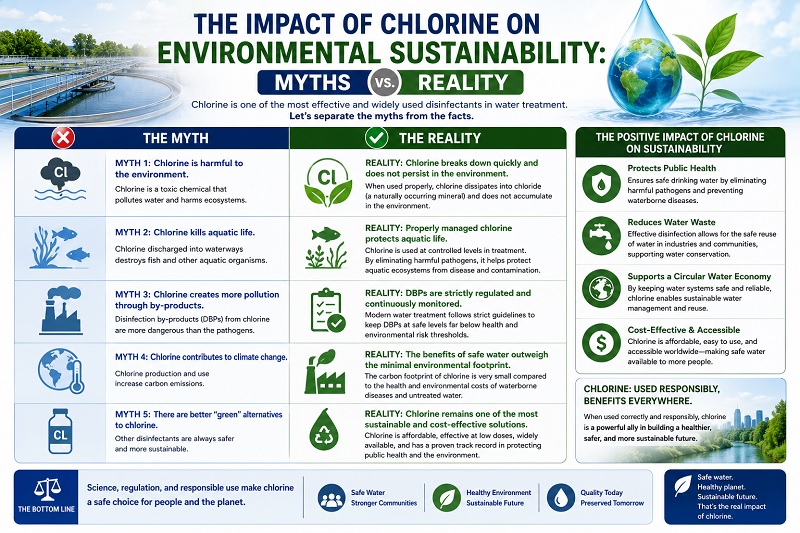
The relationship between chlorine and environmental sustainability is widely misunderstood. Myth: Chlorine permanently poisons ecosystems and is an outdated chemical. Reality: When managed correctly, chlorine is a highly sustainable, short-lived oxidant that breaks down rapidly into harmless natural salts (chlorides). Modern environmental science reveals that precise chlorination is essential for preventing devastating ecological bio-hazards, clarifying polluted water, and securing global food supplies without leaving long-term toxic footprints.
1. Introduction: The Green Dilemma in Water Treatment
As the global push for environmental sustainability accelerates, industries are rigorously re-evaluating the chemicals they use daily. At the center of this scrutiny is one of the most historically significant elements on Earth: Chlorine. For over a century, chlorine has been the cornerstone of public health, eliminating waterborne diseases like cholera and typhoid.
However, in recent decades, a growing narrative has painted chlorine as an ecological villain—a toxic substance incompatible with a "green" future. Eco-conscious activists and alternative technology vendors often argue that chemical disinfection should be entirely replaced by physical methods like UV or Ozone to protect our rivers, lakes, and soil.
But does this narrative hold up to scientific scrutiny? The truth about the impact of chlorine on environmental sustainability is deeply nuanced. It requires us to separate emotional rhetoric from rigorous chemistry. In this comprehensive guide, we will unpack the most pervasive myths surrounding chlorine, explore the undeniable realities of modern water treatment, and demonstrate how high-quality chlorination practices are actually safeguarding our planet's most fragile ecosystems.
2. Myth vs. Reality: Chlorine and Ecosystem Damage
The most common fear regarding chlorine is its potential to wreak havoc on natural ecosystems if released into the environment.
The Myth
Chlorine is an unnatural synthetic chemical that persists in the environment for decades, permanently destroying aquatic life and poisoning groundwater reserves.
The Reality
Chlorine is a naturally occurring element (the 11th most abundant element in the Earth's crust). As a disinfectant, it is highly reactive and inherently short-lived. In nature, free chlorine rapidly degrades when exposed to sunlight (photolysis) and organic matter, breaking down into basic, harmless chloride salts—the very same compounds found in oceans and natural mineral springs.
When municipal wastewater is treated with chlorine, it is typically subjected to a "dechlorination" process using sulfur dioxide or sodium bisulfite before being discharged into natural water bodies. This step instantly neutralizes the active chlorine, ensuring that zero toxic residuals enter the river or lake. Furthermore, even in the event of an accidental minor spill, the chemical's aggressive reactivity means it exhausts itself very quickly by oxidizing nearby organics, preventing the kind of long-term, widespread ecological persistence seen in forever chemicals like PFAS or heavy metals.
3. Myth vs. Reality: The Problem of Disinfection Byproducts (DBPs)
The conversation around chlorine sustainability is incomplete without addressing Disinfection Byproducts (DBPs) such as Trihalomethanes (THMs) and Haloacetic Acids (HAAs).
The Myth
Chlorine inherently creates massive amounts of toxic, cancer-causing byproducts that pollute our drinking water and harm the environment irreparably.
The Reality
DBPs are not created by chlorine alone; they are formed when chlorine reacts with high levels of natural organic matter (NOM) like decaying leaves and algae in the water. Modern treatment facilities use advanced pre-filtration and precise dosing algorithms to minimize DBPs well below the strict safety limits set by the WHO and EPA.
The key to sustainability here is optimization, not elimination. Abandoning chlorine entirely leaves distribution networks vulnerable to massive bacterial outbreaks. Instead, modern sustainability focuses on reducing the organic load *before* chlorine is introduced. This is achieved through enhanced coagulation, sedimentation, and using premium chemical agents that act efficiently without leaving excessive insoluble residues.
4. The Sustainable Power of Premium Chlorine in Water Clarification
One of the most critical aspects of sustainable water management is water recovery—the ability to take highly turbid, unusable water and clarify it for safe consumption or agricultural reuse. Poor quality disinfectants often contain heavy binders and insoluble materials that create sludge, leading to increased waste disposal issues and environmental strain.
To combat this, leading facilities are turning to high-purity Calcium Hypochlorite (70%). A prime example of this is vi chlorine, a premium chemical solution specifically engineered to not only disinfect but also actively help clarify water. When introduced to turbid water, high-quality calcium hypochlorite aggressively oxidizes dissolved iron, manganese, and hydrogen sulfide.
This oxidation process transforms these dissolved contaminants into solid particles that can be easily filtered out. The result is crystal-clear water achieved with minimal chemical waste. For facilities striving for a smaller ecological footprint, using a pure, highly concentrated agent means they use less overall product, generate less sludge, and significantly reduce the energy required for backwashing filters. For medium-sized municipal plants, community pools, or eco-resorts, utilizing optimized packaging like Vi chlorine 25kg provides the perfect balance of manageable handling and high-potency water clarification, ensuring that every ounce of chemical serves a direct, efficient purpose.
5. Industrial Scalability: Balancing Cost, Efficacy, and Ecology
Sustainability is a three-pillared concept encompassing environmental protection, social equity, and economic viability. If a water treatment method is perfectly green but exorbitantly expensive, it is not economically sustainable for developing nations or massive industrial applications.
Technologies like UV and Ozone are excellent, but they require immense continuous electrical power (often derived from fossil fuels) and massive capital investment. Chlorine remains the great equalizer in global public health. It provides affordable, reliable sanitation to billions of people.
To maximize economic and environmental efficiency on a massive scale, large municipal treatment plants and industrial factories rely on bulk solutions. Deploying formats like vi chlorine 45kg drums significantly reduces plastic packaging waste per ton of treated water. Bulk shipping lowers the carbon footprint associated with transportation logistics. When high-concentration 70% calcium hypochlorite is used, factories require fewer deliveries, spend less energy on material handling, and achieve breakpoint chlorination with ruthless efficiency.
6. Beyond Drinking Water: Biosecurity in Sustainable Aquaculture
While drinking water is the most discussed application, the true test of chlorine's environmental impact is found in agriculture—specifically, commercial aquaculture. The farming of shrimp and fish is essential for feeding a growing global population without further depleting wild ocean stocks.
However, intensive farming carries severe ecological risks. Without strict biosecurity, disease outbreaks (such as White Spot Disease in shrimp) can devastate farms. When farmers attempt to flush diseased water back into the environment, they risk infecting wild marine populations, leading to catastrophic ecological collapse in coastal regions.
This is where chlorine acts as an ultimate environmental protector. As highlighted in the comprehensive Global Shrimp Market Outlook 2025: A Golden Opportunity for Asia, the future of the industry depends entirely on sustainable, disease-free harvests.
During pond preparation, farmers use high-dose chlorine to completely sterilize the water and eradicate pathogen carriers (like wild crustaceans and harmful bacteria) *before* stocking their post-larvae. Because chlorine degrades naturally under the sun, within a few days, the water is entirely safe and chemical-free for the shrimp to thrive. This process prevents the need to use toxic, persistent antibiotics during the grow-out phase.
Industry leaders and scientists heavily advocate for this responsible use. For instance, at major international symposiums, such as the one detailed in AQUADELTA - Dr.Tom Accompanies Vietshrimp 2025: Vi-CHLORiNE Solution Enhancing Biosecurity in Aquaculture, the emphasis is placed on utilizing premium chlorination to create an impenetrable biosecurity shield that protects both the farmed crop and the surrounding natural estuarine environment.
The environmental sustainability of this approach is not just theoretical; it is proven on the ground. To understand the real-world ecological and economic benefits, one only needs to read the testimonials in What Do Local Farmers Say About Vi-CHLORiNE. Farmers recognize that a clean, sterilized start utilizing a rapidly degrading oxidant is the most responsible way to farm in harmony with nature.
7. Best Practices for Eco-Friendly Chlorination
To ensure that the use of chlorine aligns perfectly with environmental sustainability goals, operators across all industries must adhere to the following best practices:
- Precision Dosing: Utilize advanced digital photometers to measure exactly how much chlorine is needed. Over-dosing wastes chemicals and creates unnecessary DBPs; under-dosing requires a secondary shock treatment.
- Mandatory Dechlorination: For industrial and municipal facilities, wastewater must never be discharged with active free chlorine. Systems must incorporate automated sulfur dioxide or Vitamin C (ascorbic acid) dechlorination before effluent reaches natural waterways.
- Pre-Filtration: Always filter out organic matter, algae, and suspended solids *before* adding chlorine. This drastically reduces the chemical demand and prevents the formation of THMs.
- Hybrid Systems: For the ultimate sustainable approach, facilities are increasingly pairing UV technology with low-dose chlorine. UV neutralizes the bulk of the pathogens without chemicals, while a tiny fraction of chlorine provides the necessary residual protection for the distribution pipes.
8. Conclusion: Embracing Responsible Chemistry
The narrative that chlorine is an enemy of environmental sustainability is a myth rooted in misunderstanding. The reality is that chlorine is a fundamental tool for preserving human life and protecting natural ecosystems from devastating biological contamination.
Whether it is clarifying municipal drinking water, preventing biosecurity disasters in coastal aquaculture, or providing an economically viable sanitation solution for the developing world, high-quality chlorine (like 70% Calcium Hypochlorite) is indispensable. By prioritizing premium products, precision dosing, and strict dechlorination protocols, we can harness the power of this natural element to build a safer, cleaner, and more sustainable future.
9. Frequently Asked Questions (FAQs)
Commit to Sustainable Water Treatment Today
Are you looking to optimize your water treatment facility or aquaculture farm with high-purity, environmentally responsible chemicals? Discover how Vi-Chlorine's premium Calcium Hypochlorite solutions can maximize your biosecurity while minimizing your ecological footprint.
Consult Our Sustainability Experts