
Pool Still Cloudy After Shocking? Causes & How to Fix It
- Q&A Chlorine
- 11/09/2026
Shock chlorination is one of the most common treatments used when swimming pool water becomes green, dull, contaminated, or difficult to sanitize. However, pool owners are often surprised when the water does not become crystal clear immediately after treatment.
This is because shock treatment and water clarification are not the same process. Chlorine is primarily responsible for sanitation and oxidation. The filtration system, circulation system, brushing, vacuuming, and water balance are responsible for physically removing or controlling many of the particles that make water look cloudy.
If your pool has already been shocked but still looks milky, hazy, gray, or dull, the next step should be diagnosis rather than simply adding another large chlorine dose.
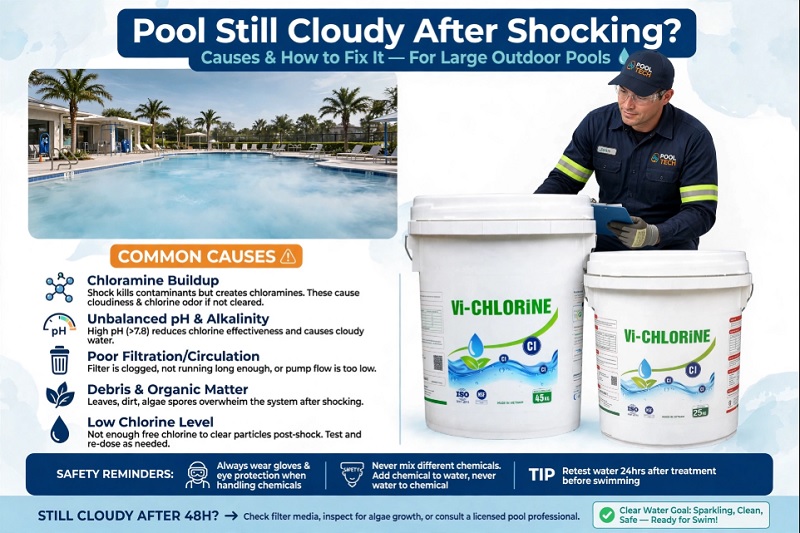
Why the Pool Has Been Shock-Chlorinated but the Water Remains Cloudy
The most common reason is that shock treatment has killed algae or oxidized contaminants, but the resulting fine particles are still suspended in the water.
Dead algae can be extremely small. Even after chlorine has successfully destroyed the organisms, the remains can continue floating through the pool. Until those particles are captured by the filter or removed by vacuuming, the water may remain cloudy.
Other common causes include:
- Dead algae suspended in the water
- A dirty or undersized pool filter
- Insufficient filtration time
- Poor water circulation
- High or unstable pH
- Excessive calcium hardness
- High total alkalinity
- Large amounts of fine debris
- Heavy swimmer contamination
- Improper chlorine dosing
- High cyanuric acid levels
- Incomplete algae treatment
Understanding the root cause is important because each situation requires a different solution.
The same principle applies in professional water treatment: disinfection must be combined with appropriate water management rather than viewed as a single-step solution. Products such as vi chlorine are used in professional disinfection and water-treatment applications where concentration, contact time, water quality, and operating conditions all influence performance.
The Pool Has Been Shock-Chlorinated but the Water Remains Cloudy Because of Dead Algae
Dead algae is one of the most frequent explanations for cloudy water after shocking.
Before treatment, algae may appear green, yellow, mustard-colored, or dark. After effective chlorination, the color can fade significantly, but the water may become grayish, whitish, or cloudy.
This can actually indicate that the chlorine has begun working.
Once algae cells are destroyed, the pool still needs to remove the dead organic material. This is where filtration becomes critical.
To clear dead algae:
- Brush the pool walls, steps, corners, and floor thoroughly.
- Run the filtration system continuously or according to the equipment manufacturer's recommendations.
- Clean or backwash the filter when pressure increases.
- Vacuum settled debris from the pool floor.
- Retest free chlorine regularly.
- Repeat brushing if algae remains attached to surfaces.
If the water remains green rather than simply cloudy, the algae may not yet be fully controlled.
The Pool Has Been Shock-Chlorinated but the Water Remains Cloudy Due to Poor Filtration
Chlorine cannot filter the water.
This distinction is essential. Chlorine kills or inactivates many microorganisms and oxidizes contaminants, but it does not physically remove every suspended particle.
If the filter is dirty, clogged, damaged, incorrectly sized, or operated for too little time, cloudy water can continue even when chlorine levels are adequate.
Check the filtration system carefully.
Sand filters
Backwash the filter when the pressure rises sufficiently above the normal clean operating pressure, following the manufacturer's instructions. Old or channelled filter media may also reduce filtration efficiency.
Cartridge filters
Remove and clean the cartridge thoroughly. A heavily contaminated cartridge can quickly become overloaded after an algae treatment.
Diatomaceous earth filters
DE filters can capture very fine particles but still require correct maintenance, backwashing, and replenishment of filtration media as specified by the manufacturer.
For commercial operators handling larger-scale disinfection requirements, appropriate chemical packaging and controlled dosing are also important. vi chlorine 45kg is an option designed for professional water-treatment and disinfection applications.
The Pool Has Been Shock-Chlorinated but the Water Remains Cloudy Because the Filter Has Not Run Long Enough
Water may not clear immediately after shock chlorination.
If the treatment has killed a significant algae population, the filter may need many hours of operation to remove the resulting particles.
The exact filtration time depends on:
- Pool volume
- Pump flow rate
- Filter type
- Severity of contamination
- Particle size
- Condition of the filter media
- Water circulation pattern
After major corrective treatment, filtration may need to operate much longer than during ordinary daily maintenance.
However, continuous filtration is useful only if the filter is actually functioning properly. A clogged or damaged filter can circulate cloudy water without making significant progress.
The Pool Has Been Shock-Chlorinated but the Water Remains Cloudy Because of Incorrect pH
Pool pH strongly affects both water clarity and chlorine chemistry.
If pH is too high, chlorine becomes less effective as a sanitizer. High pH may also contribute to mineral precipitation, which can make water appear milky or cloudy.
If pH is too low, the water can become corrosive and may damage pool surfaces and equipment.
Therefore, after shock treatment, test pH rather than guessing.
Water balance should be evaluated together with:
- Free chlorine
- Combined chlorine
- Total alkalinity
- Calcium hardness
- Cyanuric acid
Correcting water balance often improves both chlorine efficiency and water clarity.
The Pool Has Been Shock-Chlorinated but the Water Remains Cloudy After Heavy Use
Heavy swimmer load can dramatically increase chlorine demand.
Swimmers introduce:
- Sweat
- Body oils
- Sunscreen
- Cosmetics
- Hair products
- Dirt
- Organic matter
After a pool party or a very busy swimming day, a single shock treatment may begin oxidizing contaminants but not immediately restore perfect clarity.
In these situations, continue filtration, brush the pool, clean the filter, and retest the water before adding additional chemicals.
Experience from other water-treatment sectors shows the same pattern: effective chlorination depends on contaminant load and operating conditions. Practical applications are discussed in What Do Local Farmers Say About Vi-CHLORiNE, where water management and biosecurity are addressed under real operating conditions.
The Pool Has Been Shock-Chlorinated but the Water Remains Cloudy Because of High Calcium Hardness
Cloudy white or milky water can sometimes be caused by mineral precipitation rather than algae.
High calcium hardness combined with elevated pH can encourage calcium compounds to precipitate out of solution. These microscopic mineral particles scatter light and make the water appear cloudy.
This situation is more likely when:
- The source water is naturally hard.
- Calcium-containing pool products have been used repeatedly.
- pH is high.
- Total alkalinity is high.
- Water temperature is elevated.
If calcium hardness is the cause, adding more chlorine will not solve the problem.
Test the water and correct the relevant balance parameters according to professional pool guidance.
The Pool Has Been Shock-Chlorinated but the Water Remains Cloudy Because of High Cyanuric Acid
Cyanuric acid, commonly called chlorine stabilizer, helps protect chlorine from rapid UV degradation in outdoor pools.
However, excessive CYA can make chlorine management more difficult because a higher free chlorine level may be required to maintain effective sanitation.
If a pool repeatedly develops algae or cloudiness despite having measurable chlorine, excessive stabilizer may be one factor to investigate.
This issue can occur when stabilized chlorine products are used repeatedly over a long period.
Testing CYA is particularly useful when:
- The pool has persistent algae.
- Shock treatments seem less effective than expected.
- Stabilized chlorine has been used frequently.
- Water has not been partially replaced for a long period.
The Pool Has Been Shock-Chlorinated but the Water Remains Cloudy After Rain
Heavy rainfall can quickly change swimming pool conditions.
Rain may introduce dust, pollen, microorganisms, soil particles, leaves, and other contaminants. It can also dilute chlorine and alter pH and alkalinity.
If the pool was shocked after a storm but remains cloudy, several processes may be happening simultaneously.
The chlorine may have addressed biological contamination, while the filter is still working to remove suspended particles.
A practical approach after heavy rain is:
- Remove visible debris.
- Test chlorine and pH.
- Check filtration system performance.
- Brush the pool.
- Vacuum settled material.
- Clean or backwash the filter.
- Continue filtration.
Avoid repeatedly adding shock without testing because excessive chemical use may create additional water-balance problems.
The Pool Has Been Shock-Chlorinated but the Water Remains Cloudy: Should You Add More Chlorine?
Not automatically.
This is one of the most important points for pool owners.
Cloudy water after shocking does not always mean that there is insufficient chlorine.
Before adding another dose, test free chlorine and evaluate the water conditions.
Additional chlorine may be justified if:
- Free chlorine has dropped rapidly.
- Algae is still visibly active.
- The water has a very high chlorine demand.
- Testing indicates that the previous treatment was inadequate.
Additional chlorine may not be useful if:
- Free chlorine is already sufficiently elevated.
- Cloudiness is caused by dead algae.
- The filter is dirty.
- pH is out of balance.
- Calcium precipitation is occurring.
- Suspended debris simply needs filtration time.
The best decision should always be based on measurement rather than appearance alone.
This principle is equally important in large-scale water treatment, where overdosing can increase cost without necessarily improving results. Different commercial formats such as Vi chlorine 25kg can support professional operations where dosing is determined according to actual treatment objectives.
The Pool Has Been Shock-Chlorinated but the Water Remains Cloudy: Should You Use a Clarifier?
A pool clarifier may help in some situations, but it should not be the first response to every cloudy pool.
Clarifiers work by helping extremely fine suspended particles combine into larger particles that the filter can capture more easily.
They may be useful when:
- Water chemistry is balanced.
- Sanitation is under control.
- The filter is operating properly.
- Cloudiness is caused mainly by very fine suspended particles.
Before using a clarifier, always follow the product label and confirm that it is compatible with your filter system.
Adding excessive clarifier can sometimes worsen filtration performance or create additional cloudiness.
The Pool Has Been Shock-Chlorinated but the Water Remains Cloudy: Should You Use Flocculant?
Pool flocculants operate differently from ordinary clarifiers.
They are designed to cause very fine particles to aggregate and settle toward the pool floor, where they can be removed by vacuuming.
Flocculation can sometimes be helpful for severe cloudiness, but it requires careful handling and may not be appropriate for every filtration system.
When using flocculant:
- Follow the manufacturer's instructions closely.
- Confirm filter compatibility.
- Allow adequate settling time.
- Vacuum the sediment correctly.
- Avoid returning settled material back into the pool.
Never combine chemicals casually. Pool products may contain ingredients that react differently when mixed.
The Pool Has Been Shock-Chlorinated but the Water Remains Cloudy Because Circulation Is Poor
Good filtration requires good circulation.
Even an excellent filter cannot clear the pool effectively if water does not reach it.
Poor circulation can occur when:
- Return jets are poorly positioned.
- The pump flow rate is inadequate.
- Skimmers are blocked.
- The pump basket is full.
- Valves are incorrectly positioned.
- There are dead zones in the pool.
Dead zones often appear behind ladders, around steps, in corners, and in areas far from return jets.
Brush these areas manually and adjust circulation where possible.
The Pool Has Been Shock-Chlorinated but the Water Remains Cloudy: How Long Should You Wait?
There is no universal number of hours that guarantees clear water.
A lightly cloudy pool may improve relatively quickly, while a pool recovering from a severe algae bloom may require substantially more filtration and cleaning.
Instead of waiting for a specific time, monitor progress through:
- Water clarity
- Free chlorine readings
- Filter pressure
- Amount of debris captured
- Presence or absence of active algae
- pH and water balance
If the water is gradually improving, continued filtration and cleaning may be all that is needed.
If there is little or no improvement, investigate the filter system, water chemistry, and the original cause of the cloudiness.
The Pool Has Been Shock-Chlorinated but the Water Remains Cloudy: Step-by-Step Solution
Use the following troubleshooting sequence to avoid unnecessary chemical additions.
Step 1: Test the water
Measure free chlorine, pH, and other relevant parameters.
Step 2: Check whether algae is still active
If the pool remains green or surfaces are slippery, treatment may not yet be complete.
Step 3: Brush all surfaces
Brushing helps release dead algae and contaminants from walls, steps, and floors.
Step 4: Inspect the filter
Clean, backwash, or service the filter according to its type.
Step 5: Improve circulation
Confirm that the pump is operating correctly and that return jets are distributing water effectively.
Step 6: Vacuum debris
Remove material that has settled on the pool floor.
Step 7: Allow filtration time
Let the system capture fine suspended particles.
Step 8: Retest
Do not add more shock until testing indicates that additional chlorine is actually needed.
These water-treatment fundamentals are also critical in aquaculture, where disinfection and biosecurity influence production performance. Broader industry trends are discussed in Global Shrimp Market Outlook 2025: A Golden Opportunity for Asia.
The Pool Has Been Shock-Chlorinated but the Water Remains Cloudy: When Is It Safe to Swim?
Do not judge swimming safety based on water appearance alone.
A pool may look clear while having unsuitable chemistry, and a slightly cloudy pool may have acceptable chlorine levels but still present visibility concerns.
Before reopening the pool:
- Test chlorine concentration.
- Confirm pH is within the appropriate operating range.
- Ensure the pool floor and main drain are clearly visible.
- Follow the chlorine product instructions.
- Follow local swimming pool health requirements.
Good underwater visibility is particularly important for swimmer safety because lifeguards, parents, and supervisors need to see swimmers clearly.
The Pool Has Been Shock-Chlorinated but the Water Remains Cloudy: How to Prevent It Next Time
Preventing cloudy water is easier than repeatedly restoring a neglected pool.
Maintain a consistent routine that includes:
- Regular water testing
- Appropriate chlorine residual
- Correct pH
- Adequate filtration
- Routine brushing
- Frequent removal of debris
- Filter maintenance
- Monitoring cyanuric acid
- Checking calcium hardness
- Responding quickly after heavy rain or heavy pool use
A pool that repeatedly becomes cloudy may have an underlying filtration, circulation, chemistry, or maintenance problem that shock chlorination alone cannot solve.
The Pool Has Been Shock-Chlorinated but the Water Remains Cloudy: Key Takeaways
If your pool remains cloudy after shock chlorination, remember these five key points:
- Chlorine does not physically remove particles. Filtration and vacuuming are essential.
- Dead algae can make water cloudy after successful treatment.
- Do not automatically add more chlorine. Test first.
- Check pH, calcium hardness, CYA, and filtration performance.
- Allow adequate circulation and filtration time.
Effective water treatment is a system, not a single chemical action.
This integrated approach is also reflected in professional aquaculture biosecurity, where chlorine treatment is combined with water-quality management, sanitation, and operating procedures. One example is AQUADELTA - Dr.Tom Accompanies Vietshrimp 2025: Vi-CHLORiNE Solution Enhancing Biosecurity in Aquaculture.
Vi-CHLORiNE for Professional Chlorine Water Treatment
The situation where the pool has been shock-chlorinated, but the water remains cloudy demonstrates an important water-treatment principle: chlorine is highly valuable for sanitation and oxidation, but successful water management also depends on filtration, circulation, contaminant removal, correct dosage, and water chemistry.
Vi-CHLORiNE provides chlorine solutions for professional water disinfection, aquaculture biosecurity, sanitation, and water-treatment applications.
Depending on the specific treatment process, chlorine-based solutions may be used for:
- Water disinfection
- Aquaculture pond preparation
- Environmental sanitation
- Equipment disinfection
- Biosecurity programs
- Water-treatment processes
Professional users should always calculate treatment according to water volume, available chlorine concentration, water quality, organic load, target application, and technical guidance.
For swimming pools, use chlorine products specifically approved and labeled for pool applications. Professional bulk chlorine products should only be used where appropriate technical procedures and dosage controls are available.
Explore Vi-CHLORiNE solutions for aquaculture, biosecurity, environmental sanitation, and water disinfection.
Discover Vi-CHLORiNEFAQ: The Pool Has Been Shock-Chlorinated but the Water Remains Cloudy
1. Why is my pool still cloudy after adding chlorine shock?
The pool may remain cloudy because dead algae, fine debris, or oxidized contaminants are still suspended in the water. Poor filtration, incorrect pH, high calcium hardness, or inadequate circulation can also contribute. Test the water and inspect the filtration system before adding more chlorine.
2. How long does it take for cloudy water to clear after shocking a pool?
There is no fixed time for every pool. A slightly cloudy pool may improve relatively quickly, while a pool recovering from a significant algae problem may need much longer filtration, brushing, and vacuuming. The condition of the filter and circulation system strongly affects the clearing process.
3. Should I shock the pool again if it is still cloudy?
Not automatically. Test free chlorine first. If chlorine remains adequate and algae is no longer active, additional shock may not help. Focus instead on filtration, brushing, vacuuming, pH, calcium hardness, and other water-balance factors.
4. Can I swim if the pool is cloudy after shocking?
Swimming should only resume when chlorine and pH are within appropriate ranges, the product instructions allow re-entry, and underwater visibility is adequate. If the pool floor or main drain cannot be clearly seen, swimming should generally be avoided until clarity improves.
5. Will running the pool filter clear cloudy water after shock chlorination?
In many cases, yes. Filtration is essential for removing dead algae and fine suspended particles after chlorination. However, the filter must be clean, correctly sized, and functioning properly. Brushing and vacuuming may also be required to complete the cleanup process.
Conclusion: If the pool has been shock-chlorinated but the water remains cloudy, do not assume that the chlorine treatment has failed. In many cases, the sanitizer has already done its job and the remaining problem is physical removal of dead algae, fine particles, or mineral deposits. Test the water, clean the filter, improve circulation, brush and vacuum the pool, and allow sufficient filtration time before deciding whether more chlorine is needed.
Disclaimer: This article provides general educational information. Pool chemicals vary in formulation and concentration. Always follow the product label, Safety Data Sheet, pool equipment manufacturer's instructions, and applicable local swimming-pool regulations.