
Neutralize Chlorine in Pond Water: Sodium Thiosulfate Guide
- NEWS
- Q&A Chlorine
- 09/10/2026
Chlorine disinfection only protects your crop if every trace of chlorine is gone before the first post-larvae are released. This guide explains how to neutralize chlorine in pond water with sodium thiosulfate: when to use it, how to calculate the dose, how to apply it step by step, and how to test that your pond is safe to stock.
Disinfecting a pond with chlorine is one of the most effective ways to start a clean shrimp or fish crop, but it creates a second challenge: residual chlorine is toxic to post-larvae, gills, and the beneficial plankton you need for a stable pond. Stocking even a few hours too early can cause mass mortality in the first days of a cycle. With farmed shrimp demand continuing to grow, as described in Global Shrimp Market Outlook: A Golden Opportunity for Asia, farms cannot afford to lose a crop to a preventable mistake.
This article shows you how to neutralize chlorine in pond water safely and efficiently, using aeration, sunlight, and sodium thiosulfate, and how to confirm the result before stocking.
How to Neutralize Chlorine in Pond Water: Quick Answer
To neutralize chlorine in pond water, first let the disinfectant work for 24 to 48 hours, then run aerators and let sunlight break down the residual. If chlorine is still present and you need to speed things up, dissolve sodium thiosulfate in water, spread it evenly across the pond, mix with aeration, and retest until the chlorine test kit reads zero.
The short version of the process is:
- Complete the chlorine contact period (24 to 48 hours).
- Aerate strongly and let sunlight work.
- Measure the residual chlorine with a test kit.
- Calculate and apply sodium thiosulfate if the residual remains.
- Retest, repeat in small steps if needed, and run a bioassay before stocking.
Why Chlorine Residual Remains in Pond Water After Disinfection
When calcium hypochlorite dissolves in water, it releases free chlorine, mainly as hypochlorous acid and hypochlorite ions. These oxidize bacteria, algae, and disease carriers, which is exactly what you want. But the chlorine that is not consumed by organic matter stays in the water until sunlight, aeration, and chemical reactions remove it.
The amount of residual depends on the dose you applied, water temperature, sunlight, turbidity, and organic load. Farms using a measured, consistent product such as Vi Chlorine, a granular calcium hypochlorite with a minimum of 70% active chlorine, find it easier to calculate the right dose, which also makes the later dechlorination step more predictable. Accurate dosing means you disinfect effectively without leaving a heavy residual that takes days to clear.
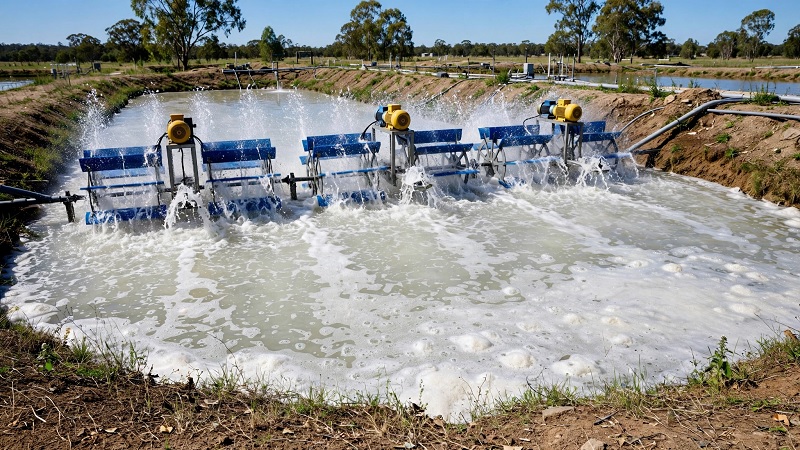
Pond water after chlorine disinfection with aerators running
Natural Dechlorination vs. Chemical Neutralization of Pond Water
There are two ways to remove chlorine from a pond. Most farms use a combination of both.
| Method | How it works | Typical time | Best for |
|---|---|---|---|
| Aeration and sunlight | Sunlight and turbulence break down and release chlorine from the water. | About 5 to 7 days | Planned schedules with spare time before stocking |
| Sodium thiosulfate | A reducing agent reacts with chlorine and converts it into harmless chloride and sulfur compounds. | Minutes to a few hours after mixing | Tight schedules, heavy residuals, or cloudy weather |
Natural dechlorination costs nothing but time, and it is the safest first step. Chemical neutralization is a tool for speeding up the process or for fixing a stubborn residual. It does not replace testing. Practical experience from the field is also valuable, and you can read What Do Local Farmers Say About Vi-CHLORiNE to see how shrimp farmers manage disinfection in real ponds.
What Is Sodium Thiosulfate and How Does It Neutralize Chlorine?
Sodium thiosulfate (Na₂S₂O₃) is a white crystalline salt widely used to dechlorinate water in aquaculture, aquariums, and water utilities. It acts as a reducing agent: it gives up electrons to chlorine, turning it into chloride ions, which are harmless at pond concentrations. The reaction is fast, which is why it is a favorite when stocking time is close.
Key facts to know before you buy:
- Check the form. It is sold as pentahydrate crystals or as anhydrous powder. The pentahydrate contains water of crystallization, so you need more of it per unit of chlorine than the anhydrous form. Always read the label.
- Use food-grade or aquaculture-grade product from a reliable supplier, free of heavy-metal contamination.
- Store it dry in a sealed container, away from acids.
Sodium Thiosulfate Dosage for Pond Water: How to Calculate It
The right dose depends on how much residual chlorine your pond actually contains, so always start with a test. Published references quote a wide range of ratios, from roughly 1.8 mg of sodium thiosulfate per 1 mg of chlorine up to about 7 mg per 1 mg of chlorine, depending on the reaction pathway, the product form, and water chemistry. For that reason, the safest method is to start with the lower figure, retest, and add more in small steps.
Use this table as a starting reference for sodium thiosulfate per 1,000 m³ (1,000,000 liters) of pond water:
| Measured residual chlorine | Starting dose (ratio 1.8:1) | Upper estimate (ratio 7:1) |
|---|---|---|
| 0.5 mg/L (ppm) | about 0.9 kg | about 3.5 kg |
| 1 mg/L (ppm) | about 1.8 kg | about 7 kg |
| 2 mg/L (ppm) | about 3.6 kg | about 14 kg |
Worked example: A 1-hectare pond filled to 1.2 m holds 12,000 m³ of water. You disinfected it at 30 ppm using 70% calcium hypochlorite, for example about 21 bags of Vi chlorine 25kg. After the contact period and a few days of aeration, your test kit still shows 1 ppm residual. At the starting ratio you would apply about 12 × 1.8 = 21.6 kg of sodium thiosulfate, mix, retest, and add more only if the reading is still above zero.
Do not overdose. Too much thiosulfate wastes money and, in large excess, may lower dissolved oxygen in the pond.
Step-by-Step: How to Neutralize Chlorine in Pond Water Before Stocking
- Wait for the contact period to finish. Never add thiosulfate during disinfection, because it will cancel the treatment. Allow 24 to 48 hours after chlorination.
- Run all aerators. Good mixing speeds up natural dechlorination and helps any chemical you add to spread through the pond.
- Test residual chlorine. Take samples from several locations and depths, including corners and shallow edges. Use a DPD or OTO test kit and read total chlorine, not only free chlorine.
- Calculate the dose. Use pond volume × residual chlorine × the starting ratio, and check whether your product is pentahydrate or anhydrous.
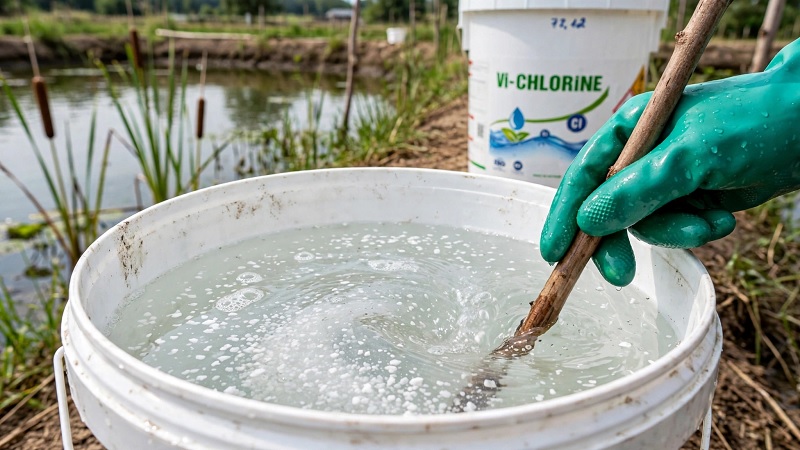
- Dissolve the sodium thiosulfate. Mix it in a bucket of clean water until fully dissolved.
- Apply evenly. Spread the solution across the surface from a boat or along the dikes, then keep paddlewheels running.
- Wait 15 to 30 minutes, then retest. Sample from the same locations. If chlorine remains, add a small additional dose and repeat.
- Confirm with a bioassay. Keep a few healthy post-larvae in the pond water for 24 to 48 hours before stocking the full pond.
What if ammonia is present?
If the pond contains ammonia, chlorine can form chloramines, which are more stable and last longer than free chlorine. This is why testing total chlorine matters. Chloramines can still be neutralized with thiosulfate, but they may need more time and a higher dose, so test carefully and repeat if necessary.
How to Test That Chlorine Is Gone From Pond Water Before Stocking
Never rely on time alone. Weather, temperature, and water quality change how fast chlorine disappears. A reliable check combines three tools:
- A chlorine test kit. DPD kits give accurate readings, and OTO kits are common on farms for a quick check. The target is zero total chlorine.
- Multiple sampling points. Chlorine can linger in dead zones with poor circulation.
- A live bioassay. A hapa net or bucket with a few post-larvae is the final proof that the water is safe.
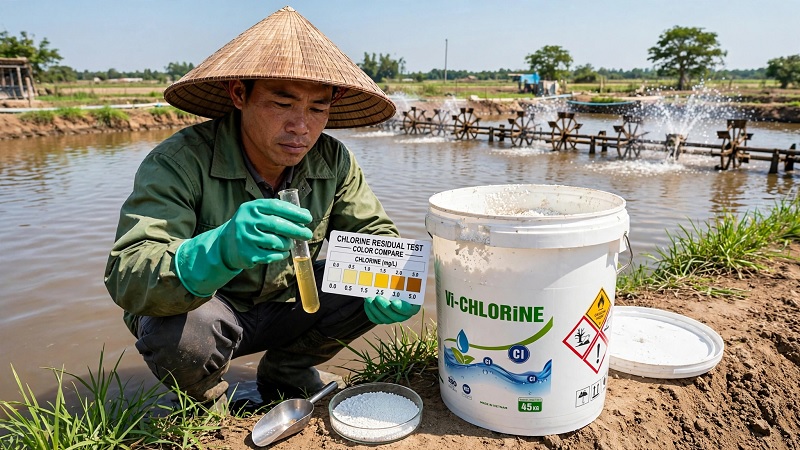
Farmer testing residual chlorine in pond water with a test kit before stocking
After the chlorine test reads zero, you can stabilize the water: check pH (around 7.5 to 8.5), dissolved oxygen (5 mg/L or higher), and alkalinity (100 to 150 mg/L) for Litopenaeus vannamei, then fertilize to build a healthy plankton bloom before stocking.
Common Mistakes When Neutralizing Chlorine in Pond Water
- Adding thiosulfate too early. It cancels the disinfection before pathogens are killed.
- Skipping the test. Dosing by guess leads either to leftover chlorine or wasted chemical.
- Poor mixing. Without strong aeration, some areas stay untreated.
- Testing only free chlorine. Chloramines can hide from a free chlorine test.
- Ignoring product form. Pentahydrate and anhydrous thiosulfate are not interchangeable at the same weight.
- Stocking right after the test. Always allow a short stabilization period and run a bioassay.
Safe Chlorine Management and Pond Biosecurity
Neutralizing chlorine is one part of a complete biosecurity routine. Dry the pond, remove sludge, filter all incoming water, disinfect with the correct dose, and neutralize and test before stocking. Wear gloves, goggles, and a mask whenever you handle chlorine or thiosulfate, and keep chemicals stored separately.
Disinfection works best as part of a whole-farm strategy. A good example is described in AQUADELTA - Dr.Tom Accompanies Vietshrimp: Vi-CHLORiNE Solution Enhancing Biosecurity in Aquaculture, which shows how disinfection supports healthier crops.
Planning Your Chlorine and Sodium Thiosulfate Supply
Large farms prepare many ponds in the same window, so plan both products together. Calculate total pond volume, decide your chlorine dose, estimate the likely residual, and order enough sodium thiosulfate for a small margin of error. For multi-pond operations, Vi chlorine 45kg packs reduce the number of bags to handle, while a consistent 70% active chlorine content keeps your dose calculations reliable from one pond to the next.
Conclusion: Neutralize Chlorine in Pond Water Before You Stock
The sequence is simple but must be followed in order: disinfect, wait for the contact period, aerate, test, neutralize with sodium thiosulfate if needed, retest until chlorine reads zero, and confirm with a bioassay. This protects your post-larvae and gives them the cleanest possible start.
Need Calcium Hypochlorite 70% for Your Pond Preparation?
Get a quote, product specifications, and export support from our team. Available 24/7 on WhatsApp: (+84) 981 370 389 or email telesales@vi-chlorine.com.
Request a Quote NowFAQ: Shrimp Pond Preparation and Chlorine Neutralization
1. Why is neutralizing chlorine important in shrimp pond preparation?
Residual chlorine is toxic to post-larvae, damages gills, and kills the plankton that stabilizes pond water. Neutralizing and testing chlorine before stocking is the final safety step of shrimp pond preparation, and skipping it can cause mass mortality within days.
2. How long does chlorine take to disappear from a shrimp pond?
With strong aeration and sunshine, chlorine commonly takes about five to seven days to dissipate after a 24 to 48 hour contact period. Cloudy weather, cool water, and high doses can extend that time, so always confirm with a test kit.
3. How much sodium thiosulfate do I need to neutralize chlorine in a shrimp pond?
It depends on the measured residual. Many references start at roughly 1.8 mg of sodium thiosulfate per 1 mg of chlorine, with some ratios as high as 7 mg, so start low, retest after 15 to 30 minutes, and add small amounts until the test reads zero.
4. Can I stock shrimp right after adding sodium thiosulfate?
No. After mixing, retest until total chlorine reads zero, then run a 24 to 48 hour bioassay with a few post-larvae. This confirms that the pond water is safe before you stock the whole pond.
5. How do I know all chlorine is gone before stocking?
Use a DPD or OTO test kit at several points and depths in the pond, aiming for zero total chlorine, and then verify with a live bioassay. Combining both methods gives the most reliable result in shrimp pond preparation.