
Is Sodium Hypochlorite the Same as Chlorine? Key Differences
- NEWS
- Q&A Chlorine
- 17/10/2026
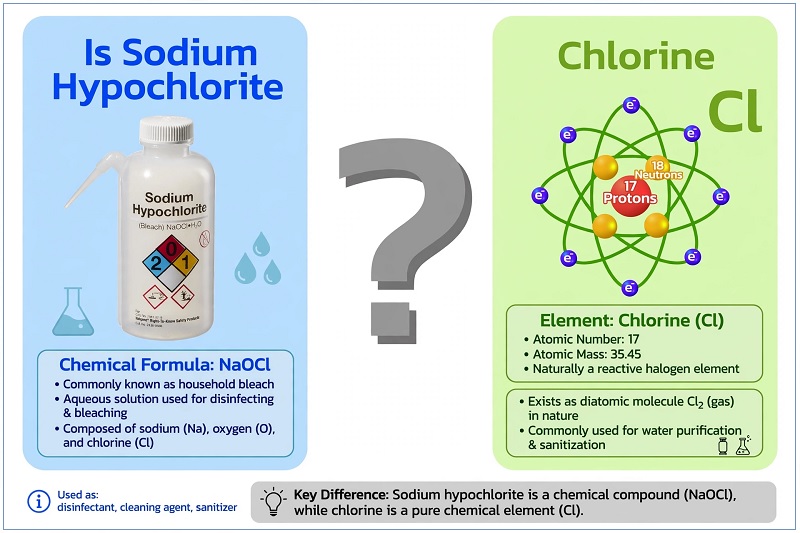
Short answer: no. Chlorine is an element (Cl₂ as a gas), while sodium hypochlorite (NaOCl) is a chemical compound that releases chlorine-based disinfectants in water. This guide explains how they differ, when each one is used, and which chlorine form works best for shrimp pond preparation.
Is Sodium Hypochlorite the Same as Chlorine?
Sodium hypochlorite is not the same as chlorine, but the two are closely related. Chlorine is a chemical element and, in its pure form, a toxic yellow-green gas. Sodium hypochlorite is a salt made by dissolving chlorine gas in a sodium hydroxide solution. When sodium hypochlorite is added to water, it forms hypochlorous acid (HOCl) and hypochlorite ions (OCl⁻), which are the active disinfecting agents known as "free chlorine."
That is why people often use the words interchangeably. A bottle of household bleach, a swimming pool "liquid chlorine" jug, and a bag of chlorine granules all disinfect through the same active species. But they differ in strength, stability, handling risks, and the by-products they leave behind. Understanding those differences matters for water treatment, and it matters even more in aquaculture, where one wrong choice can affect an entire crop cycle.
What Is Chlorine? The Element and the Disinfectant
Chlorine (symbol Cl, atomic number 17) is a halogen element. As a gas (Cl₂), it was one of the first large-scale water disinfectants and is still used by municipal water plants. Pure chlorine gas is dangerous to store and transport, so most users never handle it directly.
In everyday language, "chlorine" usually refers to any product that releases free chlorine in water. The most common forms are:
- Chlorine gas (Cl₂): used in large municipal plants under strict controls.
- Sodium hypochlorite (NaOCl): liquid bleach, typically 5–15% available chlorine.
- Calcium hypochlorite (Ca(OCl)₂): solid granules or tablets with a high available chlorine content.
- Chlorinated isocyanurates (e.g., trichlor, dichlor): stabilized solids common in swimming pools.
So "chlorine" is the broad category, and sodium hypochlorite is one member of it.
What Is Sodium Hypochlorite and How Does It Work?
Sodium hypochlorite is a pale yellow liquid with a distinctive chlorine smell. It is the active ingredient in household bleach and is widely used to disinfect surfaces, treat drinking water, sanitize pools, and bleach textiles.
When it enters water, it establishes an equilibrium between hypochlorous acid and hypochlorite ion. Hypochlorous acid is the stronger disinfectant: it penetrates the cell walls of bacteria, viruses, and algae, and oxidizes their internal structures. The ratio between the two forms depends on pH. Lower pH favors hypochlorous acid, which is why pH control is critical for effective disinfection.
Sodium hypochlorite has real advantages: it is easy to dose, dissolves instantly, and is inexpensive in small volumes. Its drawbacks are equally important:
- It is bulky because it is mostly water, which raises transport and storage costs.
- It degrades with heat, sunlight, and time, so its strength drops during storage.
- It is corrosive and can raise the pH of treated water.
Sodium Hypochlorite vs Chlorine: Key Differences
| Feature | Chlorine (Cl₂ gas) | Sodium hypochlorite (NaOCl) | Calcium hypochlorite (granular) |
|---|---|---|---|
| Physical form | Gas | Liquid | Solid granules/tablets |
| Available chlorine | ~100% | 5–15% | ~65–70% |
| Storage stability | High, in pressurized cylinders | Low; degrades over time | High when kept cool and dry |
| Handling risk | Very high | Moderate (corrosive) | Moderate (oxidizer) |
| Transport cost per unit of chlorine | Low but regulated | High | Low |
| Typical use | Municipal water | Bleach, small pools, household use | Pools, aquaculture, large-scale disinfection |
In short, sodium hypochlorite is a convenient liquid form of chlorine, but it is not chemically identical to elemental chlorine, and it is not always the most practical form for large water volumes.
Why Chlorine Form Matters for Shrimp Pond Preparation
In shrimp farming, pond preparation is the foundation of biosecurity. Before stocking, farmers must eliminate pathogens such as Vibrio bacteria, remove carriers like crabs and wild fish, and reduce organic matter that shelters disease. Chlorine disinfection of the water and sometimes the pond bottom is one of the most trusted steps.
Here is where the form of chlorine becomes a practical decision. A farm with several hectares of ponds may need hundreds of kilograms of active chlorine per cycle. Liquid sodium hypochlorite would mean moving and storing enormous volumes of product that is mostly water, and its strength could drop before it is even used. Solid, high-strength chlorine is far easier to store, weigh, and dose accurately in the field.
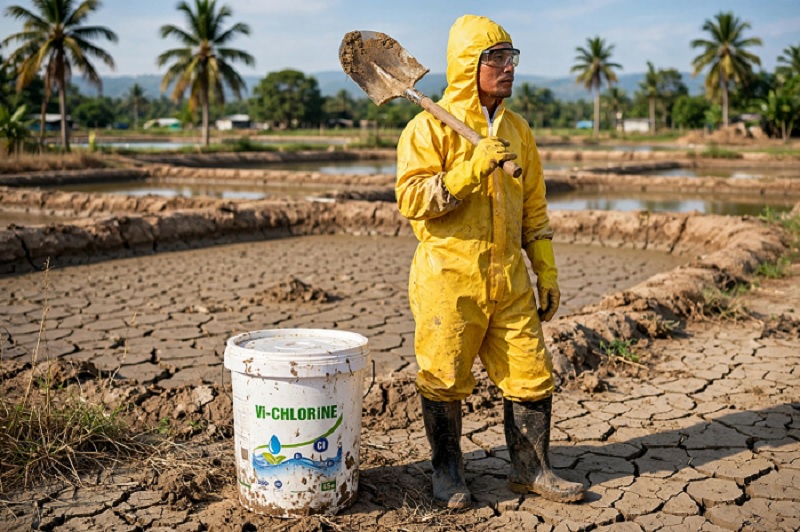
This is the reason many Vietnamese and Southeast Asian farms rely on concentrated granular products. Vi chlorine was developed for exactly this environment: a stable, high-strength chlorine disinfectant that fits the real conditions of intensive and semi-intensive shrimp ponds, including hot climates, remote farm sites, and tight pre-stocking schedules.
How to Use Chlorine in Shrimp Pond Preparation: Step by Step
Whatever chlorine product you use, the process follows the same logic. Always follow the product label and local regulations, and adjust for your water quality.
- Drain, dry, and clean the pond. Remove sludge and organic waste. Chlorine is consumed by organic matter, so dirty ponds need much higher doses and still disinfect poorly.
- Fill and filter the water. Use fine mesh filters at the inlet to keep out eggs and larvae of wild fish and crustaceans.
- Test water quality. Check pH, salinity, turbidity, and organic load. Disinfection works best at neutral to slightly acidic pH, because more hypochlorous acid is present.
- Dissolve and apply the chlorine. Pre-dissolve granules in a clean plastic container with pond water and spread evenly across the surface. Common practice targets roughly 15–30 ppm of available chlorine, depending on water conditions and product guidance.
- Aerate and mix. Run aerators so the disinfectant reaches every corner of the pond.
- Wait for the contact time. Typically 24 to 48 hours, then allow residual chlorine to break down using aeration and sunlight.
- Test for residual chlorine. Never stock postlarvae until test kits confirm that chlorine is at zero. Some farms neutralize the remainder with sodium thiosulfate.
- Condition the water. Rebuild beneficial microbes, add minerals, and stabilize the algae and plankton balance before stocking.
Choosing Vi Chlorine 45kg or 25kg for Your Farm
The right pack size depends on pond area, water depth, and how many ponds you prepare at once. Large commercial farms usually prefer bulk packaging because it reduces handling frequency and cost per kilogram. The Vi chlorine 45kg pack suits farms that disinfect multiple ponds in a single preparation window and have storage space and trained staff.
Smaller or mid-sized operations, or farms that rotate disinfection across ponds in batches, often find the Vi chlorine 25kg pack easier to carry, measure, and store. Because chlorine loses potency when exposed to moisture, heat, and sunlight, buy only the quantity you expect to use in a reasonable period and keep opened packs tightly sealed.
Safety Rules When Handling Any Chlorine Product
All chlorine products, whether sodium hypochlorite liquid or granular solids, are strong oxidizers. Safe handling protects both workers and the environment:
- Wear gloves, goggles, a mask, and long sleeves during dissolving and application.
- Never mix chlorine with acids, ammonia, or other chemicals, since toxic gases can form.
- Store in a cool, dry, ventilated place, away from fuel, organic material, and direct sunlight.
- Dissolve chlorine in water; do not add water to large amounts of dry product.
- Do not discharge treated water until residual chlorine has fully dissipated.
What Farmers Say About Vi-CHLORiNE in Real Ponds
Theory matters, but field experience is what builds trust. In the Mekong Delta, farmers who use chlorine every cycle care most about three things: consistency from bag to bag, ease of dissolving, and predictable results in disease prevention. To see how growers in Tra Vinh describe their experience, read What Do Local Farmers Say About Vi-CHLORiNE, which collects feedback straight from the ponds.
Chlorine, Biosecurity, and the Bigger Picture for Shrimp Farming
Disinfection is only one layer of biosecurity, but it is a layer that protects every other investment: seed quality, feed, probiotics, and labor. Industry partners are increasingly promoting integrated programs that combine reservoir treatment, pond disinfection, water monitoring, and strict farm hygiene. A good example is the collaboration described in AQUADELTA - Dr.Tom Accompanies Vietshrimp: Vi-CHLORiNE Solution Enhancing Biosecurity in Aquaculture, which shows how a reliable chlorine program fits within wider biosecurity strategies.
The stakes are rising as well. With demand growing across major import markets, farms that keep survival rates high and avoid disease outbreaks will capture the most value. For a broader view of where the industry is heading, see Global Shrimp Market Outlook: A Golden Opportunity for Asia. In that environment, consistent shrimp pond preparation is not just a technical step but a competitive advantage.

Common Mistakes When Using Chlorine in Shrimp Ponds
- Skipping the cleaning step. Sludge and organic matter consume chlorine and shelter pathogens.
- Guessing the dose. Under-dosing leaves survivors; over-dosing wastes money and lengthens the wait before stocking.
- Ignoring pH. High pH lowers the proportion of hypochlorous acid and weakens disinfection.
- Stocking too early. Residual chlorine harms postlarvae. Always test first.
- Using degraded product. Old or poorly stored chlorine may have lost much of its strength.

Final Thoughts: Sodium Hypochlorite Is a Type of Chlorine, Not the Same Thing
To summarize: chlorine is the element and the broad family of disinfectants built on it, while sodium hypochlorite is one specific liquid compound in that family. Both produce free chlorine in water, but they differ in concentration, stability, cost, and handling. For household cleaning and small-scale uses, sodium hypochlorite is often ideal. For large water volumes and demanding settings like aquaculture, concentrated and stable solid chlorine usually offers better value and control.
Ready to upgrade your pond disinfection program?
Get dependable, high-strength chlorine made for aquaculture and prepare safer ponds for every crop.
Contact Us TodayFAQ: Shrimp Pond Preparation
1. Why is shrimp pond preparation so important?
Pond preparation removes pathogens, toxic gases, and organic waste before stocking. A clean, disinfected pond gives postlarvae a stable start, lowers disease risk, and improves survival and feed conversion over the whole crop.
2. How long does shrimp pond preparation take?
Most farms need about 2 to 4 weeks from draining to stocking. This covers drying, cleaning, filling, disinfection, residual chlorine breakdown, and water conditioning. Time varies with weather, pond size, and soil condition.
3. How much chlorine should I use to disinfect a shrimp pond?
Many farms target around 15–30 ppm of available chlorine, but the correct dose depends on water quality, organic load, pH, and the product's chlorine content. Always follow the manufacturer's label and local guidance, and confirm with test kits.
4. How long should I wait after chlorinating before stocking shrimp?
Wait until residual chlorine tests at zero, usually 5 to 7 days after treatment with aeration and sunlight. Stocking before that point can stress or kill postlarvae, so testing is essential.
5. Can I use household bleach (sodium hypochlorite) for shrimp pond preparation?
It is possible in very small systems, but it is rarely practical for commercial ponds. Liquid bleach is low in concentration, loses strength in storage, and requires large volumes. Concentrated granular chlorine is easier to store and dose accurately at farm scale.