
Is Chlorine in Tap Water Safe? Health Guidelines & Standards
- Internal news
- 21/08/2026
Yes, chlorine in tap water is completely safe for human consumption and daily use when maintained within regulated thresholds established by global health authorities like the EPA and WHO. Typically, municipal water systems maintain total chlorine residuals up to 4.0 milligrams per liter (mg/L), with actual delivery concentrations kept between 0.2 mg/L and 0.5 mg/L to neutralize harmful pathogens without posing health risks. Understanding these safety guidelines is essential for residential households, municipal engineers, and industrial managers utilizing high-purity oxidizers like vi chlorine to maintain crystal-clear water and absolute microbiological safety.
Water is the fundamental prerequisite for human life, yet natural aquatic sources are frequently contaminated with dangerous invisible microorganisms, including pathogenic bacteria, deadly viruses, and parasitic protozoa. For over a century, chlorination has served as the frontline defense of modern public health, virtually eradicating waterborne epidemics such as cholera, typhoid fever, and dysentery. However, despite its monumental historical contributions, consumers often look at their kitchen faucets and ask: is chlorine in tap water safe? Does long-term ingestion of chlorinated water pose hidden health risks, or is it an indispensable shield?
Evaluating the safety of tap water requires an objective look at chemical regulations, toxicological evaluations, water treatment mechanics, and advanced purification products. In this comprehensive guide, we will analyze global regulatory standards, examine how chlorine interacts with water matrices, address common health concerns, explore disinfection byproducts, and connect these scientific principles to large-scale municipal, domestic, and agricultural water management applications.
Is Chlorine in Tap Water Safe According to Global Health Standards?
To answer whether chlorine in tap water is safe, we must examine the rigorous standards established by top-tier scientific and regulatory bodies, including the World Health Organization (WHO) and the United States Environmental Protection Agency (EPA). These organizations spend decades conducting exhaustive toxicological studies, multi-generational animal testing, and epidemiological reviews to establish safe consumption limits.
According to the EPA, the Maximum Residual Disinfectant Level (MRDL) for chlorine in public drinking water systems is set at 4.0 mg/L (or 4.0 parts per million - ppm). This regulatory threshold indicates that an individual can consume water containing up to 4.0 milligrams of total chlorine per liter every single day over a 70-year lifespan without experiencing adverse non-cancer health effects. Similarly, WHO guidelines state that concentrations up to 5.0 mg/L do not result in adverse health consequences.
In actual practice, the water delivered to residential taps rarely approaches these maximum boundaries. Most municipal water treatment facilities maintain a free chlorine residual between 0.2 mg/L and 0.5 mg/L at the point of delivery. This concentration is carefully calibrated: it is strong enough to continuously destroy opportunistic pathogens and biofilms that colonize underground distribution pipes, yet low enough to prevent strong chemical tastes and odors while remaining entirely safe for human ingestion.
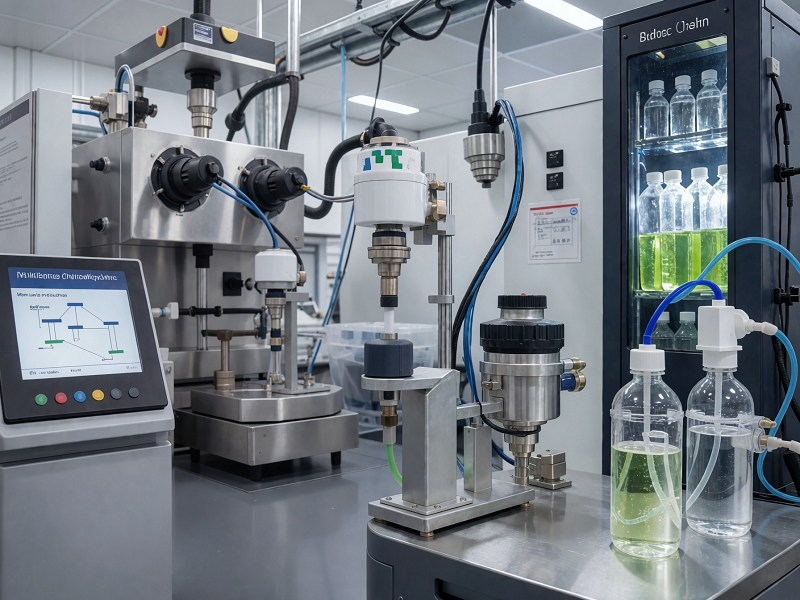
A professional water testing laboratory setting showing automated sensors and analytical equipment evaluating residual chlorine concentrations in municipal tap water.
How Tap Water Disinfection Works and Why Chlorine is Essential
To fully appreciate why chlorine is added to municipal supplies, one must understand its mechanism of action. When chlorine compounds—such as sodium hypochlorite or high-purity calcium hypochlorite—are introduced into raw water, they undergo rapid hydrolysis to form hypochlorous acid HOCl and hypochlorite ions OCl-.
Hypochlorous acid is a powerful oxidizing agent with a neutral electrical charge, allowing it to penetrate the negatively charged cell walls of bacteria, viruses, and parasites. Once inside the pathogen, HOCl aggressively attacks vital cellular enzymes and structural proteins, disrupting metabolic functions and instantly neutralizing the threat. This rapid oxidation is what ensures that water exiting a treatment plant is microbiologically sterile.
Furthermore, unlike physical treatment methods such as ultraviolet (UV) irradiation—which sterilizes pathogens on the spot but leaves no residual protection—chlorine provides a sustained chemical defense. As water travels through miles of aging municipal pipeline infrastructure toward residential homes, the remaining chlorine residual (free chlorine) acts as an active shield, destroying any new bacterial contamination that enters the network.
Addressing Safety Concerns: Disinfection Byproducts and Health Effects
While the safety of direct chlorine ingestion is well-documented, public concern often centers around secondary chemical interactions. When free chlorine reacts with natural organic matter (such as decaying leaves, humic acids, and aquatic vegetation) present in source water, it can form chemical compounds known as Disinfection Byproducts (DBPs), most notably trihalomethanes (THMs) and haloacetic acids (HAAs).
Extensive toxicological research indicates that long-term, cumulative exposure to elevated levels of certain DBPs may carry potential health risks. Consequently, modern water treatment plants employ advanced multi-stage filtration—including coagulation, sedimentation, and activated carbon filtration—to remove natural organic matter *before* chlorine is added, drastically minimizing DBP formation. Regulatory agencies enforce strict maximum contaminant levels (MCLs) for DBPs, ensuring that municipal water utilities maintain water safety across all parameters.
For residential consumers concerned about taste, odor, or residual trace compounds, simple household measures—such as letting tap water sit in an open pitcher for 24 hours to off-gas free chlorine, or utilizing activated carbon refrigerator filters—provide immediate refinement. For commercial and residential facility managers requiring reliable, high-purity chlorination without heavy insoluble residues, utilizing the Vi chlorine 25kg packaging format ensures optimal dosing precision and clean dissolution for water clarification.
Industrial and Municipal Water Applications of Chlorine
Moving beyond residential drinking water, chlorine's powerful oxidation properties are indispensable in large-scale industrial and municipal water infrastructure. Wastewater treatment plants rely heavily on robust chlorination protocols to disinfect treated effluent before releasing it back into natural rivers and coastal waters, preventing massive ecological disruption and waterborne disease transmission.
As water treatment operations scale up from municipal distribution networks to heavy industrial processing plants, chemical logistics and storage stability become critical. Upgrading to the heavy-duty vi chlorine 45kg drum guarantees that facility operators maintain an uninterrupted supply of high-concentration calcium hypochlorite ready for continuous dosing, shock sanitization, and emergency water purification workflows.
Agricultural Biosecurity and Market Perspectives on Chlorine Safety
The principles of water safety and chlorine management extend into intensive commercial sectors, most notably modern aquaculture. In high-density shrimp farming, maintaining strict biosecurity and pristine water quality is vital to preventing devastating disease outbreaks caused by aggressive pathogens such as Vibrio bacteria.
During the critical pond preparation phase, farmers rely on carefully calculated doses of calcium hypochlorite to sterilize water columns and eliminate all competing organic life before stocking delicate post-larvae shrimp. As the Asian seafood export market evolves to meet rigorous international standards, regional trade dynamics play a major role in shaping farm management practices. Industry insights into export trends and economic forecasts can be explored in the Global Shrimp Market Outlook 2025: A Golden Opportunity for Asia, which highlights how standardized water treatment protocols drive international export success.
Furthermore, major international agricultural forums—such as those featured in AQUADELTA - Dr.Tom Accompanies Vietshrimp 2025: Vi-CHLORiNE Solution Enhancing Biosecurity in Aquaculture—emphasize that utilizing reliable, high-purity chlorine formulations significantly reduces pathogen risks and optimizes disinfection workflows during pond turnaround periods.
On-the-ground validation from farming communities confirms these operational benefits. Field accounts shared by producers in key agricultural regions, detailed in What Do Local Farmers Say About Vi-CHLORiNE, illustrate how predictable chemical performance safeguards harvests, stabilizes water parameters, and improves survival rates across intensive production cycles.
Frequently Asked Questions (FAQ) About Chlorine in Tap Water Safety
Q1: Is chlorine in tap water safe to drink every day?
A: Yes. Municipal tap water containing chlorine levels at or below the EPA limit of 4.0 mg/L (ppm) is thoroughly tested and completely safe for lifelong daily consumption.
Q2: What is the ideal chlorine residual level in residential tap water?
A: Most municipal water distribution systems maintain a free chlorine residual between 0.2 mg/L and 0.5 mg/L at the consumer's tap to ensure continuous protection against bacterial growth in pipes.
Q3: Can chlorine in tap water cause skin irritation or health problems?
A: Standard drinking water chlorine levels do not cause health problems. However, individuals with extreme skin sensitivities may experience dryness, which can be easily managed with carbon shower filters and moisturizers.
Q4: How can I remove the taste and odor of chlorine from my drinking water?
A: You can eliminate chlorine taste and odor by storing tap water in an open pitcher in the refrigerator for 24 hours to allow natural off-gassing, or by using an activated carbon filter.
Q5: Do water treatment plants monitor chlorine levels continuously?
A: Yes. Modern water treatment facilities utilize automated online sensors, colorimetric test kits, and laboratory analyses to monitor free and total chlorine levels in real-time, ensuring strict regulatory compliance.
Need Expert Guidance on Water Treatment and Disinfection?
Optimize your water management protocols with professional chemical solutions and expert technical support tailored to your facility's exact requirements. Contact our technical team today!
Contact Our Experts Today