
How to Reduce pH in Shrimp Farming: 8 Safe Methods
- NEWS
- Q&A Chlorine
- 18/09/2026
pH is one of the most important water-quality parameters in shrimp farming. It affects shrimp physiology, microbial activity, mineral availability, pond productivity, and the toxicity of other compounds in the water.
A high pH reading is therefore not just a number to correct. It is often a signal that something in the pond ecosystem has changed.
One of the most common examples is excessive phytoplankton growth. During daylight, algae consume carbon dioxide through photosynthesis. As carbon dioxide decreases, pond pH rises. At night, respiration produces carbon dioxide again and pH falls.
This natural daily cycle means that farmers should not try to reduce pH based on one afternoon measurement alone. The first step is to measure pH consistently and understand the cause of the increase.
How to Reduce pH in Shrimp Farming Safely
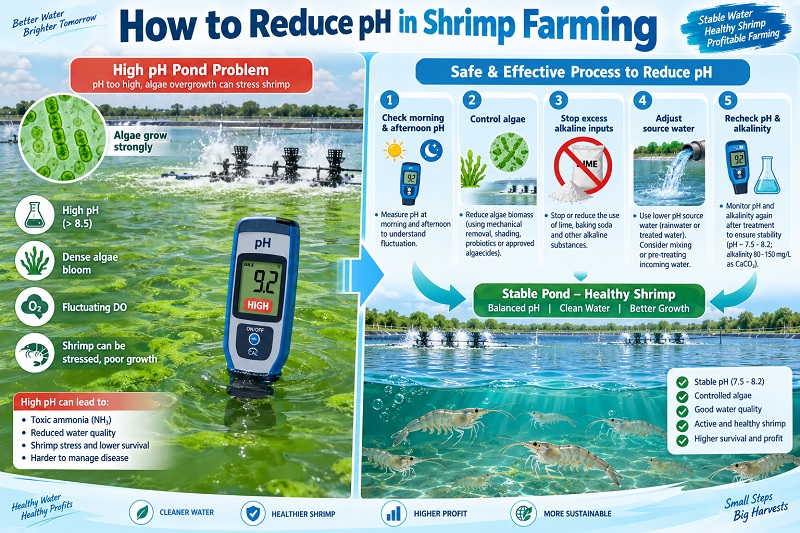
When shrimp-pond pH is consistently too high, management should focus on gradual correction rather than an aggressive chemical response.
A practical sequence is:
- Measure pH in the early morning and late afternoon.
- Check alkalinity and source-water pH.
- Evaluate algae density and water color.
- Review recent lime, mineral, or alkaline-product applications.
- Check feeding and organic loading.
- Stop unnecessary alkaline inputs.
- Control excessive phytoplankton gradually.
- Use appropriately treated replacement water when suitable.
- Continue monitoring shrimp behavior, dissolved oxygen, ammonia, and pH.
The objective is not simply to force the pH downward. The objective is to bring the pond back into a stable biological and chemical condition.
For farms developing broader water-treatment and pond-biosecurity programs, information about vi chlorine can provide additional context on chlorine-based water-management applications. Chlorine products, however, should not be treated as routine pH-lowering chemicals.
What Is a Suitable pH for Shrimp Farming?
Shrimp generally perform best when pH remains within a stable, species-appropriate range rather than fluctuating sharply throughout the day.
Many shrimp-farming systems are managed around a slightly alkaline environment, often approximately pH 7.5–8.5, although the appropriate operating range depends on species, life stage, salinity, alkalinity, farm design, and local technical recommendations.
Stability is particularly important.
A pond that moves from pH 7.7 in the morning to 8.8 in the afternoon may deserve more attention than a pond remaining relatively stable around pH 8.2.
| Observation | Possible Interpretation | Management Focus |
|---|---|---|
| High afternoon pH | Strong photosynthesis | Check phytoplankton density |
| High pH morning and afternoon | High alkalinity or alkaline inputs may contribute | Review water chemistry and pond inputs |
| Large daily pH swing | Unstable pond ecology | Improve plankton and organic-load management |
| Sudden pH rise after treatment | Possible over-application of alkaline material | Stop additional dosing and monitor |
Why Does pH Become Too High in Shrimp Farming?
Before deciding how to lower pH, identify the most likely cause. Several mechanisms can increase pond pH.
Excessive phytoplankton growth
This is one of the most common reasons for high afternoon pH.
During photosynthesis, algae and phytoplankton remove carbon dioxide from the water. Carbon dioxide is linked to the carbonate-bicarbonate equilibrium that influences pH. When substantial CO2 is removed, pH can rise.
Dense algal blooms therefore commonly produce higher afternoon pH and larger day-night fluctuations.
High alkalinity
Alkalinity describes the water's capacity to neutralize acids and is largely associated with bicarbonate, carbonate, and related compounds.
Alkalinity itself is not the same as pH, but the two are closely related. Water with substantial buffering capacity may resist attempts to change pH.
Excessive liming
Agricultural limestone and other alkaline materials are useful in appropriate situations, but unnecessary or excessive application can contribute to elevated pH depending on the product and pond chemistry.
High-pH source water
If incoming water already has high pH or high alkalinity, repeated water exchange can maintain or worsen the problem.
Imbalance in pond productivity
Feed input, nutrient availability, phytoplankton growth, bacterial activity, aeration, and sludge accumulation interact continuously. A pH problem can therefore reflect a broader imbalance rather than a single chemical deficiency.
How Algae Affect pH in Shrimp Farming
Understanding the relationship between algae and pH is essential for managing shrimp ponds.
During the day:
Photosynthesis consumes CO2 → carbon dioxide decreases → pH tends to rise.
During the night:
Respiration produces CO2 → carbon dioxide increases → pH tends to fall.
This explains why pond pH is often lowest around early morning and highest in late afternoon.
A moderate daily cycle is normal. A very large swing can indicate excessive biological activity or insufficient buffering.
Farmers should therefore record both morning and afternoon pH rather than comparing measurements taken at different times on different days.
How to Reduce High pH Caused by Excessive Algae in Shrimp Ponds
If dense phytoplankton is responsible for high pH, the goal should be to restore balance gradually.
Start by reviewing nutrient inputs. Overfeeding increases nitrogen, phosphorus, and organic matter that can support excessive plankton growth.
Useful management measures can include:
- improving feeding accuracy;
- removing accumulated sludge;
- maintaining appropriate aeration;
- avoiding unnecessary fertilization;
- monitoring water color and transparency;
- using treated replacement water where appropriate;
- avoiding sudden destruction of a dense algal bloom.
The last point is especially important.
If a large algal population collapses suddenly, decomposition can consume dissolved oxygen and release nutrients back into the water. The resulting oxygen stress may be more dangerous to shrimp than the original high pH.
How to Reduce pH in Shrimp Farming Through Water Exchange
Partial water exchange can help in some situations, but only when replacement water has suitable chemistry and adequate biosecurity.
Before exchanging water, compare:
- pond pH;
- source-water pH;
- alkalinity;
- salinity;
- temperature;
- ammonia and nitrite;
- microbial and disease risk.
Adding water with dramatically different salinity, temperature, or pH can stress shrimp even if it lowers the pond pH.
For intensive farms, incoming water is often managed through a reservoir or treatment pond before entering the production pond. This provides greater control over water quality and biosecurity.
Where chlorine-based products are used for reservoir sanitation or incoming-water preparation, larger packaging such as vi chlorine 45kg may be evaluated according to treatment volume and product specifications. Any chlorine treatment should be completed and residual chlorine appropriately managed before treated water reaches shrimp.
How Alkalinity Affects pH Control in Shrimp Farming
pH and alkalinity should be evaluated together.
Two ponds can have the same pH but respond very differently to management because their alkalinity levels differ.
Water with low alkalinity has relatively weak buffering capacity and may experience rapid pH changes. Water with higher alkalinity generally resists rapid changes.
This is one reason why blindly adding a chemical to lower pH can be unpredictable.
Farmers should measure alkalinity before making significant water-chemistry corrections, especially when pH remains high throughout the entire day rather than only in the afternoon.
Should Acid Be Used to Reduce pH in Shrimp Farming?
Strong acids can lower pH chemically, but direct acid application to a stocked shrimp pond can be hazardous if it is not professionally designed and controlled.
Potential risks include:
- rapid pH shock;
- localized zones of very low pH;
- shrimp stress or mortality;
- changes in alkalinity;
- chemical-handling injuries;
- corrosion of equipment;
- unpredictable reactions with other chemicals.
For routine pond management, correcting the cause of high pH is generally more appropriate than attempting to force pH down rapidly with a strong acid.
If acidification is part of an engineered water-treatment process, it should be based on measured alkalinity, treatment volume, controlled dosing, mixing, monitoring, and appropriate safety procedures.
Why You Should Not Reduce Shrimp Pond pH Too Quickly
Shrimp must continually adapt to their surrounding water chemistry. Sudden pH changes can interfere with physiological processes and create additional stress.
A rapid correction may also change the toxicity and availability of other compounds in the pond.
For example, pH strongly influences ammonia chemistry. As pH increases, the proportion of unionized ammonia (NH3) generally increases. NH3 is more toxic to aquatic animals than the ionized ammonium form (NH4+).
This means a high-pH event combined with elevated total ammonia nitrogen can be particularly concerning.
Farmers should therefore monitor pH, ammonia, temperature, and shrimp behavior together.
How to Monitor pH Correctly in Shrimp Farming
Good decisions depend on good measurements.
A practical monitoring program should measure pH at consistent locations and times each day.
Useful times include:
- Early morning: near the expected daily minimum;
- Late afternoon: near the expected daily maximum.
Record the results instead of looking only at individual measurements.
A simple log can include:
| Date | Morning pH | Afternoon pH | DO | Alkalinity | Water Color | Feed Intake |
|---|---|---|---|---|---|---|
| Day 1 | Record | Record | Record | Record | Observe | Observe |
| Day 2 | Record | Record | Record | As scheduled | Observe | Observe |
Trend data can reveal whether high pH is an isolated event or part of a developing pond imbalance.
How Feed Management Helps Reduce High pH Problems in Shrimp Farming
Feed management influences almost every aspect of pond water quality.
Excess feed eventually contributes to organic matter and nutrients. These nutrients can stimulate algae and microorganisms, increasing biological instability.
Improving feed efficiency can therefore indirectly help stabilize pH.
Good practices include:
- adjusting feed to shrimp biomass;
- monitoring feeding trays or automated feeding performance;
- responding to reduced appetite;
- avoiding excessive feeding during poor water-quality conditions;
- tracking feed conversion ratio;
- removing sludge and organic waste.
Practical experiences from shrimp-production environments can also be explored through What Do Local Farmers Say About Vi-CHLORiNE.
Does Aeration Reduce pH in Shrimp Farming?
Aeration is not a simple pH-lowering treatment, and its effect on pH depends on water chemistry and biological conditions.
Its primary roles are to increase oxygen transfer, improve circulation, prevent stratification, support aerobic microorganisms, and help move waste toward collection areas.
Because aeration influences carbon dioxide exchange between water and air, it can also affect carbonate chemistry. The direction and magnitude of the pH response depend on whether the water is gaining or losing CO2.
Therefore, farmers should use aeration primarily for oxygen and pond-circulation management rather than assuming that increasing aeration will automatically reduce high pH.
How to Reduce pH Fluctuation in Shrimp Farming
Preventing extreme daily fluctuations is often more important than achieving a specific decimal value.
A stable pond can be promoted by:
- maintaining appropriate alkalinity;
- avoiding excessive phytoplankton blooms;
- managing feed efficiently;
- removing sludge;
- maintaining adequate dissolved oxygen;
- monitoring ammonia and nitrite;
- avoiding sudden chemical treatments;
- using stable, properly treated source water.
The objective is to maintain an ecosystem where shrimp, beneficial microorganisms, phytoplankton, and water chemistry remain in reasonable balance.
High pH and Ammonia Toxicity in Shrimp Farming
High pH becomes more concerning when ammonia is also elevated.
Total ammonia nitrogen exists mainly as NH4+ and NH3. The balance is influenced by pH and temperature.
As pH rises, a greater proportion can occur as toxic unionized NH3.
Therefore, when afternoon pH is unusually high, farmers should consider checking ammonia rather than treating pH as an isolated parameter.
If both are elevated, management should investigate feeding, organic loading, microbial treatment, pond bottom conditions, and overall nitrogen cycling.
Preventing High pH in Shrimp Farming
Prevention is generally easier and safer than emergency correction.
Useful preventive measures include:
- Measure morning and afternoon pH consistently.
- Track alkalinity.
- Monitor plankton density and water color.
- Avoid unnecessary liming.
- Control feed input.
- Remove accumulated sludge.
- Maintain appropriate aeration.
- Use reservoir water with known chemistry.
- Monitor ammonia and nitrite.
- Make water-quality adjustments gradually.
These measures become increasingly important as farms move toward intensive and super-intensive production. Wider developments affecting the sector are discussed in Global Shrimp Market Outlook 2025: A Golden Opportunity for Asia.
Common Mistakes When Trying to Reduce pH in Shrimp Farming
Several management mistakes can turn a manageable pH problem into a more serious water-quality event.
Reacting to one afternoon measurement
Afternoon pH is naturally higher because of photosynthesis. Compare morning and afternoon values before deciding that intervention is necessary.
Adding strong chemicals without checking alkalinity
Without understanding buffering capacity, the response can be difficult to predict.
Destroying algae too rapidly
A sudden bloom collapse can cause severe dissolved-oxygen depletion and organic loading.
Using untreated replacement water
Water exchange can introduce pathogens or create temperature and salinity shock.
Ignoring ammonia
High pH can increase the toxic fraction of ammonia, making combined monitoring essential.
Trying to achieve an exact pH number
Biological ponds naturally fluctuate. Stability and shrimp performance are generally more meaningful than chasing a fixed reading throughout the day.
Can Chlorine Reduce pH in Shrimp Farming?
Chlorine should not be used as a routine chemical for lowering pH in a stocked shrimp pond.
Chlorine-based products are primarily used for disinfection, oxidation, sanitation, incoming-water preparation, equipment treatment, and biosecurity applications.
They should not be confused with pH-control chemicals.
Where chlorine is used to prepare reservoir or source water, treatment should be completed before the water is introduced into a stocked pond, and residual chlorine should be appropriately managed.
For operations with smaller treatment volumes or different storage requirements, Vi chlorine 25kg provides another packaging format that can be evaluated according to the intended water-treatment application and product specifications.
How Water Treatment Supports Stable pH in Shrimp Farming
A well-managed reservoir can help farmers control water quality before water reaches production ponds.
Source-water preparation may include:
- sedimentation;
- filtration;
- microbial control;
- disinfection where appropriate;
- residual management;
- pH and alkalinity measurement;
- salinity adjustment;
- aeration and conditioning.
This approach provides more control than introducing untreated source water directly into a pond experiencing water-quality problems.
Vi-CHLORiNE for Shrimp Farm Water Treatment and Biosecurity
Vi-CHLORiNE provides chlorine-based products for water treatment, sanitation, microbial control, and aquaculture biosecurity according to product specifications and recommended application procedures.
In shrimp farming, chlorine-based treatment can be incorporated into water-preparation and biosecurity programs for suitable applications such as reservoir treatment, pond preparation before stocking, and sanitation of selected equipment and facilities.
It is important to distinguish these applications from pH correction. Vi-CHLORiNE should not be positioned as a direct solution for lowering high pH in a stocked shrimp pond. High pH should instead be managed by identifying its underlying cause and correcting the relevant biological or chemical imbalance.
When chlorine is used for source-water preparation, operators should consider water volume, organic load, chlorine demand, contact time, treatment objective, residual chlorine, and the condition of the water before it reaches shrimp.
More information on the role of chlorine-based biosecurity in modern aquaculture can be found in AQUADELTA - Dr.Tom Accompanies Vietshrimp 2025: Vi-CHLORiNE Solution Enhancing Biosecurity in Aquaculture.
Vi-CHLORiNE offers practical chlorine product formats for pond preparation, reservoir-water treatment, sanitation, microbial control, and selected aquaculture biosecurity applications.
Contact the Vi-CHLORiNE team for product specifications, packaging information, storage recommendations, and application guidance based on your farm's water-treatment requirements.
FAQ: How to Reduce pH in Shrimp Farming
1. How can I reduce high pH in a shrimp pond?
First identify why pH is high. Check morning and afternoon pH, alkalinity, algae density, source-water chemistry, feeding, and recent lime or mineral applications. Management may involve stopping unnecessary alkaline inputs, controlling excessive algae gradually, improving feed and sludge management, and using appropriately treated replacement water where suitable. Avoid rapid chemical correction.
2. What causes high pH in shrimp farming?
Common causes include strong phytoplankton photosynthesis, excessive algal blooms, high alkalinity, high-pH source water, and excessive use of alkaline materials. Afternoon pH is naturally higher than morning pH, so both measurements should be compared.
3. What pH is suitable for shrimp farming?
Many shrimp-production systems operate successfully in slightly alkaline water, often around pH 7.5–8.5, but the appropriate range depends on species, life stage, salinity, alkalinity, and farm conditions. Stable pH with limited daily fluctuation is particularly important.
4. Can I use acid to lower the pH of a shrimp pond?
Strong acid should not be casually added directly to a stocked pond. Poorly controlled acid addition can cause localized low-pH zones, rapid pH shock, changes in alkalinity, shrimp stress, chemical-handling hazards, and equipment corrosion. Engineered acidification requires measured water chemistry, controlled dosing, mixing, and professional safety procedures.
5. Does chlorine lower pH in shrimp farming?
Chlorine should not be used as a routine pH-lowering treatment. Chlorine-based products are primarily used for disinfection, oxidation, sanitation, and biosecurity. High pond pH should be addressed by identifying and correcting its underlying cause, such as excessive phytoplankton activity, inappropriate alkaline inputs, or source-water chemistry.
Conclusion: How to Reduce pH in Shrimp Farming Effectively
So, how to reduce pH in shrimp farming? Start by determining why the pH is high rather than immediately adding chemicals.
Measure pH in both the morning and afternoon, check alkalinity, evaluate phytoplankton density, review liming and mineral applications, monitor ammonia, and assess the chemistry of incoming water.
If excessive algae are driving afternoon pH upward, focus on nutrient, feeding, sludge, and plankton management. If alkaline inputs are responsible, stop unnecessary application. Where water exchange is appropriate, use properly treated replacement water with compatible pH, salinity, temperature, and biosecurity conditions.
Most importantly, avoid sudden pH correction. In shrimp farming, stable water quality is generally more valuable than rapidly forcing the pond toward a specific pH number. Long-term control comes from balancing phytoplankton, alkalinity, feed input, organic matter, aeration, source-water quality, and overall pond management.