
Quick Answer: The Chlorine Dosage Formula
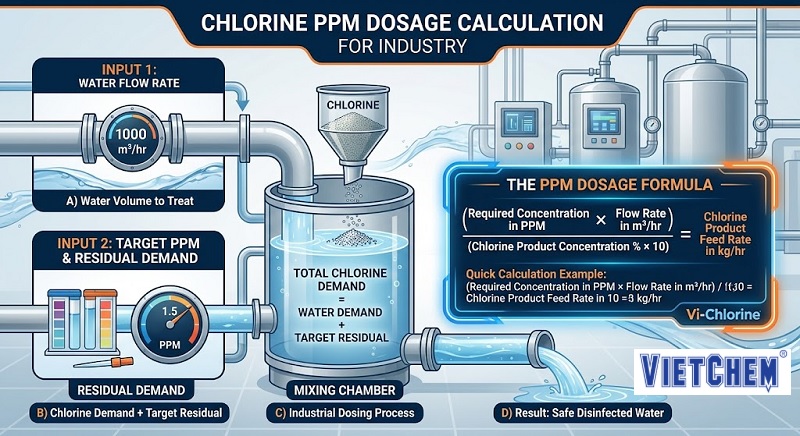
The total chlorine dosage required for industrial water treatment depends on two main factors: Chlorine Demand and the desired Target Residual.
The generalized formula to determine the amount of chemical required is:
Total Chlorine Dosage (PPM) = Chlorine Demand (PPM) + Target Residual (PPM)
Once the Total Dosage (PPM) is known, calculate the specific product feed rate (e.g., granular vi chlorine 70%) required using water volume, active concentration, and contact time. (See Section 3 for the detailed step-by-step math).
Precise chlorine dosing is not just about disinfection; it is a critical operational parameter for industrial water systems. Inaccurate calculations can lead to catastrophic microbiological outbreaks, fouled equipment, or excessive residual chlorine that corrodes infrastructure and creates toxic disinfection byproducts. Whether your application is a food processing cooling tower, a high-purity pharmaceutical loop, or process water reuse, understanding how to calculate Parts Per Million (PPM) dosage is paramount.
This comprehensive 2025 guide provides the exact mathematics and variable definitions needed to master industrial chlorination. We will analyze the core formula, variables, special considerations, and a detailed, real-world industrial case study.
Section 1: The Core Principles: Variables and Definitions
Before any math can occur, you must understand the four critical variables in the industrial chlorination equation.
| Variable | Definition and Unit | Operational Context |
|---|---|---|
| PPM (Parts Per Million) | A concentration measurement. For water, 1 PPM = 1 mg/L. | The universal unit for describing chemical dosage and residual. |
| Chlorine Demand | The amount of chlorine consumed by reacting with metals, organic matter, and microorganisms (PPM). | The most dynamic variable; must be measured *before* dosing to determine the true requirement. High organic load = High Demand. |
| Desired/Target Residual | The target concentration of *Free Available Chlorine* (FAC) remaining *after* the Demand is met (PPM). | Determined by regulatory limits, system type, and needed contact time (CT value). Cooling towers might target 0.5–1.0 PPM FAC. |
| Total Dosage (Chlorine Feed Rate) | The mathematical sum of Demand + Target Residual (PPM). | The final number that is converted into physical product mass or volume. |
Crucially, Demand is not static. If your water quality changes (e.g., during seasonal runoff in process water intake), your Chlorine Demand will spike. If you only dose for the Target Residual, all the chlorine will be consumed by the demand, leaving **zero residual** and allowing pathogens to flourish.
Section 2: The Two-Step Calculation for Industrial Applications
While the overall SGE summary provides the theoretical formula (Dosage = Demand + Residual), the true difficulty for engineers is converting that PPM number into a manageable product feed rate in an industrial system.
This is a two-step mathematical process:
Step 1: Calculate the Total Chlorine Requirement (Dosage) in PPM
Measure your water’s Chlorine Demand in a lab or via on-site titration.
Total Dosage (PPM) = Measured Demand (PPM) + Required Target Residual (PPM)
Step 2: Convert PPM Dosage into Product Mass for Your Water Volume
The mass required of your chlorine product must account for its active concentration. Industrial Calcium Hypochlorite (granular) is typically 70% active chlorine.
The generalized conversion formula is:
Pounds of Product = (Total Dosage PPM × Volume of Water in Gallons × 8.34 lbs/gallon) / (Product Concentration % × 1,000,000)
A simpler conversion for metric systems frequently used in Vietnam (where 1 mg/L = 1 g/m³):
Mass in Grams = (Total Dosage PPM × Water Volume in Cubic Meters m³) / (Product Concentration %)
Or, simplifying Product Concentration (e.g., 70% becomes 0.7):
Mass in Grams = (Total Dosage PPM × Water Volume in m³) / 0.70
This metric formula is highly efficient for operators using products like Vi chlorine 25kg buckets, allowing quick conversions from m³ to needed mass.
Section 3: Real-World Case Study: Calculating Dosing for a 500 m³ Cooling Tower
Let's apply these steps to a common industrial scenario: a large manufacturing plant cooling tower that has shown signs of bio-fouling.
Case Details:
- Total Water Volume: 500 cubic meters (m³)
- Measured Chlorine Demand: 2.5 PPM (mg/L) (measured via lab test)
- Desired Free Residual: 0.8 PPM (mg/L)
- Dosing Product: vi chlorine 45kg (70% Calcium Hypochlorite) 0
Calculation Steps:
Step 1: Determine the Total Dosage Requirement (PPM)
Dosage = Demand + Residual
Dosage = 2.5 PPM + 0.8 PPM
Total Dosage = 3.3 PPM (3.3 mg/L)
Step 2: Calculate the Product Mass Needed for 500 m³ Water Volume
Using the metric grams conversion: (PPM × m³) / 0.7
Mass (g) = (3.3 PPM × 500 m³) / 0.70
Mass (g) = 1,650 / 0.70
Mass = 2,357 Grams
Result: To achieve a safe and effective disinfection protocol that leaves a 0.8 PPM FAC residual, the operator must dose 2.36 kg of 70% granular Calcium Hypochlorite.
Section 4: Key Factor: Breakpoint Chlorination and Measurement
The mathematical result (Step 2) is only valid if you successfully cross the Breakpoint Chlorination threshold. In water containing ammonia and organics, adding chlorine initially forms chloramines (combined chlorine), which are poor disinfectants and create odors.
As you add more chlorine, it destroys these chloramines. The point where combined chlorine is minimized and further addition of chlorine results in a direct, proportional increase in *Free Available Chlorine* (FAC) is called Breakpoint. (See the upcoming diagram on Breakpoint Chlorination for a visual).
For industrial systems that reuse water or treat process water with complex organic streams, the Demand calculation (Step 1) *must* accurately predict where breakpoint will occur.
Always verify the success of your calculation by measuring Residual FAC at the *furthest* operational point in the system after the required contact time has passed. If your measured FAC is lower than your Target Residual, your initial Demand was underestimated, or your Contact Time was insufficient.
Section 5: Special Application: Industrial Aquaculture and Biosecurity
The calculations for cooling towers or intake water often differ from high-density aquaculture, where both disinfection and minimizing residual stress are critical. In the prawn industry, for instance, preparing ponds for Global Shrimp Market Outlook 2025: A Golden Opportunity for Asia requires extreme biosecurity. These calculations are specialized because they manage both organic waste load and pathogen destruction. In this context, precise dosing is fundamental. As detailed in AQUADELTA - Dr.Tom Accompanies Vietshrimp 2025: Vi-CHLORiNE Solution Enhancing Biosecurity in Aquaculture, achieving biosecurity often hinges on accurate 70% Calcium Hypochlorite dosage to secure optimal water quality.
Aquaculture demand calculations are exceptionally dynamic because they must account for fecal matter, excess feed, and fluctuating algae populations. This specialized knowledge is a core differentiator, confirming What Do Local Farmers Say About Vi-CHLORiNE regarding its reliability in complex farming water.
Conclusion: Mastery through Measurement
Calculating chlorine dosage for industrial water treatment is a simple mathematical function (Dosage = Demand + Residual), complicated only by dynamic environmental variables. Mastering it requires meticulous measurement of Demand, precise understanding of product active concentrations, and rigorous verification of the resulting residual.
By using the two-step formula provided, engineers can ensure disinfection compliance, prevent system fouling, and optimize operational costs by avoiding excessive chemical use. In the pursuit of industrial efficiency and biosecurity, the precise measurement of chlorine PPM remains an irreplaceable tool.
Maximize Your Disinfection Precision
The key to accurate dosing is dynamic measurement of demand and using a trustworthy, stable 70% product. Contact Vi-Chlorine experts today for tailored industrial dosage guides or high-purity Calcium Hypochlorite solutions.
Frequently Asked Questions (FAQ)
Q: What is a typical Chlorine Demand?
A: Demand varies drastically. Clean municipal water may have a demand <1 PPM, while untreated process reuse water in food processing may exceed 10+ PPM.
Q: Is liquid chlorine or granular chlorine easier to dose?
A: Liquid (Sodium Hypochlorite) is ready to pump but degrades rapidly, meaning its concentration—and your dosage math—changes daily. Granular (Calcium Hypochlorite) requires dissolution but is incredibly stable, keeping your math consistent over months of storage.