
How Much Chlorine in Drinking Water Is Safe? Guidelines & Standards
- Internal news
- 21/08/2026
Water is the fundamental essence of life, yet untreated natural water sources are teeming with invisible microscopic threats, including pathogenic bacteria, harmful viruses, and parasitic protozoa. To safeguard public health on a massive scale, municipal water treatment plants worldwide rely heavily on chlorine disinfection. However, a question that frequently arises among health-conscious consumers, facility operators, and water treatment engineers is: how much chlorine in drinking water is actually present, and at what point does safety transition into toxicity?
Evaluating this balance requires a deep dive into chemical guidelines, regulatory frameworks, water testing methodologies, and high-performance oxidation solutions. In this comprehensive guide, we will analyze the exact safe thresholds established by global authorities, examine how chlorine behaves in distribution pipelines, explore advanced water clarification techniques, and look at broader industrial and agricultural biosecurity practices.
How Much Chlorine in Drinking Water is Recommended by Global Health Authorities?
To answer how much chlorine in drinking water is permissible, we must turn to established international standards. The World Health Organization (WHO) and the United States Environmental Protection Agency (EPA) have spent decades conducting rigorous toxicological studies to determine safe consumption limits.
According to the EPA, the Maximum Residual Disinfectant Level Goal (MRDLG) and Maximum Residual Disinfectant Level (MRDL) for chlorine in drinking water is set at 4.0 mg/L (or 4.0 ppm). This means that water systems can legally and safely distribute water containing up to 4.0 milligrams of total chlorine per liter over a lifetime without causing adverse non-cancer health effects. Meanwhile, the WHO guidelines suggest that levels up to 5.0 mg/L do not result in any notable health risks, though most municipal distribution systems operate far below these ceilings.
In everyday reality, the water coming out of a residential tap rarely reaches 4.0 ppm. Most municipal treatment facilities aim for a residual disinfectant concentration between 0.2 mg/L and 0.5 mg/L at the point of delivery. This lower threshold is carefully calculated: it is high enough to continuously kill any opportunistic bacteria or biofilms that might colonize the miles of distribution piping between the treatment plant and your home, yet low enough to prevent unpleasant chemical tastes and odors.
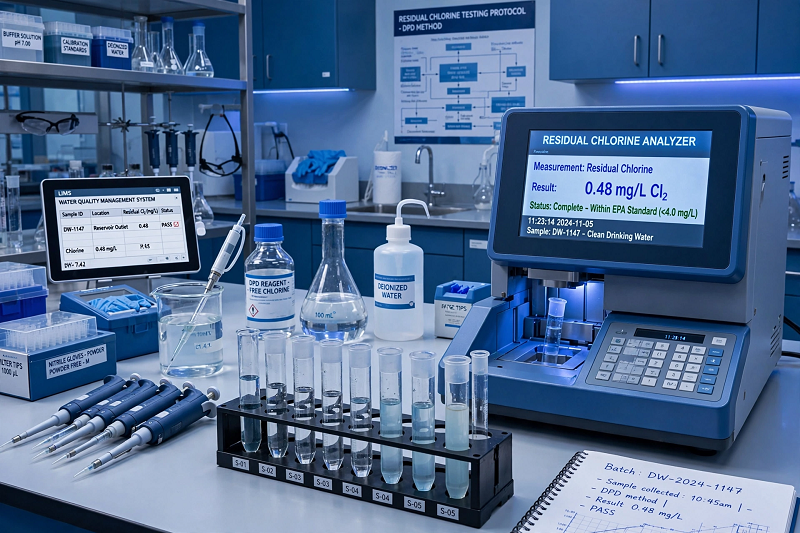
A professional water testing laboratory setting showing automated meters and cuvettes evaluating residual chlorine levels in clean drinking water samples.
Understanding Free, Combined, and Total Chlorine in Municipal Systems
When investigating how much chlorine in drinking water is active and effective, water quality experts do not just look at a single metric. They divide chlorine measurements into three distinct categories:
- Free Chlorine: This is the uncombined, active chemical fraction (hypochlorous acid and hypochlorite ions) that is fully ready to neutralize incoming pathogens. This is the true guardian of water safety.
- Combined Chlorine (Chloramines): When free chlorine reacts with organic nitrogen compounds, ammonia, or biological waste in the water, it forms chloramines. While chloramines are weaker disinfectants, they are frequently utilized in municipal water systems as secondary disinfectants because they are more stable and travel further through extensive pipe networks than free chlorine.
- Total Chlorine: The mathematical sum of both free chlorine and combined chlorine currently present in the water supply.
Managing these fractions correctly ensures water clarity and eliminates cloudy suspension particles. When water treatment systems require heavy-duty oxidation to clear up turbidity or eliminate complex organic loads before municipal distribution, operators rely on precise chemical dosing. For medium-sized storage facilities, community water tanks, or regional purification setups, utilizing the Vi chlorine 25kg packaging provides an optimal balance of high-purity calcium hypochlorite and manageable manual handling for facility personnel.
Why Chlorine is Indispensable for Safe Public Water Supplies
The introduction of continuous chlorination in the early 20th century is widely celebrated as one of the greatest public health achievements in human history. Before widespread disinfection, waterborne diseases such as cholera, typhoid fever, dysentery, and E. coli outbreaks regularly claimed millions of lives globally.
When evaluating how much chlorine in drinking water is necessary, treatment engineers calculate the "chlorine demand"—the amount of chemical required to react with all organic matter, metals, and bacteria present in raw water—plus an additional safety buffer known as the "residual." This residual guarantees that even if a pipe cracks underground or if organic debris enters a reservoir, an immediate defense barrier is already present to neutralize contaminants.
For large-scale municipal water treatment plants, industrial processing centers, and heavy-duty regional disinfection operations, securing an uninterrupted, high-capacity chemical supply is essential. Upgrading to the heavy-duty vi chlorine 45kg drum ensures that facilities have massive oxidizing power immediately available for continuous dosing and emergency water purification tasks.
Factors That Influence Chlorine Residual and Disinfection Efficiency
Simply adding a fixed amount of chemical does not guarantee that water will maintain a safe and stable profile. Several environmental and chemical variables constantly alter how chlorine behaves:
- Water Temperature: Higher water temperatures accelerate chemical reactions, causing free chlorine to dissipate much faster as it vigorously attacks organic matter. Conversely, very cold water slows down disinfection kinetics, requiring longer contact times.
- pH Levels: The pH of water dictates the ratio between highly active hypochlorous acid (HOCl) and sluggish hypochlorite ions (OCl-). Maintaining a balanced pH ensures that the available chlorine operates at peak efficiency.
- Organic Load and Turbidity: Suspended particles and organic debris shield bacteria from disinfection. Pre-filtration and clarification are vital steps before final chlorination takes place.
The principles of high-purity water treatment extend far beyond municipal drinking water into specialized agricultural and commercial sectors. In the commercial aquaculture industry, where biosecurity is critical to preventing crop-destroying diseases, maintaining precise water parameters is paramount. For instance, comprehensive market analyses detailed in the Global Shrimp Market Outlook 2025: A Golden Opportunity for Asia highlight how standardized water treatment protocols drive international export success.
Furthermore, major international agricultural forums—such as those covered in AQUADELTA - Dr.Tom Accompanies Vietshrimp 2025: Vi-CHLORiNE Solution Enhancing Biosecurity in Aquaculture—emphasize that utilizing high-grade, reliable chlorine formulations significantly reduces pathogen risks in intensive farming systems.
Practical validation from farming communities confirms these operational advantages. Field reports shared by agricultural producers in regions like the Mekong Delta, documented in What Do Local Farmers Say About Vi-CHLORiNE, illustrate how consistent chemical performance safeguards harvests, optimizes water clarity, and maximizes survival rates.
Frequently Asked Questions (FAQ) About How Much Chlorine in Drinking Water
Q1: How much chlorine in drinking water is considered safe by the EPA?
A: The EPA establishes a maximum residual disinfectant level (MRDL) of 4.0 mg/L (or 4.0 ppm) for total chlorine in public drinking water systems, which is considered safe for lifelong daily consumption.
Q2: Why does my tap water sometimes smell strongly of chlorine?
A: A strong chemical smell usually indicates the presence of chloramines (combined chlorine) or higher levels of free chlorine used during seasonal municipal shock treatments or after heavy rainfall events when source water contamination increases.
Q3: Can high levels of chlorine in drinking water cause health problems?
A: Drinking water with chlorine levels at or below the 4.0 ppm EPA limit does not cause adverse health effects. However, extremely high concentrations can cause skin irritation, digestive discomfort, and unpleasant taste or odor.
Q4: How can I remove excess chlorine from my home drinking water?
A: Excess chlorine and chloramines can be easily removed at home using activated carbon filters, reverse osmosis (RO) systems, or by simply letting a pitcher of tap water sit open in the refrigerator for a few hours to allow the chlorine gas to naturally off-gas.
Q5: How do municipal plants test how much chlorine in drinking water is present?
A: Treatment plants and health inspectors use DPD (N,N-Diethyl-p-phenylenediamine) colorimetric test kits, digital photometers, and continuous online amperometric sensors to monitor free and total chlorine levels in real-time.
Need Expert Guidance on Water Treatment and Disinfection?
Optimize your water management protocols with professional chemical solutions and expert technical support tailored to your facility's exact requirements. Contact our team today!
Contact Our Experts Today