
How Many Valence Electrons Does Chlorine Have? Chemistry & Water Treatment Guide
- Internal news
- 21/08/2026
The debate surrounding chlorine and environmental sustainability often conflates inorganic disinfectants with persistent organic pollutants. In reality, inorganic chlorine compounds like calcium hypochlorite dissociate safely into harmless chloride and calcium ions, leaving no persistent toxic residues in ecosystems. When managed responsibly through modern water treatment and high-purity solutions like vi chlorine, chlorine plays an indispensable role in safeguarding public health, preventing waterborne disease outbreaks, and supporting sustainable agricultural and industrial biosecurity without compromising ecological integrity.
When discussions of environmental sustainability arise, chemical disinfectants frequently face intense scrutiny. Among them, chlorine occupies a paradoxical position. On one hand, it is universally acknowledged as the cornerstone of modern public health, responsible for eradicating waterborne pathogens and making safe drinking water accessible to billions. On the other hand, widespread environmental myths often paint chlorine as an ecological villain, linking it indiscriminately to habitat destruction and toxic bioaccumulation.
To evaluate The Impact of Chlorine on Environmental Sustainability: Myths vs. Reality, we must separate emotional generalizations from rigorous chemical science. This comprehensive guide explores how modern water treatment technologies, green chemistry principles, and responsible manufacturing are reshaping the narrative, proving that effective disinfection and environmental stewardship can go hand in hand.
1. Deconstructing the Myths: Why Chlorine Misconceptions Persist
The most pervasive myth surrounding chlorine stems from a fundamental misunderstanding of chemical classifications. Critics often confuse elemental chlorine gas or persistent synthetic organochlorines (such as historical pesticides like DDT or industrial PCBs) with inorganic chlorine sanitizers used in water treatment, such as calcium hypochlorite.
Persistent organic pollutants are structurally complex, fat-soluble carbon-chlorine chains that resist natural degradation and accumulate in animal tissue. In stark contrast, inorganic chlorine treatments dissociate rapidly in aqueous environments. When high-purity sanitizers dissolve, they break down into simple, naturally occurring chloride ions and calcium—elements that already exist abundantly in natural water bodies and soil matrices. They do not bioaccumulate, nor do they persist indefinitely in the ecosphere.
2. The Reality of Modern Water Treatment and Ecological Protection
Far from being a threat to environmental sustainability, chlorine is actually one of its greatest enablers. Uncontrolled microbial contamination in municipal wastewater and industrial effluents can devastate local aquatic ecosystems through severe eutrophication, oxygen depletion, and massive fish kills. By neutralizing harmful bacteria, viruses, and parasites before discharge, chlorination protects natural waterways from biological overload.
Furthermore, maintaining clean water requires highly efficient oxidizing agents that do not leave behind toxic sludge. Advanced water purification facilities rely on rigorous dosing protocols and high-grade formulations to ensure that pathogenic control is achieved with minimal chemical waste. This balance ensures that human communities thrive without imposing an undue burden on surrounding aquatic habitats.
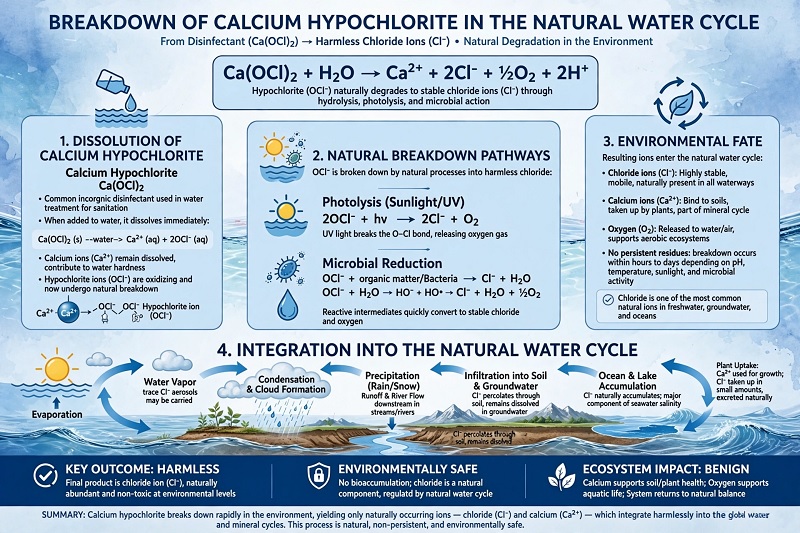
Professional diagram illustrating the breakdown of inorganic calcium hypochlorite into harmless chloride ions in a natural water cycle.
3. Industrial Efficiency and Packaging Sustainability
Environmental sustainability is not solely about chemical reactions; it also encompasses supply chain logistics, packaging efficiency, and waste reduction. Industrial chemical producers are increasingly adopting green manufacturing standards to minimize their carbon footprint during production and transport.
For facility managers and agricultural operators, selecting the right packaging volume is critical to minimizing material waste and optimizing transportation emissions. For medium-scale water treatment plants and regional operations, utilizing the Vi chlorine 25kg packaging format provides an ideal balance of substantial disinfecting volume while reducing single-use container turnover. Meanwhile, for massive municipal installations and multi-hectare industrial complexes, upgrading to the heavy-duty vi chlorine 45kg drum significantly cuts down on packaging waste per kilogram of active sanitizer deployed.
4. Sustainable Aquaculture and Biosecurity: Feeding the Future Responsibly
Nowhere is the intersection of chemical management and environmental sustainability more critical than in commercial aquaculture. As global demand for seafood surges, intensive farming operations face intense pressure to prevent disease outbreaks without contaminating surrounding coastal ecosystems.
In shrimp farming, managing viral and bacterial pathogens like Vibrio without relying on indiscriminate antibiotic use is a major milestone for ecological sustainability. Precise pond sterilization during the preparation phase ensures that pathogens are eradicated cleanly before stocking. To understand the broader economic and ecological trends driving this sector, industry stakeholders frequently analyze the insights provided in the Global Shrimp Market Outlook 2025: A Golden Opportunity for Asia.
Moreover, major international agricultural events continue to highlight how advanced biosecurity protocols protect both crop yields and environmental health. As documented during industry gatherings like AQUADELTA - Dr.Tom Accompanies Vietshrimp 2025: Vi-CHLORiNE Solution Enhancing Biosecurity in Aquaculture, modern high-purity sanitizers allow farmers to achieve maximum biosecurity with reduced chemical footprints.
On-the-ground validation of these sustainable practices comes directly from farming communities. Real-world experiences shared by producers in key agricultural regions, highlighted in What Do Local Farmers Say About Vi-CHLORiNE, demonstrate that adopting standardized, high-purity water treatment protocols prevents pond failures, conserves water resources, and secures long-term economic and environmental viability.
5. Frequently Asked Questions (FAQ)
Q1: Does chlorine accumulate in the environment like heavy metals or pesticides?
A: No. Inorganic chlorine disinfectants dissociate completely into harmless chloride and calcium ions in natural water and soil systems. They do not bioaccumulate or persist in food webs like synthetic organic pollutants.
Q2: How does modern water treatment support ecological sustainability?
A: By effectively destroying pathogens and treating wastewater before it re-enters natural waterways, chlorination prevents biological contamination, protects aquatic life from oxygen depletion, and preserves regional biodiversity.
Q3: Are high-purity chlorine products more environmentally friendly than low-grade alternatives?
A: Yes. High-purity formulations dissolve completely and leave behind minimal insoluble residue or sludge. This prevents the accumulation of particulate waste in filtration systems and natural water bodies.
Q4: Can chlorine be used sustainably in commercial aquaculture?
A: Absolutely. When used during the precise pond preparation phase and allowed to dissipate fully before stocking, chlorine eliminates disease-causing pathogens without requiring heavy antibiotic use, protecting surrounding ecosystems.
Q5: What steps are manufacturers taking to reduce the environmental footprint of chlorine packaging?
A: Industry leaders utilize robust, reusable, and recyclable high-density polyethylene (HDPE) pails and drums (such as 25kg and 45kg containers) that protect chemical integrity while minimizing single-use plastic waste.
Ready to Enhance Your Water Treatment Sustainability?
Discover how high-purity disinfection solutions can optimize your operations, ensure rigorous biosecurity, and support environmentally responsible water management. Contact our technical team today for expert guidance and tailored product recommendations.
Contact Our Experts Today