
How Many Valence Electrons Does Chlorine Have? Chemistry & Water Guide
- Q&A Chlorine
- 26/08/2026
Chlorine has exactly 7 valence electrons in its outermost energy level. With an atomic number of 17, its complete electron configuration is 2-8-7 (1s² 2s² 2p⁶ 3s² 3p⁵). Because it is only one electron shy of achieving a stable octet, chlorine is exceptionally reactive, readily accepting or sharing an electron to form powerful disinfecting and oxidizing compounds. This atomic property drives advanced water treatment solutions, such as high-purity calcium hypochlorite formulations used globally to clarify water and ensure agricultural biosecurity.
When exploring chemistry, whether for an academic examination or industrial water management, certain fundamental questions always arise. Among the most frequent inquiries from students and technicians alike is: how many valence electrons chlorine have? While it sounds like a simple textbook query, the answer holds the key to understanding why chlorine behaves the way it does, why it forms specific chemical bonds, and how it serves as one of the world's most powerful water purification agents.
In this comprehensive guide, we will break down chlorine's atomic structure, explain its electron configuration, explore the chemical mechanics of its outer shell, and connect these scientific principles to practical applications in modern water treatment. Along the way, we will examine how industry professionals leverage high-grade sanitizers—including advanced formulations of vi chlorine—to maintain crystal-clear water and safeguard large-scale aquaculture operations.
Understanding How Many Valence Electrons Chlorine Have and Its Atomic Structure
To answer how many valence electrons chlorine have, we must first examine its position on the periodic table. Chlorine is a halogen located in Group 17 and Period 3, carrying an atomic number of 17. This atomic number indicates that a neutral chlorine atom possesses 17 protons within its nucleus and precisely 17 electrons orbiting in various energy levels.
According to quantum mechanics and the Bohr model, these 17 electrons are distributed across three distinct shells:
- First Shell (Innermost): Holds a maximum capacity of 2 electrons (1s²).
- Second Shell: Accommodates 8 electrons (2s² 2p⁶).
- Third Shell (Outermost / Valence Shell): Contains the remaining 7 electrons (3s² 3p⁵).
The electrons residing in this outermost third shell are formally defined as valence electrons. Because valence electrons are positioned farthest from the attractive force of the nucleus, they dictate how the atom interacts, bonds, and reacts with other elements in its environment. Thus, knowing that chlorine has 7 valence electrons unlocks the entire framework of its chemical behavior.
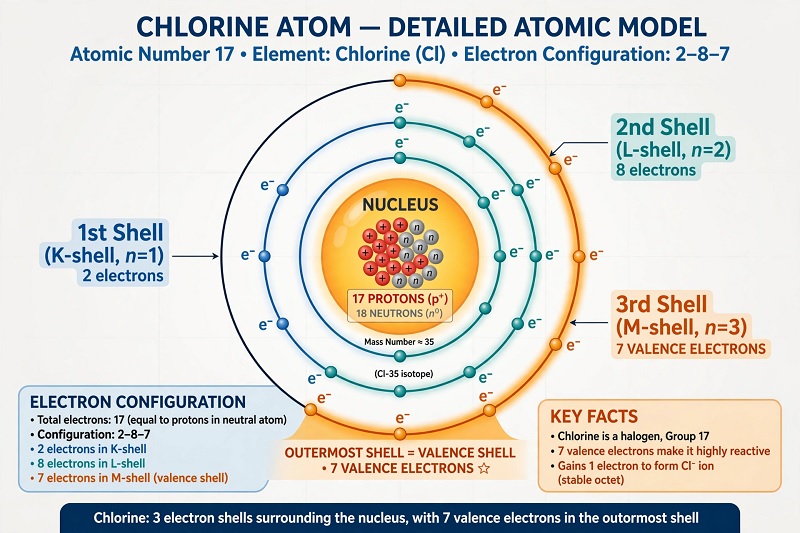
Detailed atomic model of a chlorine atom highlighting the 3 electron shells and the 7 valence electrons in the outermost ring.
Why Knowing How Many Valence Electrons Chlorine Have Explains Its High Reactivity
Understanding how many valence electrons chlorine have directly explains its legendary reactivity. In chemical science, main-group elements strive for maximum energetic stability. This drive is governed by the famous Octet Rule, which states that atoms are most stable when their valence shell is completely filled with 8 electrons, mimicking the configuration of unreactive noble gases like argon.
Because chlorine possesses 7 valence electrons, it is tantalizingly close to achieving that stable octet of 8. It lacks only a single electron to complete its outer shell. This creates a powerful thermodynamic pull characterized by high electronegativity and an aggressive electron-withdrawing tendency.
When chlorine encounters other elements—such as sodium or calcium—it readily acquires or shares an electron. By gaining that single extra electron, chlorine transforms into a negatively charged chloride ion (Cl⁻) possessing a stable, full octet. Alternatively, it can engage in covalent bonding, sharing electron pairs to form powerful sanitizing compounds like calcium hypochlorite.
Connecting How Many Valence Electrons Chlorine Have to Water Treatment with Vi-Chlorine
The electronic profile of chlorine is not merely an abstract classroom concept; it is the exact reason why chlorine is uniquely suited for water disinfection and clarification. When high-purity chlorine-based compounds are introduced into water, they undergo rapid hydrolysis, releasing active chemical agents driven by chlorine's strong oxidation potential.
These active species, primarily hypochlorous acid (HOCl), attack the cell walls and internal enzyme pathways of waterborne pathogens, bacteria, and algae, neutralizing them instantly. Furthermore, this aggressive oxidation breaks down microscopic suspended organic particles that cause cloudiness in water bodies.
For facility managers and pool operators, utilizing a refined, fast-dissolving chemical source is vital. High-grade products dissolve cleanly into the water matrix without leaving behind heavy calcium residues, ensuring that the oxidation power derived from chlorine's valence properties is fully maximized to help clarify water rapidly and safely.
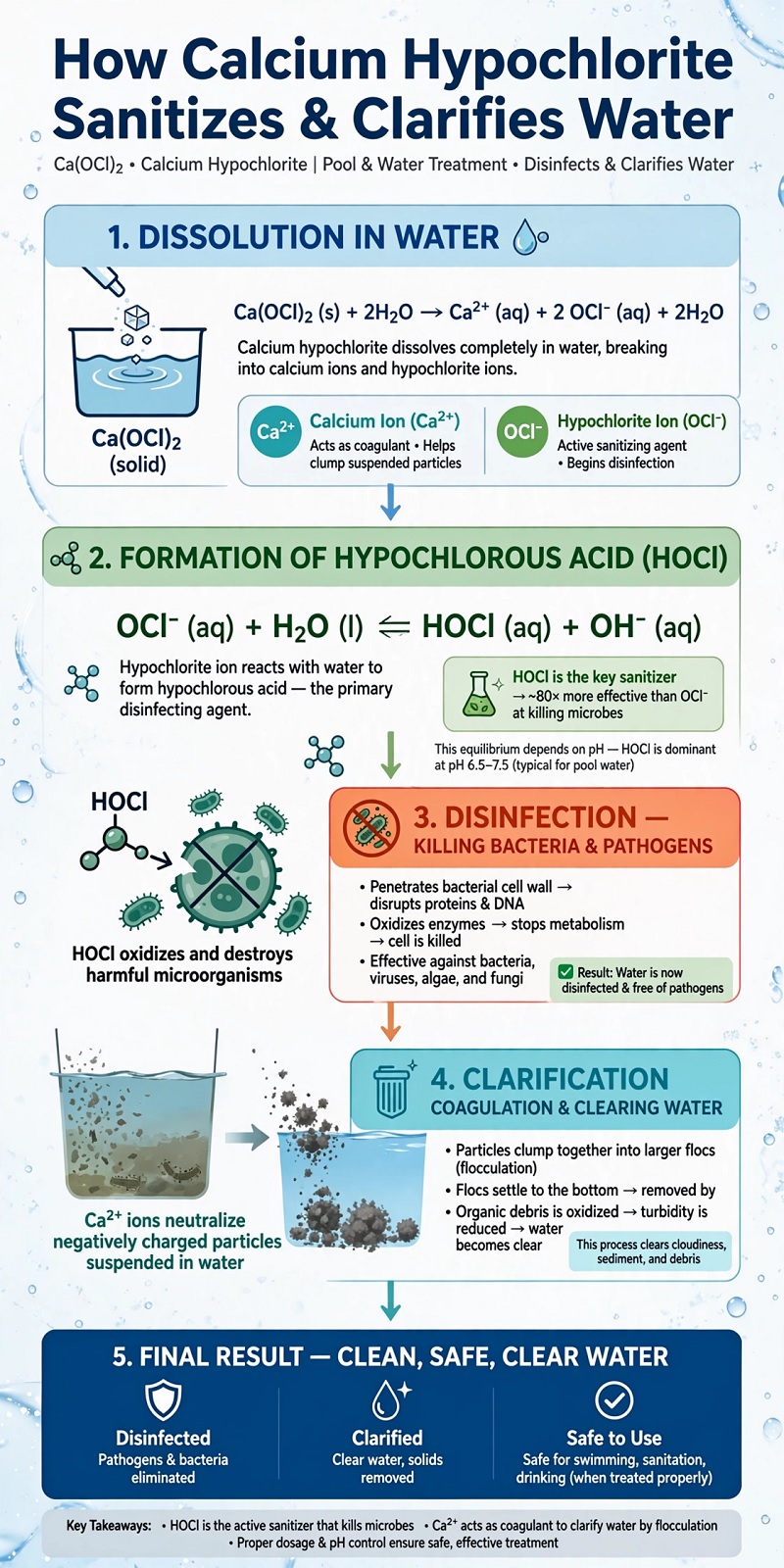
Infographic flowchart illustrating how calcium hypochlorite dissolves in water to release active sanitizing agents and clarify water.
Practical Applications: Managing Chlorine Purity and Formats like Vi Chlorine 25kg
In commercial and industrial water management, operational scale determines chemical logistics. Whether managing a municipal pool or a regional water treatment project, operators require dependable packaging that balances storage safety with ease of handling.
To support diverse operational requirements, manufacturers supply high-purity calcium hypochlorite in specialized containers:
- For medium-sized facilities, hotel pools, and seasonal aquaculture preparation, utilizing the Vi chlorine 25kg packaging provides an optimal balance of substantial disinfecting volume and ergonomic manual handling for maintenance personnel.
- For massive industrial installations, municipal wastewater plants, and large corporate shrimp farms, upgrading to the robust vi chlorine 45kg drum ensures an uninterrupted supply of heavy-duty oxidizing power for continuous dosing and emergency shock treatments.
Global Aquaculture and Market Perspectives on Chlorine Chemistry
The practical utility of chlorine chemistry extends far beyond recreational water into the high-stakes sector of commercial aquaculture. In modern shrimp farming, maintaining strict biosecurity is essential to preventing devastating disease outbreaks caused by aggressive pathogens such as Vibrio bacteria.
During the critical pond preparation phase, farmers rely on precise doses of calcium hypochlorite to sterilize water columns and pond bottoms. As the Asian seafood sector expands to meet rising international demand, standardized water treatment protocols become the cornerstone of profitability. Industry insights into regional trade dynamics can be explored in the Global Shrimp Market Outlook 2025: A Golden Opportunity for Asia, which highlights how rigorous disease prevention drives export success.
Furthermore, major international forums—such as those featured in AQUADELTA - Dr.Tom Accompanies Vietshrimp 2025: Vi-CHLORiNE Solution Enhancing Biosecurity in Aquaculture—emphasize that high-purity chlorine formulations significantly reduce operational risk parameters in intensive farming systems.
Practical feedback from agricultural communities confirms these operational benefits. Field accounts shared by producers in the Mekong Delta, detailed in What Do Local Farmers Say About Vi-CHLORiNE, illustrate how reliable chemical performance safeguards harvests, stabilizes water quality parameters, and improves survival rates.
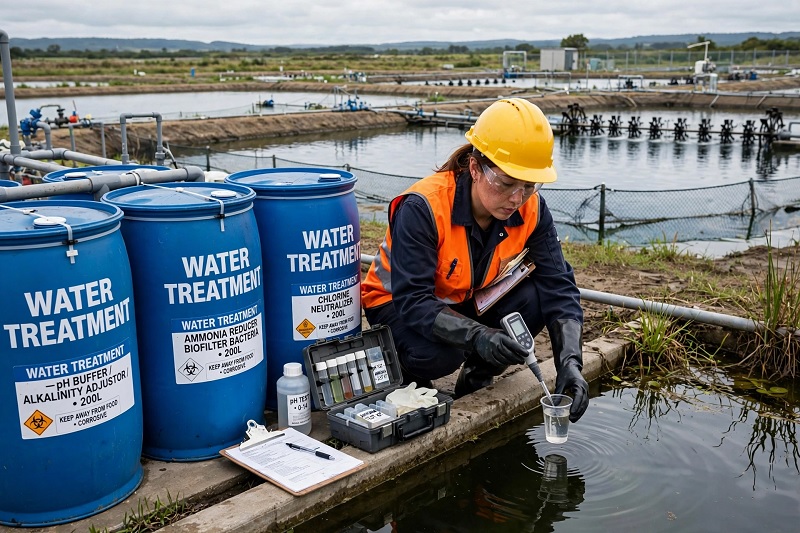
Professional photograph of an aquaculture specialist testing water parameters alongside industrial containers of water treatment chemicals.
Frequently Asked Questions on How Many Valence Electrons Chlorine Have
Chlorine has exactly 7 valence electrons located in its third and outermost energy shell (3s² 3p⁵).
Chlorine has an atomic number of 17. Following standard quantum electron shell filling rules (2, 8, 7), the first two inner shells hold 10 electrons, leaving the remaining 7 electrons in the outer valence shell.
Having 7 valence electrons means chlorine is only one electron shy of a stable octet (8). This high electronegativity makes it extremely reactive and a powerful oxidizing agent.
When chlorine gains one valence electron to achieve a full octet, it forms an ionic bond (becoming a stable chloride ion, Cl⁻), commonly found in salts like sodium chloride.
Chlorine's strong electron affinity allows it to readily form oxidizing compounds like hypochlorous acid in water, which effectively destroys bacterial cell walls and neutralizes waterborne pathogens.
Need Expert Guidance on Water Treatment and Disinfection?
Optimize your water management protocols with professional chemical solutions and expert technical support tailored to your facility's exact requirements.
Contact Our Experts Today