
How Long to Wait After Dechlorinating Water Before Adding Fish
- NEWS
- Internal news
- 09/10/2026
The right waiting time after dechlorinating water depends on the method you used, but one rule never changes: do not add fish until a test kit reads zero chlorine. This guide explains how long to wait after sodium thiosulfate, conditioners and natural dechlorination, how to confirm the water is safe, and how to introduce fish without stress.
Adding fish too early is one of the most common and most costly mistakes after disinfecting a pond, tank or water supply. Chlorine damages gills within minutes, and larvae and fry are especially sensitive. At the same time, waiting longer than necessary wastes valuable production time, which matters when the market is moving fast, as discussed in Global Shrimp Market Outlook: A Golden Opportunity for Asia.
This article answers the question directly: how long should you wait after dechlorinating the water before adding fish, and how can you be sure it is safe?
How Long to Wait After Dechlorinating Water Before Adding Fish: Quick Answer
After chemical dechlorination with sodium thiosulfate or a water conditioner, wait about 15 to 30 minutes for mixing and then confirm with a test kit that chlorine reads zero. After natural dechlorination with aeration and sunlight, ponds commonly need about five to seven days. In professional aquaculture, a 24 to 48 hour bioassay with a few animals is the final safety check before stocking the full pond or tank.
The short version is:
- Neutralize the chlorine (chemically or naturally).
- Mix and wait at least 15 to 30 minutes after any chemical is added.
- Test total chlorine at several points until the reading is zero.
- Check ammonia, pH, temperature and oxygen.
- Run a small bioassay, then acclimate and stock the fish.
Why Waiting After Dechlorination Matters for Fish Safety
Fish and larvae are far more sensitive to chlorine than people expect. Aquatic life guidelines place harmful levels at only around 0.01 to 0.02 mg/L, a concentration you cannot smell or see. Even a trace can burn gills, reduce oxygen uptake, and trigger delayed mortality that appears one or two days after stocking.
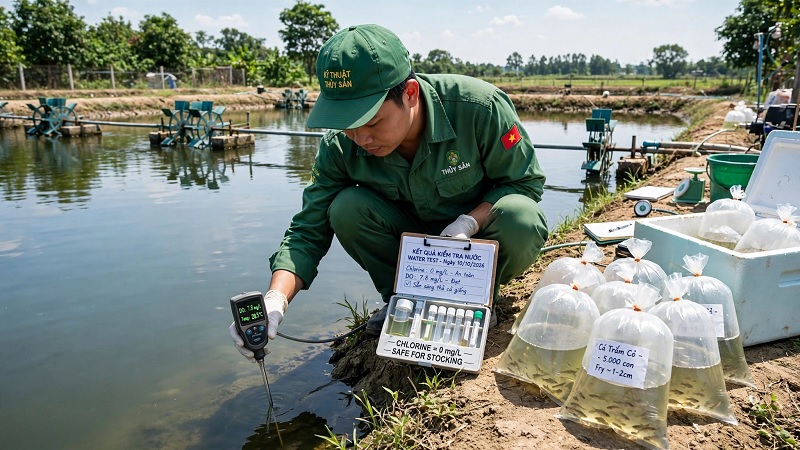
Fish pond water being tested after dechlorination before stocking fish
Waiting also gives time for the water to mix evenly. Chlorine can linger in corners, near the bottom, in pipes and in dead zones with poor circulation, so a clean reading in one spot does not prove that the whole pond is safe.
Dechlorination Waiting Time by Method and Scenario
| Scenario | Dechlorination method | Typical wait before adding fish |
|---|---|---|
| Tap water with free chlorine (small tank or aquarium) | Water conditioner | Follow the label, often minutes after mixing; test if possible |
| Tap water with chloramine | Conditioner designed for chloramine | After dosing, then check ammonia before adding fish |
| Hatchery tank after 100 to 200 ppm disinfection | Rinse, aerate, sodium thiosulfate | Until test reads zero, then about 24 hours of bioassay |
| Pond after 10 to 30 ppm chlorination | Aeration and sunlight | About 5 to 7 days, then bioassay |
| Pond after chlorination (faster schedule) | Sodium thiosulfate | Retest after 15 to 30 minutes, then 24 to 48 hours of bioassay |
How Long After Sodium Thiosulfate Can You Add Fish?
Sodium thiosulfate reacts with chlorine quickly, often within minutes once it is well mixed. This is why it is popular on tight production schedules. However, the reaction only happens where the chemical actually reaches, so you must allow enough time for mixing, and you must test afterward.
A safe routine is:
- Test first. Measure the residual chlorine so you do not guess the dose.
- Start low. Many references use roughly 1.8 mg of thiosulfate per 1 mg of chlorine as a starting ratio, and some go much higher depending on the water.
- Dissolve and spread evenly with aerators running.
- Wait 15 to 30 minutes and retest in the same places.
- Repeat in small steps if any chlorine remains.
Worked example: A pond of 12,000 m³ with 0.5 ppm residual chlorine needs about 12 × 0.9 = 10.8 kg of sodium thiosulfate at the starting ratio. Apply it, mix, wait, retest, and only add more if the test still shows chlorine.
How Long Does Natural Dechlorination Take Before Fish Can Go In?
Without chemicals, chlorine leaves water through sunlight, aeration and reactions with organic matter. For ponds, this commonly takes about five to seven days after the contact period, but the real time varies widely.
- Dose: Higher chlorine doses take longer to dissipate.
- Sunlight: Strong sun speeds breakdown; cloudy or rainy weather slows it.
- Aeration: More turbulence removes chlorine faster.
- Temperature: Warm water generally reacts faster.
- Organic load: Dirty water uses up more chlorine, which can shorten the wait but leaves more by-products.
Accurate dosing at the disinfection stage makes the waiting time easier to predict. A consistent product such as Vi Chlorine, a granular calcium hypochlorite with at least 70% active chlorine produced by Viet Tri Chemical JSC, helps you apply exactly the dose you calculated rather than an over-dose that must be cleared later.
Dechlorination Waiting Time for Ponds, Hatcheries and Tanks
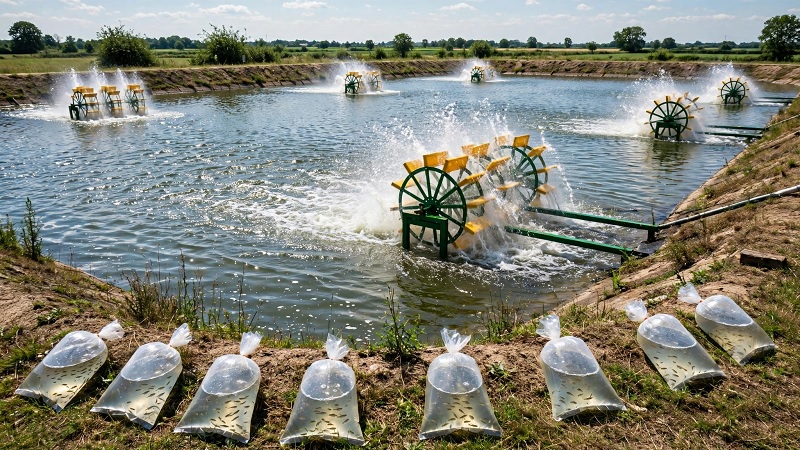
Aerators running in a pond while chlorine dissipates before stocking fish
Different systems behave differently, so plan your timeline around the system you are treating.
Grow-out ponds
A common pond schedule is a 24 to 48 hour contact period, followed by aeration and sunlight until chlorine reads zero, then one to three days of water conditioning and a bioassay. Disinfecting a 1-hectare pond holding 12,000 m³ at 20 ppm uses about 343 kg of 70% calcium hypochlorite, around 14 bags of Vi chlorine 25kg, so planning the full timeline before you start keeps the farm on schedule.
Hatchery tanks and raceways
Tanks are disinfected with stronger solutions for a shorter time, then drained, rinsed several times, and neutralized. Because volumes are small, you can retest quickly and refill in hours instead of days. A short bioassay with a few animals remains the safest final step.
Aquariums and small tanks
For tap water with free chlorine, a conditioner usually works within minutes, while standing aerated water may need about 24 hours. Remember that water treated with chloramine does not lose its chlorine by standing, so a proper conditioner is required.
How to Test That Water Is Safe Before Adding Fish
Time alone is not proof. Use these tools together:
- Chlorine test kit. A DPD kit gives accurate readings, and an OTO kit is common for quick checks. Measure total chlorine, not only free chlorine.
- Multiple sampling points. Test at the surface, mid-depth, corners and near the outlet.
- Re-test after mixing. Repeat after 15 to 30 minutes and again before stocking.
- Bioassay. Keep a few healthy fish, post-larvae or fingerlings in a hapa or bucket of the pond water for 24 to 48 hours. If they behave normally, stocking can proceed.
Water Quality Checks After Dechlorination: Ammonia, pH and Temperature
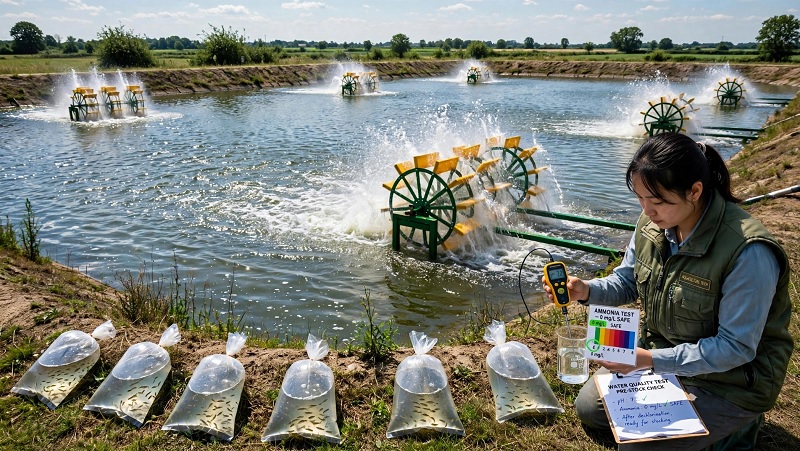
Water quality testing for ammonia and pH after dechlorination before adding fish
Dechlorinated water may be free of chlorine yet still unsuitable for fish. Check these parameters before stocking:
- Ammonia. If chloramines were present, breaking them down can release ammonia. Keep ammonia low and retest.
- pH. Aim for a stable range suitable for your species, often around 7.0 to 8.5, with small daily swings.
- Dissolved oxygen. Keep it at 5 mg/L or higher, particularly at night.
- Temperature. Match the water to the transport bags or tanks within a few degrees.
- Alkalinity and hardness. Stable buffering prevents pH crashes.
These steps are routine in well-run farms. To see how disinfection and water management are handled in real operations, you can read What Do Local Farmers Say About Vi-CHLORiNE.
How to Introduce Fish After Dechlorinating Water
- Confirm zero chlorine and a normal bioassay result.
- Acclimate gradually. Float sealed bags or mix small amounts of pond water into transport containers over 30 to 60 minutes.
- Release at the cooler hours of the day, usually early morning or evening.
- Keep aeration running and avoid feeding heavily for the first hours.
- Observe closely for the first 48 hours, watching for gasping, surface swimming or unusual mortality.
Common Mistakes After Dechlorinating Water Before Adding Fish
- Relying on the calendar only. Weather changes the dechlorination time, so always test.
- Testing only one spot. Pockets of chlorine can stay in corners and pipes.
- Adding fish right after thiosulfate without retesting.
- Ignoring chloramine. Standing water does not remove it, and ammonia may rise.
- Skipping the bioassay. It is a cheap insurance policy for an expensive crop.
- Overdosing thiosulfate. More is not better, and excess product wastes money.
Biosecurity After Dechlorination: Keeping the Water Clean
Once the water is safe, protect it. Filter incoming water, control access, disinfect tools and boots, and avoid introducing untested seed. Disinfection works best when combined with technical support and a clear protocol, as shown in AQUADELTA - Dr.Tom Accompanies Vietshrimp: Vi-CHLORiNE Solution Enhancing Biosecurity in Aquaculture.
Planning the Dechlorination Timeline for Multiple Ponds
When you prepare many ponds at once, the waiting time multiplies. Stagger your chlorination so ponds reach stocking day in sequence rather than together, and keep enough test kits, aeration and thiosulfate on hand. For example, ten 12,000 m³ ponds at 20 ppm need about 3,430 kg of product, which is about 76 bags of Vi chlorine 45kg, and ordering them early prevents delays that push back your stocking date.
Conclusion: Wait for the Test, Not Just the Clock
After dechlorinating, allow at least 15 to 30 minutes for chemical neutralization, or about five to seven days for natural dechlorination in ponds, then confirm that chlorine reads zero at several points. Check ammonia, pH, oxygen and temperature, run a bioassay, and acclimate your fish carefully. The safest rule is simple: the test result, not the timer, decides when fish go in.
Need Calcium Hypochlorite 70% for Pond and Tank Disinfection?
Get a quote, product specifications, and export support from our team. Available 24/7 on WhatsApp: (+84) 981 370 389 or email telesales@vi-chlorine.com.
Request a Quote NowFAQ: Dechlorination and Shrimp Pond Preparation
1. How long should I wait after dechlorinating water in shrimp pond preparation?
After sodium thiosulfate, wait 15 to 30 minutes, retest, and run a 24 to 48 hour bioassay. After natural dechlorination, ponds commonly need about five to seven days with aeration and sunlight, and the final decision should always be based on a zero chlorine test.
2. Can I add fish or shrimp immediately after using sodium thiosulfate?
No. Allow time for mixing, then retest chlorine at several points. Chlorine can remain in corners and low-flow areas, so stock only after a zero reading and a successful bioassay.
3. How do I know chlorine is completely gone from my pond water?
Use a DPD or OTO chlorine test kit at different depths and locations, aiming for zero total chlorine. Confirm with a small bioassay of healthy animals kept in the water for 24 to 48 hours.
4. Does dechlorination also remove ammonia or chloramine by-products?
Not necessarily. Breaking down chloramines can release ammonia, so test ammonia after dechlorination and wait for it to fall to a safe level, which is an important step in shrimp pond preparation before stocking.
5. What should I check at the end of shrimp pond preparation before stocking?
Check residual chlorine (zero), ammonia, pH, dissolved oxygen, temperature, alkalinity and transparency, then run a bioassay. Matching pond conditions to the hatchery's water reduces stress and improves early survival.