
How Long Does Chlorine Stay in Water? Evaporation Timelines & Guide
- Internal news
- 21/08/2026
On average, free chlorine in an open container of tap water takes anywhere from 24 hours to 5 days to completely evaporate, depending heavily on surface area, ambient temperature, and sunlight exposure. In swimming pools exposed to direct UV rays, free chlorine can deplete within a few hours, whereas chloramines (combined chlorine) linger much longer. Understanding chlorine dissipation rates is critical for residential water management, aquatic hobbyists, and large-scale industries utilizing high-performance sanitizers like vi chlorine to clarify water and maintain optimal biosecurity.
Water treatment is an intricate science where timing is everything. Whether you are letting tap water sit out for a household aquarium, managing chemical dosages for a community swimming pool, or preparing a multi-acre aquaculture pond for shrimp stocking, one of the most frequently asked questions by operators and consumers alike is: how long does chlorine stay in water?
The answer is not a single fixed number. Chlorine is an exceptionally reactive chemical element that behaves dynamically based on its environment. Its lifespan in water is influenced by temperature, container geometry, sunlight intensity, and the presence of organic contaminants. In this comprehensive guide, we will break down the exact timelines of chlorine dissipation, examine the chemical forces at play, and connect these principles to professional water purification and agricultural applications.
How Long Does Chlorine Stay in Water? Core Timelines Across Different Environments
To understand how long chlorine stays in water, we must first analyze the specific setting in which the water is stored or treated. Chlorine is a volatile gas that naturally off-gases into the atmosphere over time, but the rate of this escape varies drastically:
- Open Pitchers or Glasses (Tap Water): If you fill a standard pitcher with chlorinated tap water and leave it uncovered at room temperature, it typically takes between 24 hours and 48 hours for free chlorine to reduce to undetectable levels. However, in larger volumes or deeper containers with small surface areas, complete dissipation can take up to 4 or 5 days.
- Outdoor Swimming Pools: In a swimming pool under direct sunlight, free chlorine can be consumed or degraded by ultraviolet (UV) radiation in as little as 2 to 4 hours on a hot summer day. This is why commercial and residential pools require continuous chemical dosing or stabilizers (like cyanuric acid) to protect chlorine from rapid photolysis.
- Aquaculture Ponds & Wastewater Treatment: When high concentrations of chlorine (such as 20 to 30 ppm) are introduced into agricultural ponds for heavy pathogen disinfection, it takes anywhere from 3 to 7 days of aeration, sunlight, and natural breakdown for the active residuals to drop safely below 0.5 ppm.
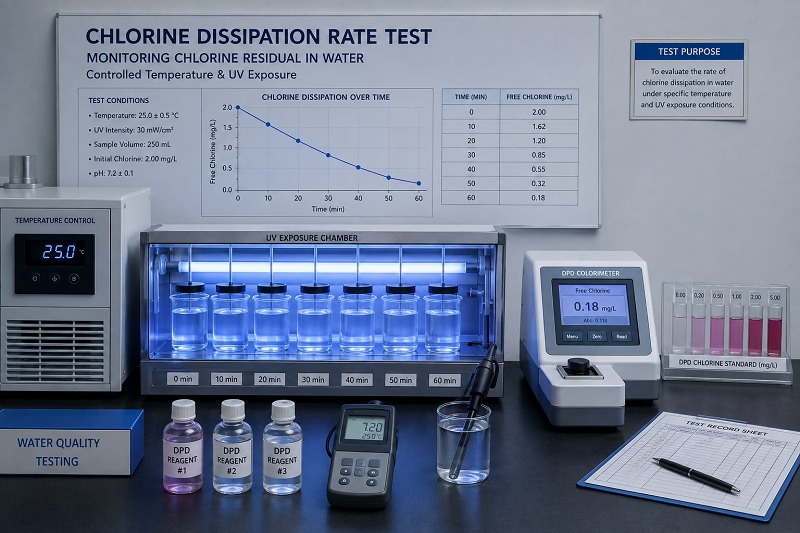
A technical laboratory setup monitoring chlorine dissipation rates in water samples under controlled temperature and UV exposure
Key Environmental Factors Affecting How Long Chlorine Stays in Water
The rate at which chlorine leaves water is governed by several core physical and chemical parameters. If you are trying to accelerate or delay chlorine dissipation, understanding these factors is essential:
- Sunlight and UV Radiation: Ultraviolet light acts as a powerful catalyst that breaks down free chlorine molecules almost instantly. Water kept in dark, sealed containers will retain its chlorine residual for weeks, while sunlit water loses it rapidly.
- Water Temperature: Thermal energy accelerates molecular movement. Warm water causes chlorine molecules to evaporate and react with organic matter much faster than cold water. Boiling water can strip out free chlorine in as little as 15 to 20 minutes.
- Surface Area-to-Volume Ratio: Because chlorine is a gas trying to escape into the air, surface area matters. A wide, shallow basin allows chlorine to dissipate much faster than a deep, narrow storage tank.
- Organic Load (Chlorine Demand): When chlorine encounters bacteria, algae, ammonia, or organic debris, it immediately reacts to oxidize them. This consumes the available chlorine, shortening its lifespan in contaminated water compared to pure, filtered water.
Free Chlorine vs. Combined Chlorine: Understanding Persistence
When investigating how long chlorine stays in water, it is vital to distinguish between different chemical states. Municipal water treatment facilities often utilize two main forms of disinfectants, each with very different longevity profiles:
Free Chlorine (hypochlorous acid and hypochlorite ions) is the active, aggressive sanitizer ready to neutralize pathogens. Because it is highly reactive, it dissipates quickly when exposed to air and organic matter. On the other hand, Combined Chlorine (chloramines, formed when free chlorine binds with ammonia or nitrogenous waste) is far more stable. Chloramines do not evaporate easily; they can linger in water systems for over a week unless actively broken down through breakpoint chlorination or removed via activated carbon filtration.
For facility managers and water treatment technicians seeking precise control over free chlorine residuals and rapid water clarification, utilizing high-grade, fast-dissolving chemicals is crucial. For medium-scale water storage tanks and regional pools, utilizing the Vi chlorine 25kg packaging provides an optimal balance of high-purity calcium hypochlorite and manageable manual handling for operational personnel.
Industrial Scaling and Management with Vi-Chlorine 45kg
As water treatment operations scale up from residential pools to municipal plants and intensive industrial facilities, chemical logistics and storage stability become paramount. Understanding chlorine longevity helps engineers schedule shock treatments and continuous dosing intervals without risking under-chlorination or excessive chemical buildup.
For massive municipal installations, large wastewater treatment plants, and multi-hectare agricultural operations, securing a steady and robust supply of high-purity oxidizing power is non-negotiable. Upgrading to the heavy-duty vi chlorine 45kg drum ensures that facility operators have an uninterrupted supply of high-concentration calcium hypochlorite ready for continuous dosing, rapid shock treatments, and emergency water purification tasks.
Aquaculture Biosecurity and Market Dynamics
The principles of chlorine dissipation take on monumental importance in commercial aquaculture, particularly in intensive shrimp farming. Before stocking a new crop, farmers must calculate precisely how long it takes for heavy chlorine doses (often 20–30 ppm) to completely dissipate so that toxic residuals do not harm fragile post-larvae shrimp.
As the Asian seafood industry evolves to meet rising global standards, regional trade dynamics play a major role in shaping farm management practices. Industry insights into export trends and economic forecasts can be explored in the Global Shrimp Market Outlook 2025: A Golden Opportunity for Asia, which highlights how rigorous water protocols drive international success.
Furthermore, major international agricultural forums—such as those featured in AQUADELTA - Dr.Tom Accompanies Vietshrimp 2025: Vi-CHLORiNE Solution Enhancing Biosecurity in Aquaculture—emphasize that utilizing reliable, high-purity chlorine formulations significantly reduces pathogen risks and optimizes dissipation windows during pond turnaround periods.
On-the-ground validation from farming communities confirms these operational benefits. Field accounts shared by producers in key agricultural regions, detailed in What Do Local Farmers Say About Vi-CHLORiNE, illustrate how predictable chemical performance safeguards harvests, stabilizes water parameters, and improves survival rates across intensive production cycles.
Frequently Asked Questions (FAQ) About How Long Chlorine Stays in Water
Q1: How long does it take for chlorine to evaporate from tap water in an open container?
A: In an open container at room temperature, free chlorine typically evaporates within 24 to 48 hours, though larger volumes can take up to 4 or 5 days depending on surface area and air circulation.
Q2: Does sunlight make chlorine disappear faster?
A: Yes. Ultraviolet (UV) radiation from the sun accelerates the breakdown of free chlorine molecules, causing swimming pools or exposed water bodies to lose their chlorine residual within hours on sunny days.
Q3: Can I speed up the removal of chlorine from water?
A: Absolutely. You can accelerate chlorine removal by boiling the water for 15 to 20 minutes, using activated carbon filters, adding neutralizing agents like vitamin C (ascorbic acid), or providing vigorous aeration.
Q4: How long does chlorine stay in water in aquaculture ponds after disinfection?
A: Following a heavy disinfection dose (20-30 ppm), chlorine typically stays active for 3 to 7 days. Farmers must test for zero residual or use sodium thiosulfate to neutralize it before stocking shrimp or fish.
Q5: Do chloramines evaporate as quickly as free chlorine?
A: No. Chloramines (combined chlorine) are much more stable and do not evaporate easily through simple standing. They can remain in water for over a week unless treated with specialized carbon filters or reducing agents.
Need Expert Guidance on Water Treatment and Disinfection?
Optimize your water management protocols with professional chemical solutions and expert technical support tailored to your facility's exact requirements. Contact our technical team today!
Contact Our Experts Today