
Dry Tech Pool Shock: Uses, Dosage, How to Use & Safety Guide
- Q&A Chlorine
- 11/09/2026
Swimming pool owners often search for a fast and effective way to restore water quality after heavy use, rainfall, algae growth, or a sudden loss of chlorine. This is where dry chlorine shock products can be useful.
Unlike routine sanitizer dosing, shock treatment is intended to raise the chlorine level significantly for a limited period so that the water can handle a higher contaminant load. However, not all shock products are the same, and the phrase “dry tech pool shock” can refer broadly to dry granular chlorine shock products used in pool maintenance.
Understanding the chemistry, dosage, timing, and limitations of these products is essential for safe and efficient treatment.
What Is Dry Tech Pool Shock?
Dry tech pool shock generally refers to a dry, granular chlorine shock product designed for rapid dissolution and high-intensity pool sanitation.
Depending on the specific formulation, dry pool shock may contain compounds such as calcium hypochlorite or other chlorine-releasing ingredients. These products are designed to deliver a high available chlorine concentration when added to water.
Unlike slow-dissolving chlorine tablets, which are primarily used to maintain routine sanitizer levels over time, pool shock is usually used for corrective or periodic treatment.
Typical applications include:
- Increasing free chlorine rapidly
- Controlling algae outbreaks
- Oxidizing swimmer waste
- Treating water after heavy rain
- Restoring chlorine after intensive pool use
- Helping reduce combined chlorine
- Supporting recovery from cloudy or dull water
Professional chlorine solutions are also used outside recreational swimming pools. vi chlorine supports professional water disinfection and biosecurity applications where accurate dosing, water quality, and contact conditions are essential.
How Does Dry Tech Pool Shock Work?
Dry tech pool shock works by releasing active chlorine into pool water. Once dissolved, chlorine forms disinfecting species that react with microorganisms and oxidizable contaminants.
During ordinary pool use, free chlorine is continuously consumed by:
- Sweat
- Body oils
- Sunscreen
- Cosmetics
- Dust
- Leaves
- Algae
- Rainwater contaminants
- Microorganisms
When chlorine demand becomes greater than the pool's normal sanitizer input, free chlorine levels may fall and water quality can deteriorate.
Shock treatment temporarily raises the available chlorine concentration, helping the pool respond to these contaminants more aggressively.
However, chlorine does not physically remove particles from water. That job still belongs to the filtration system.
When Should You Use Dry Tech Pool Shock?
Dry tech pool shock is most useful when pool conditions indicate that routine sanitizer dosing is no longer sufficient.
Common situations include:
After heavy swimmer use
A pool party or unusually busy swimming day can increase the amount of organic material in the water. This can rapidly consume free chlorine.
After heavy rainfall
Rain can introduce contaminants and dilute the existing water chemistry.
When algae appears
Green, yellow, or mustard-colored growth can indicate inadequate sanitation or circulation.
When chlorine levels fall too low
If testing shows very low free chlorine, corrective treatment may be necessary.
When the water becomes cloudy
Cloudiness can be associated with low sanitizer, algae, suspended solids, or poor filtration.
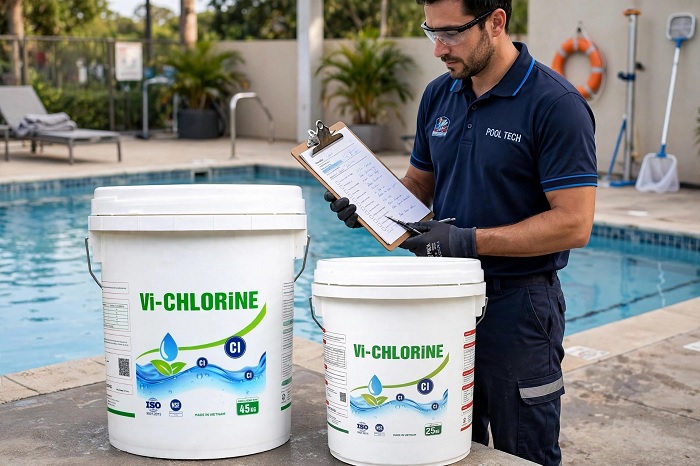
For larger professional disinfection operations, chlorine is often supplied in commercial-scale packaging. An example is vi chlorine 45kg, intended for professional water treatment rather than casual residential pool dosing.
What Is the Best Time to Add Dry Tech Pool Shock?
Dry tech pool shock is generally best applied in the evening or after direct sunlight has decreased.
The reason is simple: ultraviolet radiation can break down free chlorine in outdoor pools.
By shocking the pool in the evening, chlorine has several hours to react with contaminants before strong sunlight returns.
Benefits of evening application include:
- Reduced UV-related chlorine loss
- More effective overnight contact time
- Lower chance of swimmers entering during treatment
- More time for filtration and circulation
- Easier retesting before the next swimming period
If immediate corrective treatment is required, however, do not delay treatment simply to wait for night.
How Much Dry Tech Pool Shock Should You Use?
The correct dry tech pool shock dose depends on the exact product formulation, available chlorine content, current chlorine level, pool volume, and treatment objective.
Never dose pool shock solely by visual judgment.
Before treatment, determine:
- Pool volume
- Current free chlorine concentration
- Target treatment level
- Available chlorine percentage
- Manufacturer dosage instructions
A basic theoretical relationship is:
Required active chlorine = Pool volume × Desired chlorine increase
Because 1 ppm in water is approximately equal to 1 mg/L, a 10,000-liter pool theoretically requires 10 grams of active chlorine to increase chlorine concentration by 1 ppm.
The amount of actual product required will be greater if the product contains less than 100% available chlorine.
Actual pool conditions can also consume chlorine rapidly, so the result should always be verified by testing.
How to Use Dry Tech Pool Shock Safely
Safe use of dry tech pool shock requires proper handling and strict attention to the product label.
A general application process is:
- Test the pool water.
- Measure the actual pool volume.
- Check pH and sanitizer levels.
- Calculate the required dose.
- Wear appropriate protective equipment.
- Add the product according to the manufacturer's instructions.
- Maintain proper circulation.
- Keep swimmers out during treatment.
- Retest before allowing swimming.
Never mix dry chlorine with acids or other pool chemicals.
Do not combine different chlorine products in the same container, feeder, or scoop unless specifically permitted by the manufacturer.
Users working with chlorine in professional water-treatment applications often rely on practical operational knowledge. What Do Local Farmers Say About Vi-CHLORiNE provides real-world perspectives on chlorine-based water management and biosecurity.
Should You Pre-Dissolve Dry Tech Pool Shock?
Whether dry tech pool shock should be pre-dissolved depends entirely on the product instructions.
Some granular chlorine products may be added directly to the pool, while others may require pre-dissolution.
Never assume one method applies to every product.
Improper addition can create a highly concentrated chlorine zone that may:
- Bleach pool liners
- Damage surfaces
- Create uneven sanitizer distribution
- Increase handling risk
If pre-dissolution is specifically recommended, follow the exact order and dilution instructions provided by the manufacturer.
Does Dry Tech Pool Shock Kill Algae?
Dry tech pool shock can be very effective in controlling many algae problems when chlorine concentration is adequate and the pool is properly maintained.
However, shock treatment alone may not completely clear an algae-infested pool.
A proper algae treatment process may also require:
- Brushing pool walls and floor
- Running the filtration system
- Cleaning or backwashing the filter
- Vacuuming dead algae
- Retesting free chlorine
- Correcting pH
If the pool remains green after treatment, chlorine demand may still be high or algae may still be active.
Why Is the Water Cloudy After Using Dry Tech Pool Shock?
Cloudy water after applying dry tech pool shock does not necessarily mean the treatment failed.
Several causes are possible.
Dead algae
Once algae is killed, microscopic particles can remain suspended in the water.
Poor filtration
If the filter is dirty or undersized, the pool may stay cloudy.
High calcium hardness
Some chlorine products can contribute calcium, which may increase cloudiness when water chemistry is already out of balance.
Incorrect pH
High pH can reduce chlorine effectiveness and contribute to mineral precipitation.
Excessive chemical dosing
Adding too much product can create unnecessary water-balance problems.
In commercial water-management environments, chemical concentration and packaging selection are critical. Vi chlorine 25kg provides an alternative pack size for professional applications.
Dry Tech Pool Shock vs Chlorine Tablets
Dry tech pool shock and chlorine tablets serve different purposes.
Pool shock is usually intended for rapid corrective treatment, while chlorine tablets are normally used for gradual sanitizer maintenance.
Dry pool shock:
- Fast chlorine increase
- Useful for algae or contamination
- Often applied periodically
- Requires careful dosing
Chlorine tablets:
- Slow dissolution
- Helps maintain routine chlorine residual
- Often used with floaters or feeders
- May contain stabilizer depending on formulation
One should not automatically replace the other.
Dry Tech Pool Shock vs Liquid Chlorine
Another common comparison is dry tech pool shock versus liquid chlorine.
Both can provide active chlorine, but they differ in storage, concentration, handling, and effects on water chemistry.
Dry products are often:
- Compact
- Easy to store when kept dry
- Convenient for transport
- Stable when handled correctly
Liquid chlorine may be:
- Easy to measure
- Fast to disperse
- Useful for frequent pool dosing
- More sensitive to storage heat and age
The best option depends on the pool system, maintenance routine, product availability, and operator preference.
How Often Should You Use Dry Tech Pool Shock?
There is no universal schedule for dry tech pool shock.
Some pool owners shock periodically, while others rely more heavily on water testing and actual chlorine demand.
Factors that influence treatment frequency include:
- Swimmer load
- Outdoor temperature
- Rainfall
- Sunlight
- Algae pressure
- Filtration performance
- Free chlorine level
- Combined chlorine
- Organic contamination
Testing is more reliable than following a calendar alone.
This principle also applies in aquaculture, where water treatment must respond to actual environmental conditions. Global Shrimp Market Outlook 2025: A Golden Opportunity for Asia highlights the broader importance of efficient water management and biosecurity in modern aquaculture.
Can You Swim After Adding Dry Tech Pool Shock?
You should not swim immediately after adding dry tech pool shock.
The correct re-entry time depends on:
- Product formulation
- Dose used
- Pool volume
- Circulation
- Final free chlorine level
Do not rely only on a fixed number of hours.
The safest approach is to follow the product instructions and test the water before swimming.
Water should meet the appropriate chlorine and pH conditions for swimming.
Does Dry Tech Pool Shock Raise Calcium Hardness?
Some forms of dry tech pool shock, particularly calcium hypochlorite-based products, can contribute calcium to pool water.
This matters in areas where source water already has high calcium hardness.
Over time, excessive calcium can contribute to:
- Scale formation
- Cloudy water
- Mineral deposits
- Rough pool surfaces
Pool owners using calcium-based chlorine products regularly should monitor calcium hardness as part of routine water testing.
How to Store Dry Tech Pool Shock
Proper storage of dry tech pool shock is critical because concentrated chlorine products are strong oxidizers.
General storage principles include:
- Keep the product in its original container.
- Keep the container tightly closed.
- Store in a cool, dry, ventilated location.
- Protect from moisture.
- Keep away from acids.
- Keep away from combustible materials.
- Do not store near oils or organic chemicals.
- Keep out of reach of children.
Always refer to the Safety Data Sheet for product-specific storage requirements.
Common Mistakes When Using Dry Tech Pool Shock
Several mistakes can reduce the effectiveness of dry tech pool shock or create unnecessary risks.
Adding shock without testing
Testing should guide chlorine treatment.
Using too much product
More chlorine does not automatically mean better water quality.
Ignoring pH
Improper pH can reduce chlorine efficiency.
Mixing chlorine products
This can cause dangerous chemical reactions.
Shocking during strong sunlight unnecessarily
UV exposure can accelerate chlorine loss.
Ignoring filtration
Chlorine cannot remove dead algae or suspended debris by itself.
Allowing swimmers back too soon
Always verify water chemistry first.
Dry Tech Pool Shock Troubleshooting Guide
If dry tech pool shock does not appear to be working, follow this sequence:
- Test free chlorine.
- Check pH.
- Inspect for algae.
- Check filter pressure.
- Clean or backwash the filter.
- Brush pool surfaces.
- Vacuum settled debris.
- Check cyanuric acid.
- Check calcium hardness.
- Retest before adding more chlorine.
This systematic process helps identify whether the issue is chlorine demand, water balance, algae, filtration, or circulation.
Dry Tech Pool Shock and Professional Water Treatment
The principles behind dry tech pool shock are also relevant to professional water-treatment operations.
Effective chlorination depends on:
- Correct concentration
- Accurate water-volume calculation
- Organic load
- Contact time
- Water chemistry
- Temperature
- Circulation
- Verification through testing
In aquaculture, these principles form part of broader biosecurity strategies designed to reduce pathogen pressure and protect production systems.
Industry programs increasingly combine chlorine treatment with structured biosecurity. A practical example is AQUADELTA - Dr.Tom Accompanies Vietshrimp 2025: Vi-CHLORiNE Solution Enhancing Biosecurity in Aquaculture, which discusses chlorine-based solutions in modern aquaculture operations.
Vi-CHLORiNE as a Professional Alternative to Dry Tech Pool Shock Applications
Although consumers searching for dry tech pool shock are typically focused on swimming pool maintenance, the same chlorine chemistry has important applications in professional water treatment, sanitation, and aquaculture.
Vi-CHLORiNE provides professional chlorine solutions intended for applications where water disinfection and biosecurity are important.
Potential professional applications include:
- Water disinfection
- Aquaculture pond treatment
- Pond preparation
- Biosecurity programs
- Equipment sanitation
- Environmental disinfection
- Professional water-treatment systems
Vi-CHLORiNE is available in commercial packaging suitable for different operational requirements.
Professional users should calculate chlorine treatment based on water volume, active chlorine content, organic load, water chemistry, target concentration, and required contact time.
For residential swimming pools, use products specifically labeled for swimming pool treatment and follow the manufacturer's directions.
Explore Vi-CHLORiNE products for aquaculture, water disinfection, environmental sanitation, and professional water-treatment applications.
Explore Vi-CHLORiNEFAQ About Dry Tech Pool Shock
1. What is dry tech pool shock used for?
Dry tech pool shock is typically used to rapidly increase the chlorine concentration in pool water. It may be used after heavy swimming, rainfall, algae growth, low chlorine readings, or other situations where routine sanitation is no longer sufficient.
2. When is the best time to use dry tech pool shock?
For outdoor pools, evening or after sunset is generally the preferred time because lower UV exposure allows chlorine to remain active longer. If urgent sanitation is required, however, corrective treatment should not be delayed solely to wait for nighttime.
3. How much dry tech pool shock should I add?
The dose depends on the pool volume, current free chlorine level, target treatment level, and percentage of available chlorine in the product. Always follow the manufacturer's dosage instructions and verify the water with a chlorine test kit.
4. Why is my pool cloudy after using dry tech pool shock?
Cloudiness may result from dead algae, fine suspended particles, poor filtration, incorrect pH, high calcium hardness, or excessive chemical dosing. Test the water and inspect the filtration system before adding more chlorine.
5. How long after using dry tech pool shock can I swim?
There is no universal waiting period for every product. Re-entry depends on the treatment dose, chlorine formulation, water circulation, pool volume, and final free chlorine concentration. Follow the product label and test the water before swimming.
Conclusion: Dry tech pool shock can be an effective tool for restoring pool sanitation after heavy use, algae growth, rainfall, or declining chlorine levels. The best results come from combining accurate dosing with proper pH, strong circulation, filtration, brushing, vacuuming, and regular testing. Avoid treating shock as a substitute for routine maintenance, and never add more chlorine simply because the water does not clear immediately.
Disclaimer: This article provides general educational information. Chlorine products vary in formulation, concentration, and approved applications. Always follow the product label, Safety Data Sheet, pool equipment manufacturer's instructions, and applicable local regulations.