
Does Boiling Water Remove Chlorine? Truth, Timelines & Guide
- Internal news
- 21/08/2026
Yes, boiling water is an effective and traditional method to remove free chlorine. When municipal tap water reaches a rolling boil for approximately 15 to 20 minutes, free chlorine gas and hypochlorous acid molecules become highly volatile, converting into gas and escaping into the atmosphere. However, boiling is ineffective against chloramines (combined chlorine), which require specialized carbon filtration or chemical reducing agents. Understanding these thermal and chemical dynamics is essential for home filtration, municipal distribution management, and industrial water purification setups leveraging high-grade oxidizers like vi chlorine to rapidly clarify water and ensure absolute microbial safety.
Water treatment is a cornerstone of modern public health, ensuring that billions of people have access to safe, pathogen-free water every single day. Chlorine remains the most widely used chemical disinfectant globally due to its remarkable ability to eliminate harmful bacteria, viruses, and parasites. However, once water reaches the end user—whether in a residential kitchen, a laboratory, or a commercial aquaculture facility—the presence of residual chlorine can become undesirable. It can impart an unpleasant chemical taste and odor, react negatively with sensitive aquatic life, or interfere with delicate industrial processes.
Among the myriad domestic solutions people attempt, boiling water is frequently cited. But how effective is this method really? Does boiling water remove chlorine entirely, or are there hidden limitations that consumers and facility operators need to know? In this comprehensive guide, we will analyze the thermodynamic chemistry behind thermal chlorine dissipation, differentiate between free and combined chlorine species, explore practical limitations, and connect these concepts to advanced water management and industrial disinfection strategies.
The Thermodynamics of Chlorine: How Boiling Water Drives Off Gas
To answer whether boiling water removes chlorine, we must first look at the physical state of chlorine in municipal drinking water supplies. When sodium hypochlorite or calcium hypochlorite dissolves in water, it hydrolyzes to form hypochlorous acid (HOCl) and hypochlorite ions (OCl), which together constitute "free chlorine."
Free chlorine exists in a delicate equilibrium between dissolved liquid solutes and volatile gases. Chlorine is naturally volatile, meaning it has a strong tendency to transition from a liquid phase into a gas phase. When you heat water, you increase the kinetic energy of its molecules. As thermal energy rises toward a rolling boil 100°C or 212°F, the solubility of gases in water decreases dramatically. The dissolved chlorine molecules rapidly gain energy, break their aqueous bonds, and escape into the air as chlorine gas Cl2 or related vapor species).
Scientific studies and water quality engineering guidelines demonstrate that maintaining a rolling boil for 15 to 20 minutes is sufficient to drive off virtually 100% of free chlorine from a standard volume of tap water. This makes boiling a reliable emergency method for individuals seeking chlorine-free water for specific domestic uses, sensitive house plants, or small aquarium setups.
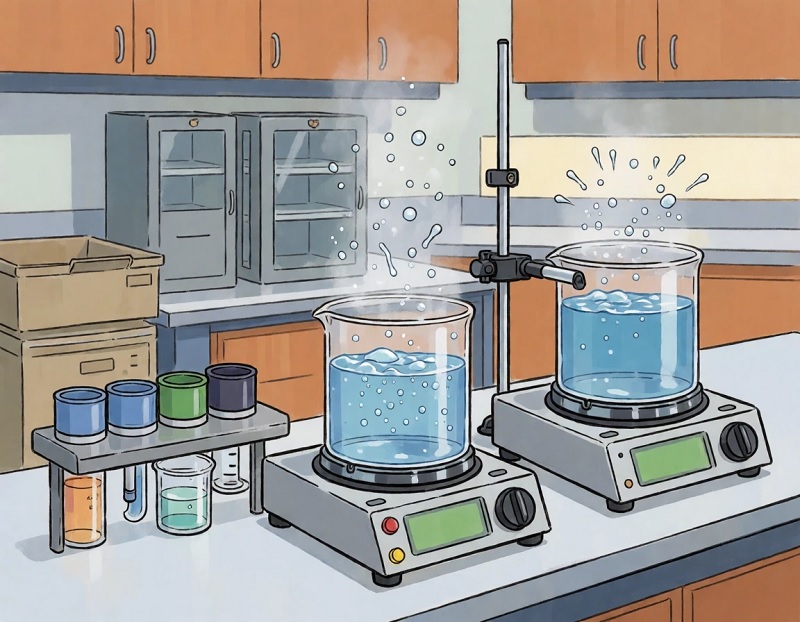
A laboratory setup illustrating thermal agitation and gas off-gassing during water boiling experiments.
Free Chlorine vs. Chloramines: Why Boiling Doesn't Always Work
While boiling is highly effective against free chlorine, a critical catch exists in modern water treatment: many municipal utilities no longer use free chlorine exclusively. Instead, they add ammonia to the water supply alongside chlorine to create chloramines, also known as combined chlorine.
Chloramines are chemically stable covalent bonds between chlorine and nitrogenous compounds. Because these bonds are significantly stronger and less volatile than free chlorine, they do not easily off-gas when heated. If your municipal tap water is treated with chloramines, simply boiling the water for 20 minutes will leave a substantial portion of the disinfectant intact. Breaking down chloramines requires prolonged boiling (often hours), intense ultraviolet irradiation, or targeted activated carbon filtration and chemical neutralization using reducing agents like sodium thiosulfate.
For facility managers, swimming pool operators, and commercial water treatment plants dealing with massive volumes of water, boiling is entirely impractical. Instead, professionals rely on precision chemical dosing to control organic loads and achieve rapid water clarification. For medium-scale water storage tanks, hospitality pools, and regional distribution networks, utilizing the Vi chlorine 25kg packaging format provides an optimal balance of high-purity calcium hypochlorite and manageable manual handling for operational personnel.
Practical Drawbacks and Risks of Boiling Water for Chlorine Removal
Although boiling successfully addresses free chlorine, relying on it as a primary dechlorination method for large-scale use introduces several notable drawbacks:
- Energy Inefficiency and Cost: Heating large volumes of water requires substantial thermal energy. Scaling this up for commercial use, manufacturing facilities, or large agricultural systems is economically prohibitive.
- The Concentration Effect: When water boils vigorously, a percentage of the liquid evaporates into steam. If you boil an open pot of water for too long, the volume of water decreases while dissolved minerals, heavy metals, and non-volatile impurities remain behind, effectively concentrating them.
- Time and Handling Hazards: Boiling, cooling, and storing large quantities of water requires dedicated time and handling equipment, increasing the risk of thermal burns and secondary microbial contamination during cooling phases.
To bypass the inefficiencies of thermal processing, industrial and municipal engineers utilize robust, high-capacity chemical oxidizers. For massive municipal water treatment plants, large-scale wastewater disinfection facilities, and multi-hectare commercial operations, upgrading to the heavy-duty vi chlorine 45kg drum ensures an uninterrupted, reliable supply of high-concentration calcium hypochlorite ready for continuous dosing, shock treatments, and rapid water purification.
Scaling Water Purification: Agricultural Biosecurity and Market Insights
The principles of chlorine management extend far beyond municipal drinking water into critical commercial sectors, most notably intensive aquaculture. In modern shrimp farming, maintaining strict biosecurity and water clarity is vital to preventing devastating disease outbreaks caused by aggressive pathogens such as Vibrio bacteria.
During the critical pond preparation phase, farmers introduce carefully calculated doses of calcium hypochlorite to sterilize water columns and eliminate all competing organic life before stocking high-value post-larvae shrimp. As the Asian seafood export market evolves to meet rigorous international standards, regional trade dynamics play a major role in shaping farm management practices. Industry insights into export trends and economic forecasts can be explored in the Global Shrimp Market Outlook 2025: A Golden Opportunity for Asia, which highlights how standardized water treatment protocols drive international success.
Furthermore, major international agricultural forums—such as those featured in AQUADELTA - Dr.Tom Accompanies Vietshrimp 2025: Vi-CHLORiNE Solution Enhancing Biosecurity in Aquaculture—emphasize that utilizing reliable, high-purity chlorine formulations significantly reduces pathogen risks and optimizes disinfection workflows during pond turnaround periods.
On-the-ground validation from farming communities confirms these operational benefits. Field accounts shared by producers in key agricultural regions, detailed in What Do Local Farmers Say About Vi-CHLORiNE, illustrate how predictable chemical performance safeguards harvests, stabilizes water parameters, and improves survival rates across intensive production cycles.
Frequently Asked Questions (FAQ) About Boiling Water and Chlorine
Q1: Does boiling water completely remove chlorine?
A: Boiling water for 15 to 20 minutes successfully removes nearly all free chlorine through thermal off-gassing. However, it is ineffective against chloramines (combined chlorine), which require specialized carbon filters or chemical neutralization.
Q2: Why does boiling remove free chlorine so quickly?
A: Chlorine is a volatile dissolved gas. Applying heat increases molecular kinetic energy while decreasing gas solubility in water, causing the chlorine to vaporize and escape into the atmosphere.
Q3: Can I remove chlorine by letting water sit out instead of boiling?
A: Yes. Letting tap water sit uncovered at room temperature for 24 to 48 hours allows free chlorine to naturally evaporate, though surface area and container depth affect the exact timeline.
Q4: Is boiled water safe to give to fish or sensitive plants immediately?
A: After boiling, the water must be completely cooled back to ambient temperature and thoroughly aerated to restore dissolved oxygen before introducing it to fish tanks or sensitive plants.
Q5: Do chloramines in tap water get removed by boiling?
A: No. Chloramines form stable chemical bonds with ammonia that do not break down easily under normal boiling temperatures. Advanced filtration methods like catalytic carbon are required to remove them.
Need Expert Guidance on Water Treatment and Disinfection?
Optimize your water management protocols with professional chemical solutions and expert technical support tailored to your facility's exact requirements. Contact our technical team today!
Contact Our Experts Today