
Controlling Algae in Fish Ponds Using Chlorine: Dosage Guide
- NEWS
- Q&A Chlorine
- 09/10/2026
Chlorine can clear stubborn algae from fish ponds, but only when it is used at the right moment, at the right dose, and with a full neutralization routine. This guide explains when chlorine is appropriate for algae control, how to calculate the dosage in ppm, how to apply it step by step, and how to prevent algae from returning after treatment.
Algae are part of every healthy pond, but when they grow out of control they quickly become a production problem. Thick green mats, scum on the surface, and dense blue-green blooms can cause oxygen crashes at night, wild pH swings, off-flavor in fish, and even toxin risks. As the aquaculture sector continues to expand across Asia, as described in Global Shrimp Market Outlook: A Golden Opportunity for Asia, farms that keep their water clean and stable gain a real advantage in survival, growth, and feed efficiency.
This article covers controlling algae in fish ponds using chlorine, including what chlorine can and cannot do, practical dosages, safety, and long-term prevention.
Controlling Algae in Fish Ponds Using Chlorine: Quick Answer
Chlorine controls algae in fish ponds by oxidizing algal cells, but it should be used in empty or prepared ponds, reservoirs and surfaces, not in ponds with fish present. Pond water is commonly treated at about 10 to 30 ppm of active chlorine, and algae mats on dikes or pond bottoms are spot-treated at stronger solutions. After treatment, the chlorine must be neutralized and tested for zero before stocking.
The basic sequence is:
- Remove or harvest fish, or treat an empty pond or reservoir.
- Remove heavy algae mats and sludge by hand or machine.
- Calculate and apply the chlorine dose evenly.
- Aerate and allow the correct contact time.
- Dechlorinate, test for zero chlorine, and clean out dead algae.
- Refill, rebuild a balanced plankton bloom, and stock.
Why Algae Overgrowth Becomes a Problem in Fish Ponds
Algae feed on sunlight and nutrients, mainly nitrogen and phosphorus. Fish ponds receive large amounts of both from feed, fish waste and fertilizer, so blooms are common in warm, sunny conditions. A moderate green bloom is useful because it produces oxygen and shades the pond. A dense bloom is dangerous.
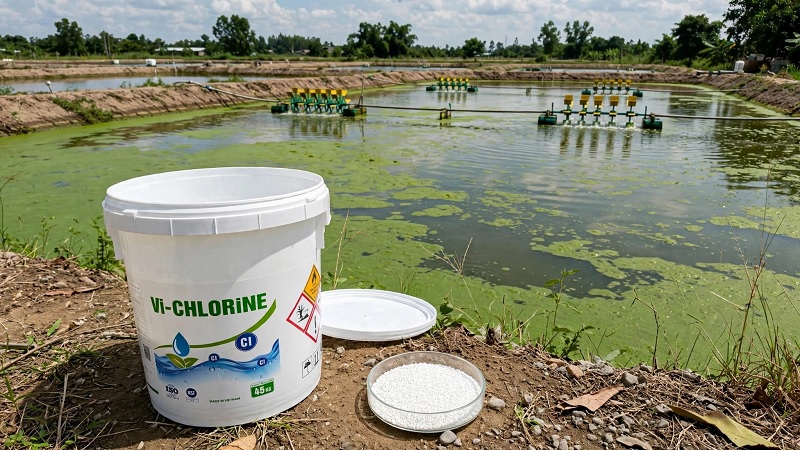
Green algae bloom on the surface of a fish pond that needs chlorine treatment
Common problems caused by excessive algae include:
- Oxygen crashes. Algae produce oxygen in daylight but consume it at night, and a die-off can strip the water of oxygen.
- pH swings. Photosynthesis raises pH during the day and respiration lowers it overnight.
- Off-flavor. Some blue-green algae release compounds that make fish taste muddy.
- Toxin risks. Certain cyanobacteria can produce toxins harmful to fish and animals.
- Blocked equipment. Filamentous algae clog screens, pumps and nets.
Types of Algae in Fish Ponds and How Chlorine Affects Them
| Algae type | What it looks like | Main problem | Chlorine approach |
|---|---|---|---|
| Green phytoplankton | Green, cloudy water | Night-time oxygen drops when too dense | Treat pond water before stocking, or reduce nutrients if fish are present |
| Blue-green algae (cyanobacteria) | Blue-green scum, paint-like film, musty smell | Off-flavor and possible toxins | Treat empty ponds and reservoirs; avoid disturbing dense blooms in stocked ponds |
| Filamentous algae | Green hair-like mats, often on the bottom and edges | Clogs screens and traps fish | Remove physically, then spot-treat mats and surfaces with stronger solutions |
| Diatoms and mixed blooms | Brown or golden water | Unstable oxygen and water quality | Disinfect and rebuild a balanced bloom in preparation |
How Chlorine Kills Algae in Fish Ponds
When calcium hypochlorite dissolves, it forms hypochlorous acid, a powerful oxidizer that damages algal cell membranes and pigments. The cells lose their ability to photosynthesize and break down. Chlorine also kills many bacteria, small zooplankton and wild fish that can disturb pond balance, which is why it plays a double role in pond preparation.
For consistent results, you need a disinfectant with stable chlorine content. Vi Chlorine is a granular calcium hypochlorite with a minimum of 70% active chlorine, produced by Viet Tri Chemical JSC and exported through VIETCHEM. The flakes dissolve quickly, so you can mix a measured solution and spread it evenly across a pond or onto algae-covered surfaces.
When to Use Chlorine for Algae Control in Fish Ponds
The most important rule is that chlorine at algae-killing strength is toxic to fish. Use it only where fish are absent or can be protected.
- Empty or fallow ponds: disinfect the pond water or spot-treat algae on the bottom and dikes before the next crop.
- Reservoirs and treatment ponds: clear algae and disinfect water before moving it to the grow-out pond.
- Concrete tanks, raceways and equipment: disinfect surfaces after draining.
- Not suitable: stocked ponds with fish inside. For those, focus on aeration, nutrient control and expert advice, because dumping chlorine in a stocked pond can kill the whole crop.
Chlorine Dosage for Algae Control in Fish Ponds: ppm Guide
Dosage is measured in ppm (mg/L) of active chlorine. Dirty water with heavy algae has a high chlorine demand, so a jar test is always recommended. These ranges are common starting points, and you should confirm them against local regulations and your technical team's advice:
| What you are treating | Typical active chlorine | Typical contact time |
|---|---|---|
| Empty pond water or reservoir (general algae and disinfection) | 10 to 30 ppm | 24 to 48 hours with aeration |
| Algae mats on pond bottom, dikes and concrete (spot treatment) | 100 to 200 ppm | 30 to 60 minutes |
| Nets, screens and tools | 50 to 200 ppm | 30 to 60 minutes |
Because Vi-Chlorine contains 70% active chlorine, divide the required ppm by 0.70 to find the amount of product:
| Target active chlorine | 70% calcium hypochlorite needed |
|---|---|
| 10 ppm | about 14.3 kg per 1,000 m³ of water |
| 20 ppm | about 28.6 kg per 1,000 m³ of water |
| 30 ppm | about 42.9 kg per 1,000 m³ of water |
| 100 ppm | about 143 g per 1 m³ of spot solution |
| 200 ppm | about 286 g per 1 m³ of spot solution |
Worked example: A 0.5-hectare pond with an average depth of 1.5 m holds 7,500 m³ of water. At 20 ppm you need about 7.5 × 28.6 = 215 kg of product, roughly nine bags of Vi chlorine 25kg, a convenient size for ponds that are far from roads or worked by small teams.
Step-by-Step: Controlling Algae in a Fish Pond Using Chlorine
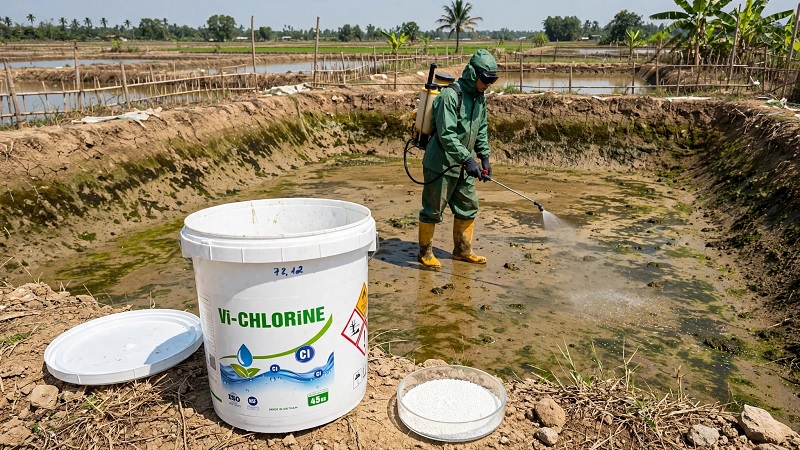
Farm worker applying chlorine solution to control algae in an empty fish pond
- Harvest or remove fish. Never apply algae-killing doses to a pond with live fish.
- Remove algae mats and sludge. Rake out floating mats and clean the feeding area, because organic matter consumes chlorine.
- Check pH. Chlorine works better at neutral to slightly alkaline pH. Very high pH from a heavy bloom reduces effectiveness, so adjust or increase the dose cautiously.
- Calculate the dose using pond volume and your jar test result.
- Dissolve in a bucket. Always add granules to water, never the other way around.
- Apply evenly. Spread the solution across the surface from a boat or along the dikes, then run aerators or paddlewheels to mix.
- Spot-treat stubborn areas. Spray algae on dikes, pipes and concrete with the stronger solution.
- Hold for 24 to 48 hours. Keep aeration running.
- Neutralize and test before filling, stocking or discharging.
Dechlorination and Cleanup After Algae Treatment
Dead algae do not disappear. They sink, decompose, and release ammonia while consuming oxygen. Skipping the cleanup step can cause a second water quality crisis right after the chlorine has been removed.
- Aerate strongly. Aeration and sunlight break down chlorine naturally, usually within about five to seven days.
- Neutralize if needed. Sodium thiosulfate can speed removal. Start with a low dose, retest after 15 to 30 minutes, and repeat until the test kit reads zero.
- Remove dead algae and sludge from the pond bottom before refilling or stocking.
- Test water quality. Check ammonia, pH, dissolved oxygen and alkalinity.
- Run a bioassay. Keep a few healthy fish in pond water for 24 to 48 hours before full stocking.
Good practice has to work outside the textbook too. To see how disinfection is applied in real farms, you can read What Do Local Farmers Say About Vi-CHLORiNE.
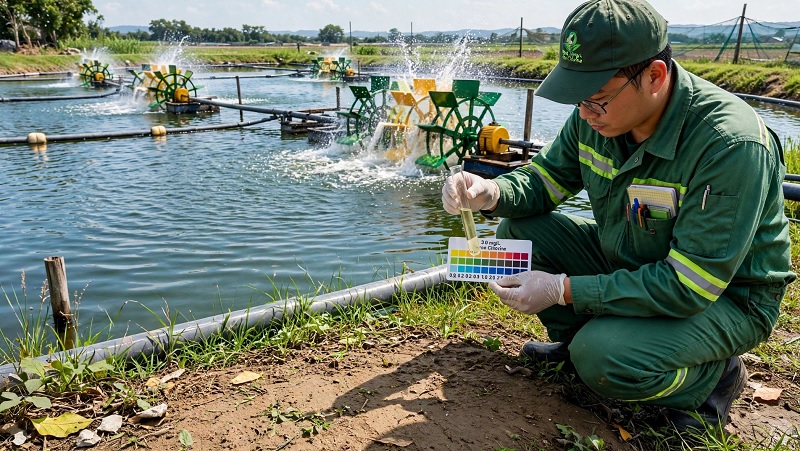
Pond aerators running after chlorine algae treatment while residual chlorine is tested
Preventing Algae Regrowth in Fish Ponds After Chlorine Treatment
Chlorine clears the current problem, but algae return if nutrients stay high. The best long-term algae control is a prevention plan:
- Feed carefully. Uneaten feed is the largest source of nutrients, so use measured rations and feeding trays.
- Keep ponds deep enough. Depths of at least one meter reduce light reaching the bottom and limit filamentous algae.
- Aerate. Good circulation prevents surface scums and oxygen swings.
- Manage sludge. Remove it between crops, because it stores phosphorus and nitrogen.
- Use filter-feeding fish such as silver carp or tilapia where suitable, since they can graze phytoplankton.
- Add beneficial bacteria to compete for nutrients and break down waste.
- Monitor transparency with a Secchi disc. If visibility falls below about 20 cm, the bloom is likely too dense.
Water management works best as part of a complete biosecurity plan, like the approach shown in AQUADELTA - Dr.Tom Accompanies Vietshrimp: Vi-CHLORiNE Solution Enhancing Biosecurity in Aquaculture.
Safety Rules for Using Chlorine to Control Algae
- Wear PPE: chemical-resistant gloves, goggles, a mask or respirator, and waterproof clothing.
- Work in open air and avoid breathing dust or fumes.
- Never mix chlorine with acids, ammonia, fuel, oils or fertilizers.
- Store the product dry, sealed and away from sunlight and organic material.
- Keep water nearby for emergency rinsing of skin and eyes.
- Neutralize before discharge and follow local environmental rules.
Common Mistakes When Controlling Algae in Fish Ponds with Chlorine
- Treating a stocked pond. This can kill fish within hours.
- Ignoring dead algae. Decomposition can cause an ammonia and oxygen crisis.
- Guessing the dose. Too little fails; too much damages the pond ecosystem and delays stocking.
- Treating turbid, dirty water. Clean and settle first to cut chlorine demand.
- Forgetting to test. Always confirm zero chlorine before stocking.
- Not fixing the cause. Without nutrient control, algae return in weeks.
Planning Your Chlorine Supply for Algae Control and Pond Preparation
Pond preparation happens in tight windows between crops, so calculate your needs early. Add up the volume of all ponds and reservoirs, choose the target ppm, and add a margin for ponds with heavy algae. For example, a 2-hectare pond at 1.5 m depth holds 30,000 m³ and needs about 860 kg at 20 ppm. For large farms, Vi chlorine 45kg packs cut the number of bags to move, which means about 19 bags instead of 35 smaller ones.
Conclusion: Use Chlorine Wisely to Control Algae in Fish Ponds
Chlorine is a powerful tool for resetting a pond that has been overrun by algae, but it works best in empty or prepared ponds and reservoirs. Remove fish, clean heavy mats, apply the correct dose, neutralize, test for zero chlorine, and then fix the nutrient problem so the pond stays balanced. Treat chlorine as one step in a complete pond management plan, not a quick fix.
Need Calcium Hypochlorite 70% for Pond Preparation?
Get a quote, product specifications, and export support from our team. Available 24/7 on WhatsApp: (+84) 981 370 389 or email telesales@vi-chlorine.com.
Request a Quote NowFAQ: Algae Control and Shrimp Pond Preparation
1. How does algae control fit into shrimp pond preparation?
During shrimp pond preparation, algae mats and heavy blooms are removed or treated while the pond is empty or in a reservoir. Chlorine disinfection then clears remaining algae and pathogens, and fertilization rebuilds a balanced bloom before stocking.
2. Can I use chlorine in a pond that already has fish or shrimp?
No. Algae-killing doses of chlorine are toxic to fish, shrimp and larvae. Use chlorine only in empty ponds, reservoirs and on surfaces, and neutralize it completely before any animals are introduced.
3. How much chlorine is needed to kill algae in a pond?
Many farms use about 10 to 30 ppm of active chlorine for pond water and 100 to 200 ppm for spot-treating algae mats. With 70% calcium hypochlorite, 20 ppm equals about 28.6 kg per 1,000 m³. Always run a jar test first.
4. How long should I wait to stock after treating algae with chlorine?
Wait until residual chlorine tests at zero, which commonly takes five to seven days with aeration and sunlight. Then confirm with a 24 to 48 hour bioassay before stocking the full pond.
5. How can I stop algae from coming back after shrimp pond preparation?
Control nutrients with careful feeding, remove sludge between crops, keep ponds aerated and deep enough, use beneficial bacteria, and monitor transparency daily. These steps address the cause of algae blooms instead of only treating the symptoms.