
Chlorine vs. UV Disinfection: Pros and Cons for Modern Water Treatment
- Q&A Chlorine
- 14/07/2026
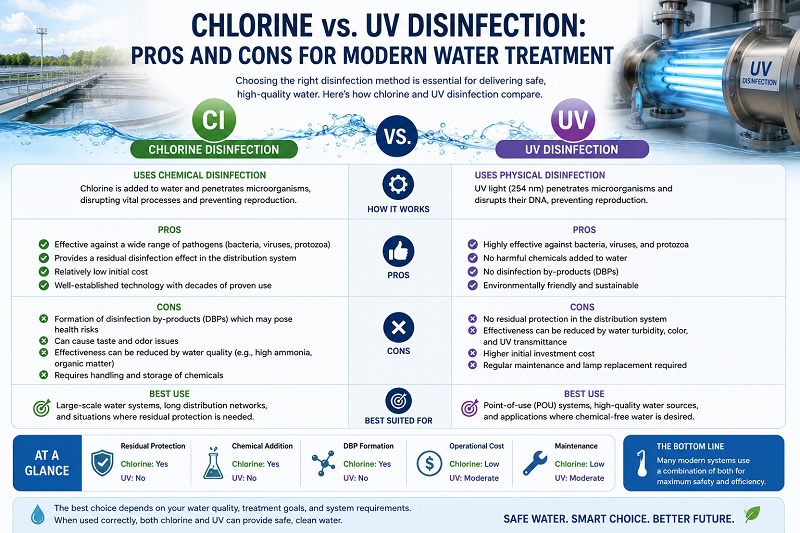
The main difference between chlorine and UV disinfection lies in their mechanism and residual protection. Chlorine is a chemical oxidant that destroys pathogen cell walls and remains in the water (residual chlorine) to prevent recontamination during distribution. UV (Ultraviolet) disinfection is a physical process that uses light to alter pathogen DNA, preventing replication, but it leaves no residual protection. For maximum safety, modern water treatment facilities often use a hybrid approach: UV for primary disinfection and Chlorine for long-lasting residual security.
1. The Evolution of Water Disinfection
Providing safe, pathogen-free water is one of the most significant public health achievements in human history. For over a century, chemical disinfection has been the undisputed king of water purification. However, as technology advances and environmental concerns regarding chemical byproducts grow, alternative methods have stepped into the spotlight.
Today, facility managers, municipal engineers, and private system operators frequently face a critical decision: Chlorine vs. UV Disinfection. Should they rely on the tried-and-true chemical oxidation of chlorine, or invest in the modern, residue-free physical process of Ultraviolet (UV) light? To make an informed decision, one must deeply understand not just how these technologies work in isolation, but how they interact with the specific qualities of the water being treated.
2. Understanding Chlorine Disinfection: The Chemical Shield
Chlorine disinfection is a chemical process. When chlorine compounds—such as calcium hypochlorite, sodium hypochlorite, or chlorine gas—are introduced into water, they undergo a rapid chemical reaction. They form Hypochlorous acid (HOCl) and Hypochlorite ions (OCl-). These compounds are highly reactive oxidants.
When these oxidants encounter bacteria, viruses, or algae, they aggressively attack the cell walls, penetrating the microorganisms and destroying their internal enzymes and proteins. This process effectively neutralizes the pathogens, rendering the water safe for consumption or industrial use.
The most distinctive feature of this method is residual protection. After the initial "chlorine demand" (the amount of chlorine needed to destroy existing pathogens and organic matter) is met, any remaining chlorine stays in the water. This "free residual chlorine" acts as a continuous shield, actively killing any new bacteria introduced as the water travels through miles of pipes to reach the end consumer.
3. Understanding UV Disinfection: The Physical Barrier
Unlike chlorine, Ultraviolet (UV) disinfection does not add any chemicals to the water. It is a strictly physical process. UV systems utilize specialized lamps that emit UV-C light, typically at a wavelength of 254 nanometers (nm). This specific wavelength is germicidal.
As water passes through a UV chamber, the ultraviolet light penetrates the cell walls of microorganisms and strikes their nucleic acids (DNA and RNA). The high-energy light causes adjacent thymine bases in the DNA to bond together, creating "thymine dimers." This structural damage prevents the pathogen from replicating. If a bacterium or virus cannot reproduce, it cannot cause infection—it is effectively dead.
Because nothing is added to the water, UV disinfection does not alter the taste, smell, or pH of the water. However, the moment the water exits the UV chamber, the disinfection process stops completely. There is zero residual protection downstream.
4. Pros and Cons of Chlorine Disinfection
Chlorine remains the most widely used disinfectant globally for several compelling reasons, but it is not without its drawbacks.
Pros of Chlorine
- Lasting Residual Protection: The absolute biggest advantage. Chlorine protects water in transit, preventing biofilm buildup in pipes and neutralizing cross-contamination.
- Highly Scalable and Cost-Effective: From a small backyard pool to a massive city water plant, chlorine is highly economical. For immense municipal operations, bulk supplies like vi chlorine 45kg provide an incredibly cost-efficient way to dose massive volumes of water consistently.
- Visible Measurement: Operators can easily and accurately measure residual chlorine levels using simple colorimetric test kits, ensuring the water is constantly safe.
- Oxidation of Metals: Chlorine helps precipitate iron, manganese, and hydrogen sulfide, aiding in overall water clarification.
Cons of Chlorine
- Disinfection Byproducts (DBPs): When chlorine reacts with natural organic matter (like decaying leaves), it can form Trihalomethanes (THMs) and Haloacetic Acids (HAAs), which are strictly regulated due to potential health risks over long-term exposure.
- Taste and Odor: Improperly balanced chlorine can give water a noticeable chemical taste and a "pool-like" smell.
- Handling and Storage: Chlorine chemicals require strict safety protocols for storage and handling to prevent accidents or toxic gas exposure.
- Cryptosporidium Resistance: Certain hard-shelled parasites, like Cryptosporidium, are highly resistant to standard chlorine doses.
5. Pros and Cons of UV Disinfection
UV technology has surged in popularity, especially in environmentally conscious regions and specialized industries, solving many of the problems associated with chemical dosing.
Pros of UV
- Zero Chemical Byproducts: UV creates no THMs or HAAs. The water composition remains completely unchanged, preserving natural taste and odor.
- Effective Against Resistant Pathogens: UV light easily inactivates chlorine-resistant protozoa like Giardia and Cryptosporidium.
- Instantaneous Process: Disinfection occurs in seconds as the water passes the lamp; there is no need for large contact tanks or waiting periods.
- Safe for the Environment: With no chemicals discharged, UV is highly favorable for wastewater effluent released back into natural rivers and lakes.
Cons of UV
- No Residual Protection: This is the critical flaw for municipal systems. Once water leaves the UV chamber, it is vulnerable to recontamination in the distribution pipes.
- Requires Clear Water (Low Turbidity): UV light cannot penetrate cloudy or murky water. Suspended solids act as "shields," hiding pathogens from the light rays. Pre-filtration or chemical clarification is mandatory.
- High Energy and Maintenance Costs: UV lamps consume continuous electricity, and the quartz sleeves housing the bulbs must be meticulously cleaned and replaced annually to ensure light transmission.
6. Direct Comparison Table: UV vs. Chlorine
| Feature / Characteristic | Chlorine Disinfection | UV Disinfection |
|---|---|---|
| Disinfection Mechanism | Chemical Oxidation (Destroys cells) | Physical Alteration (Damages DNA) |
| Residual Protection | Yes (Stays in pipes) | No (Only works inside chamber) |
| Taste & Odor Impact | Can cause chemical taste/smell | No impact |
| Byproducts Formed | Yes (THMs, HAAs if organics are present) | None |
| Efficacy vs Protozoa | Low (Struggles with Cryptosporidium) | Very High |
| Dependency on Water Clarity | Moderate (Consumes more chemical) | Extreme (Must be crystal clear) |
7. Why Water Clarity is Crucial: The Synergistic Approach
One of the most overlooked aspects of implementing a UV system is the absolute necessity for water clarity (low turbidity and low UV Transmittance interference). If water contains high levels of suspended solids, algae, or organic matter, the UV light rays will be blocked, allowing pathogens to pass through safely in the shadows of these particles.
This is where the debate between Chlorine and UV turns into a partnership. Instead of choosing one over the other, the most advanced water treatment systems use a hybrid approach.
Using premium chemical clarifiers and oxidizers like vi chlorine (high-purity Calcium Hypochlorite 70%) serves as a vital pre-treatment step. The chemical shock effectively oxidizes iron, breaks down organic matter, and precipitates suspended solids. Once this matter is filtered out, the resulting water is crystal clear—maximizing UV Transmittance (UVT). The UV system can then operate at peak efficiency to handle protozoa, while a small, final dose of chlorine provides the necessary residual for the distribution pipes.
For mid-sized operations, residential complexes, or commercial applications, utilizing adaptable packaging like Vi chlorine 25kg ensures operators can precisely manage the clarification and oxidation process before water reaches the UV reactors, protecting the expensive quartz sleeves from mineral scaling.
8. The Aquaculture Battlefield: A Unique Perspective
While municipal drinking water focuses on human safety, the commercial aquaculture sector faces an entirely different set of challenges where the choice between UV and Chlorine can dictate the survival of a multi-million dollar harvest.
In modern shrimp farming, biosecurity against devastating viruses (like White Spot Syndrome or Early Mortality Syndrome) is the highest priority. As detailed in the Global Shrimp Market Outlook 2025: A Golden Opportunity for Asia, the demand for pristine aquatic environments has never been higher as farmers aim for export-grade quality.
In this industry, UV systems are often impractical for primary pond preparation due to the massive volumes of highly turbid, nutrient-rich water. UV light simply cannot penetrate muddy pond water. Therefore, aggressive chemical sterilization is mandatory.
This reality is echoed at major industry conferences. For example, during events covered in AQUADELTA - Dr.Tom Accompanies Vietshrimp 2025: Vi-CHLORiNE Solution Enhancing Biosecurity in Aquaculture, experts heavily advocate for using potent Calcium Hypochlorite to completely reset pond ecology, eradicate pathogen carriers, and oxidize sludge before stocking.
To understand the practical implications and why chemical reliability is preferred over delicate physical systems in harsh farming conditions, you can read firsthand experiences in What Do Local Farmers Say About Vi-CHLORiNE. Farmers rely on the aggressive, visible, and measurable oxidation power of high-grade chlorine to secure their livelihoods.
9. How to Choose the Right System for Your Needs
Deciding between Chlorine and UV—or choosing to integrate both—depends entirely on your specific application:
- Choose strictly UV if: You are treating a single-point-of-use residential well, you have excellent pre-filtration, water travels a very short distance to the tap, and you want zero chemical footprint.
- Choose strictly Chlorine if: You are managing a large municipal grid, a commercial swimming pool, or an agricultural pond where water must remain protected over time and distance, and where turbidity is variable.
- Choose a Hybrid System if: You manage a modern municipal water treatment plant, a hospital water system, or a food & beverage manufacturing facility where you need the absolute highest standard of biosecurity (UV for protozoa) combined with verifiable safety metrics (Chlorine residual).
10. Frequently Asked Questions (FAQs)
Need Expert Guidance on Water Disinfection?
Whether you need high-purity Calcium Hypochlorite for residual protection, or you are looking to clarify your water to maximize UV transmittance, our experts are here to help. Discover the power of premium water treatment chemicals today.
Contact Vi-Chlorine Experts Now