
Chlorine Tablets for Water Tanks: How to Choose and Use
- NEWS
- Q&A Chlorine
- 17/10/2026
Chlorine tablets for water tanks are solid, slow-dissolving disinfectants that release free chlorine to kill bacteria, viruses, and algae in stored water. Used correctly, they keep tank water safe, prevent slime and odors, and reduce the cost of frequent manual dosing. This guide covers how they work, how to choose the right type, how much to use, and where chlorine fits into aquaculture and farm water systems.
What Are Chlorine Tablets for Water Tanks?
Chlorine tablets are compressed disinfectant products designed to dissolve gradually in water. As they dissolve, they release hypochlorous acid and hypochlorite ions, the "free chlorine" that destroys harmful microorganisms. Because they dissolve slowly, tablets can maintain a steady chlorine level for days, which makes them popular for rainwater tanks, rooftop tanks, storage cisterns, farm reservoirs, and swimming pools.
Water in a storage tank is never perfectly sterile for long. Sunlight, warm temperatures, dust, leaves, insects, and biofilm on tank walls all encourage microbial growth. A small, controlled chlorine residual is the simplest and most widely used way to stop that growth before it becomes a health or quality problem.
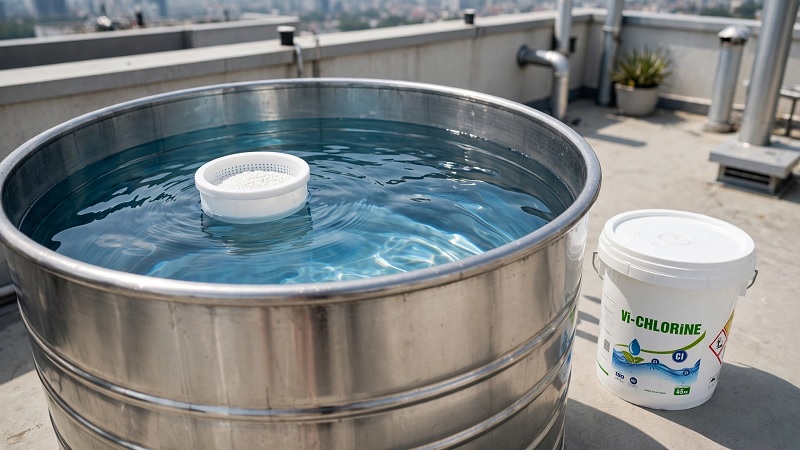
Types of Chlorine Tablets: Which One Is Right for Your Tank?
Not all chlorine tablets are the same, and choosing the wrong one is the most common mistake. The main types are:
- Calcium hypochlorite tablets: Very high available chlorine (around 65–70%), fast-acting, and effective for shock disinfection. They leave a little calcium in the water and require careful storage.
- Trichloroisocyanuric acid (TCCA, "trichlor") tablets: Slow-dissolving, around 90% available chlorine, and stabilized against sunlight with cyanuric acid. Common in pools, but many are not intended for drinking water.
- Sodium dichloroisocyanurate (NaDCC) tablets: Widely used for emergency and household drinking water treatment. They dissolve more readily and are often approved for potable use.
The rule is simple: if the water is for drinking or food preparation, use only products that are labeled and approved for potable water. If the tank is for irrigation, livestock, or aquaculture reservoirs, choose a product that matches the target use and local regulations. Always read the label.
How Chlorine Tablets Disinfect Stored Water
Once in water, chlorine attacks microorganisms through oxidation. It damages cell walls and disrupts enzymes, which kills bacteria such as E. coli and Salmonella, inactivates many viruses, and controls algae. Three factors decide how well this works:
- Chlorine dose: The concentration you reach in the tank.
- Contact time: How long the chlorine stays in contact with the water before use.
- Water conditions: Organic matter, turbidity, pH, and temperature all change how much chlorine is used up and how effective it is.
Dirty tanks consume chlorine rapidly. That is why cleaning a tank before disinfecting it matters as much as the tablets themselves. Clear, low-turbidity water needs less chlorine and holds a residual for longer.
How to Use Chlorine Tablets in Water Tanks: Step-by-Step
- Empty and scrub the tank. Remove sediment, algae, and biofilm with a brush and clean water. Rinse thoroughly.
- Check the tank volume. Calculate liters or cubic meters so you can dose accurately.
- Choose the right tablet. Use a potable-approved product for drinking water.
- Calculate the dose. Follow the manufacturer's instructions. As a general reference, initial disinfection of a cleaned tank often targets around 50 mg/L of chlorine for several hours, while routine maintenance aims for a low residual, commonly 0.2–0.5 mg/L at the point of use.
- Add tablets safely. Use a floating dispenser or a tank feeder. Never drop tablets directly onto the tank floor, where they can create a concentrated, corrosive spot.
- Allow contact time. Leave the water for the time recommended on the product label, often several hours up to a day for shock disinfection.
- Flush and test. Run taps until the water is clear and chlorine levels fall into the acceptable range. Use a test kit to confirm.
- Monitor regularly. Re-test weekly or after heavy rain, heat waves, or any maintenance work.
Chlorine Tablets for Water Tanks vs Granular Chlorine
Tablets are not always the best option. The right form depends on tank size, how often you disinfect, and how much water you treat.
| Factor | Chlorine tablets | Granular chlorine |
|---|---|---|
| Dissolving speed | Slow and steady | Fast |
| Best for | Small to medium tanks, ongoing maintenance | Large volumes, shock disinfection, reservoirs |
| Dosing control | Fixed tablet size, easy to count | Flexible, precise by weight |
| Cost at scale | Higher per kg of chlorine | Lower per kg of chlorine |
| Handling | Simple, low dust | Needs pre-dissolving and careful mixing |
For household tanks, tablets win on convenience. For farms and aquaculture operations that treat large volumes of water, bulk granular chlorine is usually more economical and easier to scale.
Chlorine for Farm Water Storage and Shrimp Hatchery Tanks
Water storage is not only a household issue. Aquaculture farms depend on clean reservoirs and header tanks to supply ponds and nursery systems. Contaminated source water can introduce Vibrio bacteria, parasites, and wild larvae of crabs and fish that carry disease into otherwise well-managed ponds.
That is where a purpose-built aquaculture disinfectant makes a difference. Vi chlorine is a concentrated, stable chlorine product made for aquaculture biosecurity. While small tanks may be handled with tablets, farms that treat reservoirs, settling ponds, and grow-out ponds benefit from higher-strength chlorine that can be weighed, dissolved, and applied quickly across large water volumes.
Where Chlorine Fits in Shrimp Pond Preparation
Good shrimp pond preparation starts with the water that enters the farm. A typical biosecurity chain looks like this: reservoir treatment, filtration, disinfection, pond preparation, and finally conditioning before stocking. Chlorine plays a role at several points in that chain:
- Reservoir and storage tank disinfection to remove pathogens before the water reaches the ponds.
- Pond water disinfection to eliminate bacteria, wild fish, and crustacean carriers prior to stocking.
- Equipment and tool sanitation for nets, pipes, buckets, and tanks.
Farms often choose pack sizes by how much water they handle. The Vi chlorine 45kg pack is a practical option for commercial farms that disinfect several ponds or large reservoirs per cycle, since it lowers the cost per kilogram and reduces packaging waste.
How Much Chlorine Do You Need for a Water Tank?
The exact amount depends on the product, its available chlorine percentage, and your target concentration. A simple formula helps:
Chlorine needed (grams) = Tank volume (liters) × Target dose (mg/L) ÷ Available chlorine (%) ÷ 10
For example, to reach 50 mg/L in a 1,000-liter tank using a product with 65% available chlorine, you would need roughly 77 grams of product. In practice, organic matter, sunlight, and heat reduce the actual residual, so testing after dosing is more reliable than calculation alone.
Smaller farms and workshops that treat limited volumes, such as nursery tanks or wash stations, often find the Vi chlorine 25kg pack easier to store, carry, and measure. Keep the container sealed between uses so that moisture does not reduce its strength.
Safety Tips for Using Chlorine Tablets and Disinfectants
Chlorine is a powerful oxidizer. Handle it with the same respect you would give any industrial chemical:
- Wear gloves, safety glasses, and a mask when opening containers and handling tablets.
- Never mix different chlorine products or combine chlorine with acids or ammonia-based cleaners.
- Store in a cool, dry, ventilated place away from sunlight, fuels, and organic materials.
- Keep tablets out of reach of children and animals.
- Do not use pool trichlor tablets for drinking water unless the label explicitly allows it.
- Always allow chlorine to dissipate before discharging water into the environment or using it for sensitive purposes.
Common Mistakes with Chlorine Tablets in Water Tanks
- Skipping tank cleaning. Biofilm shields bacteria and eats up chlorine.
- Using the wrong tablet type. Pool tablets may add stabilizer that builds up and is unsuitable for drinking water.
- Placing tablets on the tank floor. This creates a high local concentration that can damage tanks and liners.
- Never testing the water. Without a test kit, you are guessing.
- Using expired or damp product. Moisture and age reduce chlorine strength.
- Ignoring pH. High pH reduces the proportion of active hypochlorous acid and weakens disinfection.
Field Experience and Biosecurity: Learning from Real Farms
Technical data tells you how chlorine should perform. Field feedback tells you how it behaves in daily operations. Farmers in the Mekong Delta handle heat, variable salinity, and tight pre-stocking schedules, and their experience shows what works. You can read their perspective in What Do Local Farmers Say About Vi-CHLORiNE.
Chlorine is most effective when it is part of a broader biosecurity program rather than a single fix. The partnership highlighted in AQUADELTA - Dr.Tom Accompanies Vietshrimp: Vi-CHLORiNE Solution Enhancing Biosecurity in Aquaculture shows how disinfection, monitoring, and farm management come together to protect production.
The industry has strong reasons to take this seriously. Rising demand and tightening quality standards reward farms that avoid outbreaks. For the commercial picture behind these decisions, read Global Shrimp Market Outlook: A Golden Opportunity for Asia.
Final Thoughts on Choosing Chlorine Tablets for Water Tanks
Chlorine tablets are an easy, affordable way to keep stored water clean. For homes and small tanks, pick a potable-approved tablet, clean the tank first, dose carefully, and test the residual. For farms and aquaculture operations that manage large volumes, a concentrated granular product often gives better control and lower cost per treated cubic meter. In both cases, the best results come from the same habits: clean first, dose accurately, allow contact time, and always verify with a test kit.
Need reliable chlorine for your farm water system?
Talk to our team about the right chlorine solution and pack size for your reservoirs and ponds.
Contact Us TodayFAQ: Shrimp Pond Preparation
1. What is shrimp pond preparation?
Shrimp pond preparation is the set of steps taken before stocking: draining, drying, cleaning the pond bottom, filling with filtered water, disinfecting, and conditioning the water. Its purpose is to remove pathogens and create a stable environment for postlarvae.
2. How long should shrimp pond preparation take?
Most farms allow about 2 to 4 weeks. This includes drying and cleaning, filling and filtering, disinfection, waiting for residual chlorine to break down, and conditioning the water. Weather and soil type can lengthen or shorten the schedule.
3. Why is chlorine used in shrimp pond preparation?
Chlorine is a fast, broad-spectrum disinfectant. It kills harmful bacteria such as Vibrio, reduces algae, and eliminates unwanted fish and crustacean carriers that can bring disease into the pond. It is also widely available and cost-effective at farm scale.
4. Can I use chlorine tablets for shrimp pond preparation?
Tablets can work for small nursery tanks and equipment, but they are rarely practical for large ponds. Concentrated granular chlorine is easier to dose by weight and more economical when you treat thousands of cubic meters of water.
5. When is it safe to stock shrimp after chlorine treatment?
Stock only after a test kit confirms that residual chlorine has dropped to zero. This commonly takes about 5 to 7 days with aeration and sunlight. Stocking too early can stress or kill postlarvae.