
Chlorine Tablets for Kiddie Pool: Safe Dosage & How to Use
- Q&A Chlorine
- 10/09/2026
Keeping a children's pool clean can be more challenging than it looks. Kiddie pools are usually shallow, warm, frequently used by children, and may quickly collect dirt, grass, sunscreen, sweat, leaves, insects, and other organic contaminants. These conditions can encourage microorganisms to develop rapidly, especially during hot weather.
Chlorine is one of the most widely used disinfectants for swimming pool water. However, the correct approach for a small kiddie pool is different from treating a large residential or commercial pool. Pool volume must be calculated carefully, chlorine concentration needs to be monitored, and children should never enter the water while concentrated chlorine products are being added.
This article provides practical information for parents, pool owners, distributors, and water-treatment professionals who want to understand how chlorine tablets can be used for small pools safely and effectively.
What Are Chlorine Tablets for Kiddie Pool?
Chlorine tablets are concentrated chlorine-based products designed to release active chlorine into water over time. Depending on the chemical formulation, tablets may dissolve slowly or relatively quickly and can be used to maintain an appropriate disinfectant residual in swimming pool water.
When chlorine dissolves in water, it forms active disinfecting species that help control bacteria, algae, and other microorganisms. The effectiveness of chlorine depends on several factors, including:
- Pool water volume
- Active chlorine concentration of the product
- Water temperature
- pH level
- Sunlight exposure
- Number of swimmers
- Organic contamination in the pool
- Frequency of water replacement
Because a kiddie pool may contain only a few hundred liters of water, using a full-size swimming pool tablet without calculating the dose may result in excessive chlorine concentration.
For this reason, chlorine should always be treated as a water-treatment chemical rather than simply dropping a tablet into the pool and assuming the water is safe.
Companies working in aquaculture and professional water treatment also use chlorine-based disinfectants for broader biosecurity applications. One example is vi chlorine, a chlorine product developed for professional disinfection and water-treatment applications.
Do You Need Chlorine Tablets for Kiddie Pool Water?
Not every kiddie pool necessarily needs continuous chlorination.
Very small inflatable pools that are emptied after every use may be easier to maintain by draining the water, cleaning the surfaces, allowing the pool to dry, and refilling it with fresh water before the next use.
However, larger children's pools that hold water for several days may benefit from controlled disinfection, particularly when they have filtration or circulation systems.
Chlorine treatment may be considered when:
- The pool water remains in place for multiple days.
- The pool is used frequently by several children.
- The pool contains a circulation or filtration system.
- Warm temperatures promote rapid biological growth.
- The water becomes cloudy or develops slippery surfaces.
- Frequent draining and refilling is impractical.
For very small pools without filtration, however, water replacement and physical cleaning can often be simpler than attempting to maintain a stable chemical balance.
Are Chlorine Tablets Safe for Kiddie Pool Use?
Chlorine tablets can be used safely only when the product is appropriate for the application and the resulting chlorine concentration is properly controlled.
The main risk with small pools is overdosing. Because the water volume is limited, adding too much concentrated chlorine can quickly push the free chlorine level above the intended range.
Children may be more likely than adults to swallow pool water accidentally or experience irritation when water chemistry is poorly controlled. Therefore, chlorine should never be estimated purely by visual judgment.
Several basic safety principles should always be followed:
- Read and follow the product label.
- Determine the pool's actual water volume before dosing.
- Use a chlorine test kit or test strips.
- Never allow children to handle chlorine tablets.
- Never mix different chlorine chemicals together.
- Do not mix chlorine with acids or household cleaners.
- Keep concentrated chemicals away from skin and eyes.
- Store chlorine in its original container in a dry, ventilated location.
- Keep the product securely away from children and animals.
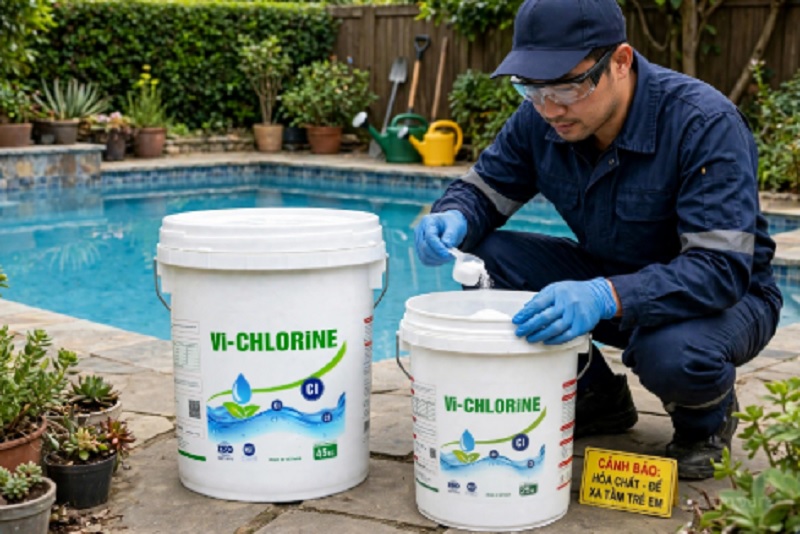
Professional chlorine products may be packaged for much larger treatment operations. For example, vi chlorine 45kg is intended for professional-scale water treatment and disinfection applications rather than direct consumer dosing of a small children's pool.
How Much Chlorine Tablets for Kiddie Pool Water?
The correct amount cannot be determined simply by counting tablets. The calculation should be based on three pieces of information:
- The volume of water in the pool.
- The percentage of available chlorine in the product.
- The desired free chlorine concentration.
Chlorine concentration in swimming pool water is normally expressed in parts per million, or ppm. For water, 1 ppm is approximately equivalent to 1 milligram per liter.
A simplified theoretical calculation is:
Required active chlorine (mg) = Pool volume (L) × Desired chlorine increase (mg/L)
For example, if a pool contains 1,000 liters of water and the goal is to theoretically increase available chlorine by 1 ppm:
1,000 L × 1 mg/L = 1,000 mg = 1 gram of active chlorine
If a product contains 70% available chlorine, the theoretical product requirement would be:
1 g ÷ 0.70 ≈ 1.43 g of product
This example demonstrates why a standard large chlorine tablet may be inappropriate for a small pool. A single tablet could contain far more available chlorine than the small water volume requires.
Actual chlorine demand is affected by sunlight, organic matter, water chemistry, temperature, contamination, and product formulation. Therefore, calculation should always be followed by water testing rather than treated as a guarantee of the final chlorine concentration.
How to Calculate Kiddie Pool Water Volume Before Adding Chlorine Tablets
Correct pool volume is essential for safe dosing.
For a rectangular pool:
Volume = Length × Width × Average water depth
For a circular pool:
Volume = π × Radius² × Average water depth
When measurements are expressed in meters, the calculated result is in cubic meters. One cubic meter equals approximately 1,000 liters.
For example, a rectangular kiddie pool measuring:
- 2 meters long
- 1.5 meters wide
- 0.4 meters average water depth
would contain approximately:
2 × 1.5 × 0.4 = 1.2 m³
That equals approximately 1,200 liters.
Do not use the manufacturer's maximum pool capacity if the pool is filled only partially. Calculate according to the actual water depth whenever possible.
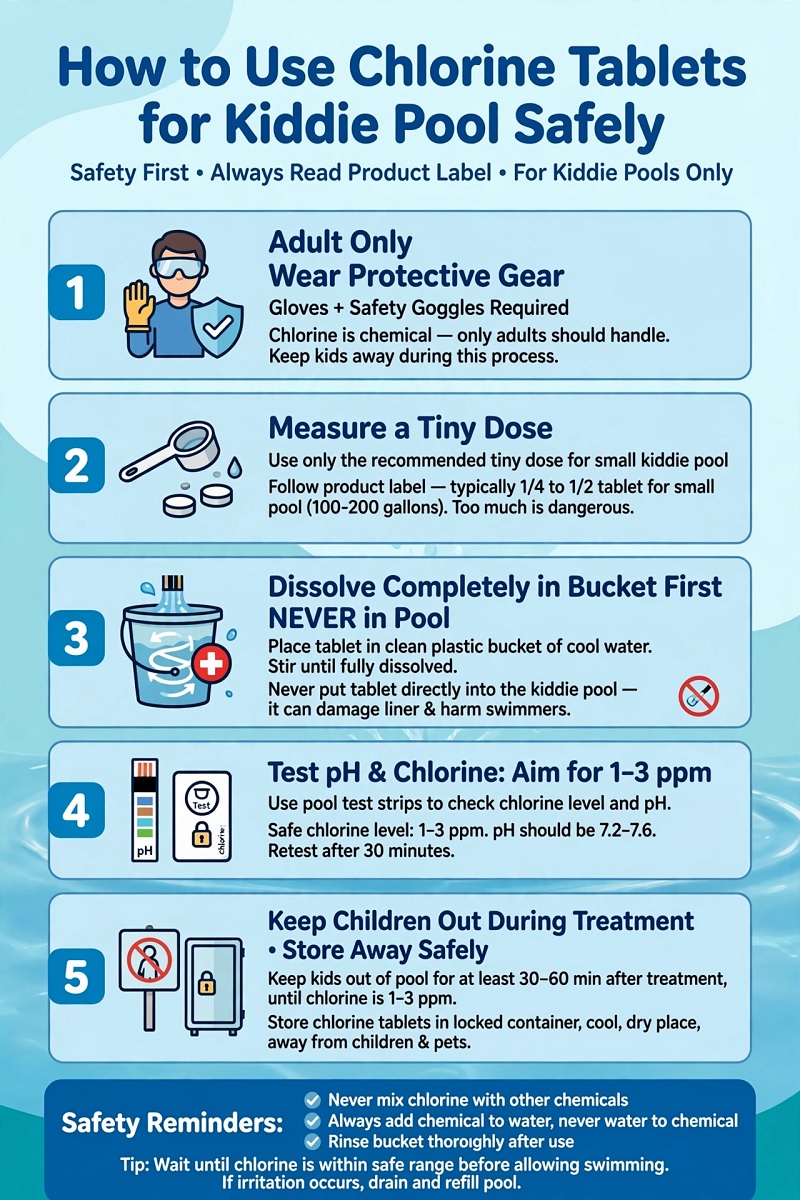
How to Use Chlorine Tablets for Kiddie Pool Safely
The exact method depends on the chlorine product, tablet size, active ingredient, and manufacturer's directions. Never assume that all chlorine tablets dissolve or behave in the same way.
A typical controlled treatment process involves the following steps.
1. Determine the water volume
Calculate how many liters or gallons of water are actually in the kiddie pool.
2. Check the chlorine product label
Confirm:
- Active ingredient
- Available chlorine percentage
- Tablet weight
- Recommended applications
- Manufacturer dosing instructions
3. Test the water
Use appropriate pool test strips or a liquid testing kit to determine free chlorine and pH before adding more sanitizer.
4. Dose carefully
Use only the amount appropriate for the water volume and product concentration. For very small pools, this may require a product specifically designed for small-volume dosing rather than a large tablet.
5. Ensure adequate distribution
If the pool has circulation, operate the circulation system according to the manufacturer's instructions. Concentrated chlorine should not remain in direct contact with vinyl or other pool surfaces because it may cause bleaching or material damage.
6. Keep children out during treatment
Do not allow swimmers to enter while concentrated chlorine is being added or before the water reaches an appropriate swimming condition according to the product instructions and test results.
7. Test again
Always verify the actual chlorine concentration instead of relying solely on calculated dosing.
Chlorine treatment is also widely used in aquaculture biosecurity, where control of pathogens and water quality can directly affect production performance. Experiences from real users are discussed in What Do Local Farmers Say About Vi-CHLORiNE, which highlights practical perspectives from farmers using chlorine-based solutions in water management.
Should Chlorine Tablets Be Placed Directly in a Kiddie Pool?
In most cases, placing a concentrated chlorine tablet directly on the bottom of a vinyl kiddie pool is not recommended unless the product manufacturer specifically instructs this method.
A tablet sitting against a vinyl surface can create a highly concentrated chlorine zone. This may discolor, weaken, or damage the material.
In conventional pools, slow-dissolving tablets may be used through equipment such as:
- Floating chlorine dispensers
- Inline chlorinators
- Automatic chemical feeders
However, even a floating dispenser designed for a large swimming pool may deliver too much chlorine for a very small kiddie pool.
The safest approach is to use a product and dosing method specifically suitable for the actual pool volume.
Chlorine Tablets for Kiddie Pool vs Liquid Chlorine
Both tablets and liquid chlorine can provide active chlorine, but they behave differently.
Chlorine tablets generally offer slower release and convenient storage. They may be useful when maintaining sanitizer levels over time, but tablet size can make accurate dosing difficult in very small pools.
Liquid chlorine disperses more quickly and can sometimes be measured in small quantities more easily. However, its concentration must still be known, and it can degrade during storage, especially when exposed to heat and sunlight.
The best product depends on pool size, filtration system, user experience, local availability, and the manufacturer's instructions.
For professional users requiring chlorine in a practical commercial pack size, Vi chlorine 25kg provides another packaging option for water-treatment, disinfection, aquaculture, and related professional applications.
What Free Chlorine Level Should a Kiddie Pool Have?
There is no single universal number that should be applied blindly to every children's pool because recommendations can vary according to local regulations, pool type, sanitizer system, and product instructions.
For treated swimming pools, maintaining a measurable free chlorine residual is essential because chlorine is continuously consumed by contaminants and environmental exposure.
Users should follow applicable local swimming pool health guidance and the chemical manufacturer's instructions. Pool water should be tested before swimming, especially after adding chemicals.
Other water parameters also affect chlorine performance.
pH
Chlorine effectiveness changes significantly with pH. If pH becomes excessively high, a smaller proportion of chlorine remains in its more effective disinfecting form.
Sunlight
Ultraviolet radiation can break down chlorine, particularly in outdoor pools.
Organic contamination
Sweat, sunscreen, dirt, leaves, and other organic materials consume available chlorine.
Water temperature
Warm water can encourage biological activity and may increase sanitizer demand.
How Often Should You Add Chlorine Tablets to a Kiddie Pool?
Chlorine should be added based on testing rather than an arbitrary fixed schedule.
A pool used heavily during a hot summer afternoon can consume chlorine much faster than the same pool sitting unused under cover.
Factors increasing chlorine demand include:
- High swimmer load
- Strong sunlight
- High temperature
- Rainwater entering the pool
- Dust and debris
- Leaves and insects
- Sunscreen and body oils
- Long periods without filtration
For small children's pools, frequent testing is particularly important because water chemistry can change rapidly.
Can Chlorine Tablets Prevent Algae in a Kiddie Pool?
Maintaining proper sanitation can significantly reduce the likelihood of algae growth, but chlorine alone cannot compensate for poor pool maintenance.
Algae commonly appear when sanitizer levels become inadequate, circulation is poor, surfaces are not cleaned, or debris remains in the water.
To minimize algae:
- Maintain appropriate sanitizer levels.
- Remove debris frequently.
- Brush or clean pool surfaces.
- Maintain circulation where applicable.
- Replace heavily contaminated water.
- Keep pool equipment clean.
The importance of water quality and biosecurity extends far beyond recreational pools. Similar principles play a major role in aquaculture, particularly as Asian seafood production expands. The article Global Shrimp Market Outlook 2025: A Golden Opportunity for Asia explores market developments and the growing importance of efficient, biosecure aquaculture production.
When Should You Drain a Kiddie Pool Instead of Adding Chlorine Tablets?
Sometimes replacing the water is more practical than adding additional chemicals.
Consider draining, cleaning, and refilling a small pool when:
- The water has become extremely cloudy.
- There is visible fecal contamination.
- The pool contains large amounts of dirt or organic material.
- Water chemistry cannot be restored easily.
- The pool has no filtration or circulation system.
- The total water volume is small enough to replace conveniently.
- The water has remained stagnant for an extended period.
Draining alone is not enough if a visible biofilm or slippery layer has developed. Pool surfaces should also be physically cleaned according to the pool manufacturer's recommendations before refilling.
Common Mistakes When Using Chlorine Tablets for Kiddie Pool
Incorrect chlorine use can reduce disinfection performance or create unnecessary safety risks. Avoid these common mistakes.
Using a full-size tablet in a very small pool
Pool tablets designed for tens of thousands of liters of water may be far too concentrated for a small inflatable pool.
Adding chlorine without calculating water volume
Without knowing the pool volume, accurate chemical dosing is impossible.
Never testing the water
Chlorine should not be judged by smell or appearance. Testing is the only practical way to understand sanitizer concentration.
Mixing chlorine chemicals
Different chlorine formulations should never be mixed unless specifically allowed by the manufacturer. Mixing incompatible chemicals can cause dangerous reactions.
Allowing tablets to sit on vinyl surfaces
Highly concentrated chlorine can damage or discolor pool liners.
Adding extra chlorine whenever the water smells strongly of chlorine
A strong pool smell does not necessarily mean that free chlorine concentration is high. Poorly maintained water can contain combined chlorine compounds associated with unpleasant odors.
Ignoring physical cleaning
Sanitizer works best as part of a complete maintenance process that includes debris removal, circulation, surface cleaning, and appropriate water replacement.
How to Store Chlorine Tablets for Kiddie Pool Treatment
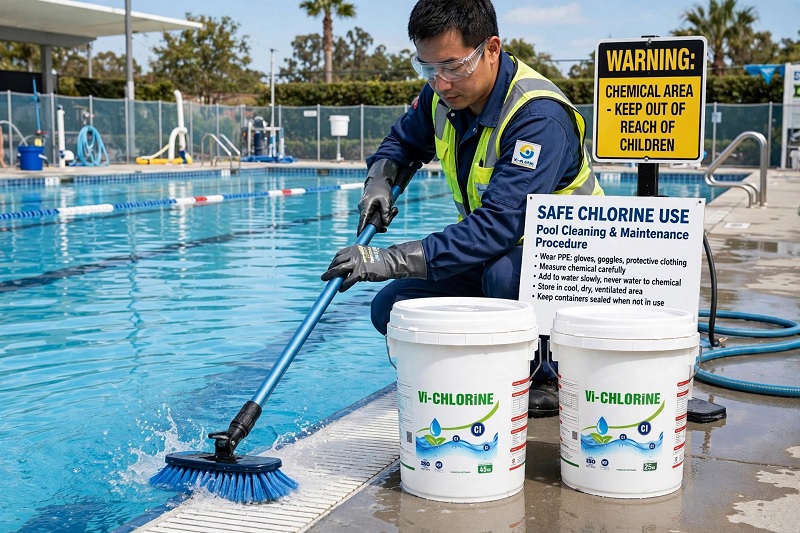
Proper chemical storage is essential regardless of whether chlorine is being used for a pool, aquaculture system, industrial water system, or other disinfection application.
Chlorine products should generally be:
- Stored in their original labeled packaging.
- Kept tightly closed when not in use.
- Protected from moisture.
- Stored in a cool and well-ventilated location.
- Kept away from combustible materials.
- Separated from acids and incompatible chemicals.
- Kept inaccessible to children.
Users should always review the product's safety data sheet and label for specific storage, handling, first-aid, and compatibility requirements.
Why Water Testing Matters When Using Chlorine Tablets for Kiddie Pool
Water testing turns chlorine treatment from guesswork into controlled water management.
At minimum, pool owners should understand free chlorine and pH. Depending on the system, other measurements such as total alkalinity, stabilizer concentration, calcium hardness, or combined chlorine may also be useful.
The most important principle is simple: chemical dose does not automatically equal final water concentration.
Once chlorine enters the water, some of it can immediately react with contaminants. Sunlight may degrade it, and environmental conditions may further change the residual. Testing confirms what remains available in the pool.
This principle is also fundamental in professional water treatment and aquaculture biosecurity. At industry events such as VietShrimp, technologies and operating practices increasingly focus on controlling pathogens before they spread through production systems. More details are available in AQUADELTA - Dr.Tom Accompanies Vietshrimp 2025: Vi-CHLORiNE Solution Enhancing Biosecurity in Aquaculture.
Chlorine Tablets for Kiddie Pool: Simple Maintenance Checklist
For convenient reference, pool owners can use the following basic checklist:
- Calculate the actual pool water volume.
- Read the chlorine product instructions carefully.
- Confirm the percentage of available chlorine.
- Test free chlorine before adding sanitizer.
- Check pH.
- Add only the calculated amount appropriate for the pool.
- Never place concentrated tablets directly on vulnerable pool surfaces unless specifically permitted.
- Keep children away while chemicals are being handled.
- Allow adequate circulation and dispersion.
- Retest the water before swimming.
- Remove leaves, dirt, and other debris regularly.
- Drain and clean very small pools when chemical treatment becomes impractical.
Good pool sanitation is not about using the greatest amount of chlorine. It is about maintaining the correct amount for the water conditions.
Choosing a Chlorine Product for Water Treatment
When selecting chlorine, buyers should consider more than price alone. Important product characteristics include:
- Available chlorine concentration
- Chemical purity
- Dissolution characteristics
- Packaging quality
- Storage stability
- Technical documentation
- Traceability
- Intended application
- Manufacturer or supplier support
Consumer swimming pool tablets and professional water-treatment chlorine products may differ significantly in concentration, tablet size, packaging, dissolution behavior, and recommended applications.
Always select a product specifically suited to the intended water-treatment process and follow the corresponding technical instructions.
Vi-CHLORiNE for Professional Water Treatment and Disinfection
While parents searching for chlorine tablets for kiddie pool usually need small-dose swimming pool products, larger water-treatment operations require products designed for professional applications.
Vi-CHLORiNE is developed for water disinfection, environmental sanitation, aquaculture biosecurity, and professional water-treatment applications. It is available in practical commercial packaging suitable for farms, water-treatment operators, distributors, and other professional users.
Potential applications include:
- Water disinfection
- Aquaculture pond preparation
- Equipment sanitation
- Biosecurity programs
- Water-treatment systems
- Environmental disinfection
When using chlorine products for professional applications, dosage should always be determined according to treatment objectives, water quality, active chlorine concentration, and applicable technical guidance.
Explore Vi-CHLORiNE products and learn more about chlorine solutions for water disinfection and aquaculture biosecurity.
Explore Vi-CHLORiNEFAQ About Chlorine Tablets for Kiddie Pool
1. Can I put chlorine tablets in a kiddie pool?
Yes, chlorine-based sanitizers may be used in some kiddie pools, but only when the product is suitable for the pool and the dose is calculated according to the actual water volume. A standard large swimming pool tablet may contain too much chlorine for a small children's pool. Always follow the product label and test the water before allowing children to swim.
2. How much chlorine tablet should I use in a kiddie pool?
The correct amount depends on pool volume, tablet weight, available chlorine concentration, existing free chlorine level, and desired chlorine residual. Do not dose by tablet count alone. Calculate the water volume first and verify the final free chlorine concentration using a pool test kit.
3. Can I put a chlorine tablet directly on the bottom of an inflatable pool?
Generally, concentrated chlorine tablets should not be left directly against vinyl or inflatable pool surfaces unless the manufacturer specifically recommends this method. High localized chlorine concentrations can bleach or damage pool materials. Use an approved dosing method appropriate for the pool size.
4. How long after adding chlorine tablets can kids swim?
There is no single waiting time that applies to every chlorine product. The correct time depends on the chemical formulation, dose, circulation, pool volume, and resulting free chlorine concentration. Follow the product instructions and test the water before swimming rather than relying only on elapsed time.
5. Are chlorine tablets necessary for a small kiddie pool?
Not always. Very small pools without filtration may be easier and safer to maintain by draining, cleaning, drying, and refilling them frequently. Larger kiddie pools that retain water for several days may benefit from controlled chlorination when proper testing, dosing, and circulation are available.
Note: This article provides general educational information about chlorine and water treatment. Always follow the specific chlorine manufacturer's instructions, the pool manufacturer's guidance, the product Safety Data Sheet, and applicable local health and swimming pool regulations.