
Chlorine in Sewage Treatment: How It Helps Grease Separation
- NEWS
- Q&A Chlorine
- 11/09/2026
Sewage treatment is a multi-stage process designed to remove solids, organic matter, pathogens, nutrients, oils, grease, and other contaminants before water is discharged, reused, or treated further.
Among the chemicals used in wastewater treatment, chlorine is one of the best known. It has traditionally been associated with disinfection, but its role can extend beyond pathogen control. In some treatment systems, chlorine may support odor control, oxidation of reduced compounds, slime control, and the breakdown of certain organic contaminants that interfere with treatment efficiency.
This has led to the statement that chlorine is used in the treatment of sewage to help grease separation. The statement contains an important truth, but it requires context.
Chlorine does not act like a mechanical grease separator. Instead, it may improve treatment conditions around grease removal by oxidizing contaminants, reducing biological growth, modifying wastewater characteristics, and helping control compounds associated with fats, oils, and grease.
Professional chlorine-based products such as vi chlorine are used in controlled water-treatment, sanitation, and biosecurity applications where chlorine dosage and operating conditions must be carefully managed.
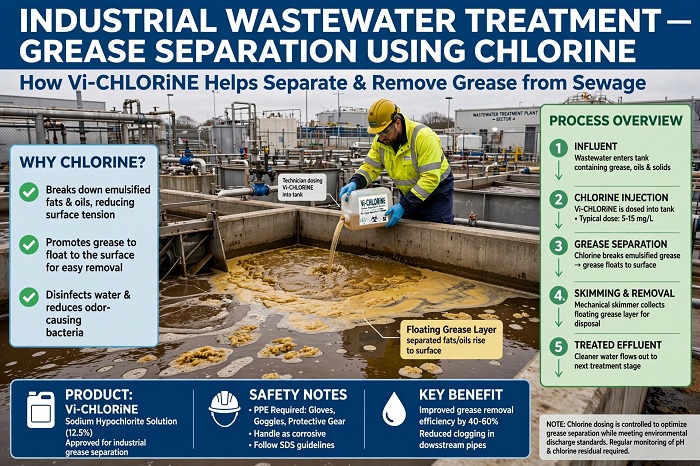
Why Chlorine Is Used in the Treatment of Sewage to Help Grease Separation
To understand why chlorine may support grease separation, it is first necessary to understand the behavior of fats, oils, and grease in wastewater.
These contaminants are commonly grouped under the abbreviation FOG:
- Fats
- Oils
- Grease
FOG can enter sewage systems from:
- Restaurants
- Food-processing plants
- Commercial kitchens
- Hotels
- Industrial facilities
- Households
- Meat and dairy processing
Some grease floats easily and can be skimmed from the surface. Other grease becomes emulsified into small droplets that remain suspended in wastewater.
Chlorine may influence this treatment process through oxidation and microbial control, helping reduce certain substances that stabilize emulsions or contribute to biological fouling.
This can make downstream physical or chemical separation processes more effective in some applications.
How Chlorine Is Used in the Treatment of Sewage to Help Grease Separation
Chlorine acts primarily as an oxidizing agent and disinfectant.
When chlorine is added to water, it forms active chlorine species. One important reaction can be simplified as:
Cl2 + H2O ⇌ HOCl + H+ + Cl−
Hypochlorous acid, HOCl, is a strong oxidizing and disinfecting species.
Depending on pH, hypochlorous acid can dissociate:
HOCl ⇌ H+ + OCl−
Both HOCl and OCl− contribute to oxidation and disinfection, although their relative effectiveness differs.
In sewage containing grease and organic contaminants, active chlorine may react with:
- Organic compounds
- Odor-causing substances
- Microorganisms
- Reduced sulfur compounds
- Biological slime
By reducing some of these interfering materials, chlorination can sometimes help prepare wastewater for more effective downstream grease removal.
Chlorine Is Used in the Treatment of Sewage to Help Grease Separation Through Oxidation
Oxidation is one of chlorine's most important functions in wastewater treatment.
Organic contaminants can create difficult conditions for separation systems. Some compounds act as emulsifying agents, keeping oil droplets finely dispersed in water.
Oxidation may change the characteristics of these compounds and reduce some of the factors that stabilize grease emulsions.
However, chlorine does not simply “dissolve grease.” That is a common misunderstanding.
Its role is more accurately described as supporting treatment conditions through chemical oxidation.
In larger professional treatment applications, chlorine is often supplied in industrial packaging. For example, vi chlorine 45kg is designed for professional water-treatment and disinfection operations.
Chlorine Is Used in the Treatment of Sewage to Help Grease Separation by Controlling Biological Slime
Wastewater systems frequently develop biological films and slime on pipes, tanks, screens, flotation equipment, and other surfaces.
These deposits can trap grease and suspended solids.
If biological growth becomes excessive, it can:
- Reduce hydraulic efficiency
- Increase clogging
- Trap additional grease
- Create odor problems
- Interfere with separation equipment
Controlled chlorination can help suppress unwanted biological growth in specific parts of a treatment system.
By reducing slime and microbial fouling, operators may improve the effectiveness of downstream oil and grease separation.
This does not mean chlorine should be added indiscriminately. Excessive chlorine can negatively affect beneficial microorganisms used in biological wastewater treatment.
Why Chlorine Is Used in the Treatment of Sewage to Help Grease Separation and Odor Control
Grease-rich wastewater often creates severe odor problems.
When organic material decomposes under low-oxygen conditions, compounds such as hydrogen sulfide and other reduced sulfur substances may form.
These compounds can produce strong and unpleasant odors.
Chlorine can oxidize some odor-causing compounds and suppress certain microorganisms responsible for anaerobic decomposition.
This is particularly useful in:
- Equalization tanks
- Collection systems
- Pumping stations
- Pre-treatment areas
- Grease-handling zones
Better odor control can improve operating conditions while grease is removed through physical or chemical methods.
Field experience with chlorine-based water management can also provide useful practical insight. What Do Local Farmers Say About Vi-CHLORiNE presents user experiences with chlorine-related treatment and biosecurity practices.
Is Chlorine the Main Reason Grease Separates in Sewage Treatment?
No.
This is one of the most important technical clarifications.
Although chlorine may support treatment conditions, grease separation is normally performed by physical, physicochemical, or biological treatment processes.
The most common technologies include:
- Grease traps
- Oil-water separators
- Skimming tanks
- Dissolved air flotation
- Coagulation and flocculation
- Sedimentation
- Biological treatment
Chlorine may complement some of these processes but should not be considered a substitute for properly designed grease-removal equipment.
How Grease Traps Work When Chlorine Is Used in the Treatment of Sewage to Help Grease Separation
Grease traps are among the simplest technologies used to remove fats, oils, and grease from wastewater.
They operate mainly on density differences.
Grease is usually less dense than water and therefore tends to rise toward the surface when the wastewater is allowed to slow down and remain relatively calm.
Heavier solids settle to the bottom, while grease accumulates at the top.
The clearer wastewater leaves through a separate outlet.
Chlorine is not necessary for this basic gravity-separation mechanism.
However, chlorination in other parts of a treatment train may help control microorganisms, odors, and slime that could otherwise interfere with overall system operation.
How Dissolved Air Flotation Works When Chlorine Is Used in the Treatment of Sewage to Help Grease Separation
Dissolved air flotation, or DAF, is widely used for removing oils, grease, and suspended solids from industrial wastewater.
The process creates microscopic air bubbles that attach to suspended materials and oil droplets.
These particles then rise to the surface, forming a floating sludge layer that can be mechanically removed.
DAF systems are frequently used in:
- Food processing
- Meat processing
- Dairy plants
- Industrial wastewater treatment
- High-FOG wastewater applications
In some treatment systems, controlled chemical oxidation may be used before or after flotation, but DAF itself performs the actual physical grease separation.
Chlorine Is Used in the Treatment of Sewage to Help Grease Separation Alongside Coagulation
Emulsified oil can be difficult to separate because the droplets are extremely small and remain stable in water.
Coagulation and flocculation are therefore commonly used to destabilize these particles.
Typical treatment chemicals may include:
- Aluminum-based coagulants
- Iron-based coagulants
- Polymers
- pH-adjustment chemicals
These chemicals help small particles and oil droplets form larger flocs that can be separated by sedimentation or flotation.
Chlorine may support the overall process through oxidation, but it is usually not the principal coagulant.
For facilities with moderate professional consumption requirements, Vi chlorine 25kg offers another packaging format for professional treatment and sanitation operations.
Chlorine Is Used in the Treatment of Sewage to Help Grease Separation Before Biological Treatment
This application requires particular care.
Biological wastewater-treatment systems depend on living microorganisms to break down organic pollutants.
These microorganisms are essential in processes such as:
- Activated sludge
- Moving bed biofilm reactors
- Sequencing batch reactors
- Biological aeration systems
Too much chlorine entering a biological treatment process can damage or kill the beneficial microorganisms.
Therefore, chlorination upstream of a biological system must be carefully controlled.
If chlorine is used for odor control, slime control, or oxidation before biological treatment, operators must consider:
- Chlorine dose
- Contact time
- Residual chlorine
- Wastewater organic load
- Biological sensitivity
Uncontrolled chlorination can reduce treatment performance rather than improve it.
Chlorine Is Used in the Treatment of Sewage to Help Grease Separation After Biological Treatment
Chlorination is more commonly associated with the final stages of wastewater treatment.
After solids and organic pollutants have been removed, chlorine may be added to disinfect the treated effluent.
The primary objective is to reduce pathogenic microorganisms before discharge or reuse.
Final chlorination may also provide secondary benefits related to odor and microbial control.
However, at this stage, most fats, oils, and grease should already have been removed by upstream treatment systems.
What Factors Affect How Chlorine Is Used in the Treatment of Sewage to Help Grease Separation?
The effectiveness of chlorine depends on multiple water-quality and operating factors.
pH
pH strongly affects the balance between hypochlorous acid and hypochlorite.
This influences chlorine's oxidation and disinfection performance.
Organic load
Wastewater with a high organic load can consume chlorine rapidly.
This is known as chlorine demand.
Temperature
Temperature influences reaction rates and biological activity.
Contact time
Chlorine requires sufficient contact time to achieve the intended chemical or disinfection effect.
Grease concentration
The amount and form of grease can determine whether physical separation, coagulation, flotation, or other methods are required.
Suspended solids
High suspended-solid concentrations can increase chlorine demand and reduce treatment efficiency.
Benefits When Chlorine Is Used in the Treatment of Sewage to Help Grease Separation
When correctly designed and controlled, chlorine may provide several benefits within a sewage-treatment process:
- Pathogen control
- Odor reduction
- Oxidation of selected contaminants
- Slime and biofilm control
- Improved sanitation
- Support for downstream treatment processes
These benefits explain why chlorine remains an important chemical in many water-treatment applications.
The growing importance of water quality and biosecurity can also be seen in aquaculture markets. Global Shrimp Market Outlook 2025: A Golden Opportunity for Asia discusses industry developments in which effective water management has become increasingly important.
Limitations When Chlorine Is Used in the Treatment of Sewage to Help Grease Separation
Chlorine should not be considered a universal solution for grease-rich wastewater.
Several limitations must be considered.
High chlorine demand
Sewage contains large quantities of organic material that can rapidly consume chlorine.
Impact on biological treatment
Excessive chlorine can inhibit beneficial microorganisms.
Formation of disinfection by-products
Chlorine can react with organic substances to form chlorinated by-products. Treatment design should therefore minimize unnecessary chlorine use.
Incomplete grease removal
Chlorine does not replace oil-water separators, grease traps, DAF systems, or other physical separation technologies.
Chemical handling risks
Concentrated chlorine products require careful storage, dosing, and handling.
Safety When Chlorine Is Used in the Treatment of Sewage to Help Grease Separation
Chlorine-based products are powerful oxidizing chemicals and must be handled according to technical instructions.
General safety requirements include:
- Use appropriate personal protective equipment.
- Store products in their original containers.
- Keep chlorine products dry when required.
- Store away from acids.
- Keep away from incompatible chemicals.
- Provide adequate ventilation.
- Follow the Safety Data Sheet.
- Use calibrated dosing equipment.
Chlorine products should never be mixed casually with other chemicals.
Mixing chlorine with acids can release hazardous chlorine gas.
How to Optimize When Chlorine Is Used in the Treatment of Sewage to Help Grease Separation
The most effective approach is to treat chlorine as one part of an integrated wastewater-treatment system.
A typical grease-rich wastewater process might include:
- Screening to remove large solids.
- Grease trapping or primary oil separation.
- Equalization.
- pH adjustment if needed.
- Coagulation and flocculation.
- DAF or sedimentation.
- Biological treatment.
- Secondary clarification.
- Filtration if required.
- Final disinfection.
Chlorine can be introduced at selected points for specific objectives such as odor control, microbial control, oxidation, or final disinfection.
The correct treatment point should be determined by wastewater characteristics and process design.
Why Chlorine Is Used in the Treatment of Sewage to Help Grease Separation in Broader Water Management
The principles of chlorination used in sewage treatment are also relevant to other water-management industries.
Effective chlorination requires control of:
- Water volume
- Chlorine concentration
- Organic load
- pH
- Temperature
- Contact time
- Target microorganisms
This is especially important in aquaculture, where water quality and biosecurity can directly affect animal health and production performance.
Industry programs increasingly combine chlorination with broader biosecurity strategies. One example is AQUADELTA - Dr.Tom Accompanies Vietshrimp 2025: Vi-CHLORiNE Solution Enhancing Biosecurity in Aquaculture.
Vi-CHLORiNE When Chlorine Is Used in the Treatment of Sewage to Help Grease Separation
The statement “chlorine is used in the treatment of sewage to help grease separation” is best understood as part of a broader wastewater-treatment strategy.
Chlorine can support sewage and industrial water treatment through oxidation, disinfection, odor control, and biological-fouling control. However, actual grease separation normally relies on physical and physicochemical technologies such as grease traps, oil-water separators, flotation, coagulation, and skimming.
Vi-CHLORiNE provides chlorine-based solutions for professional water treatment, sanitation, environmental disinfection, and aquaculture biosecurity.
Potential professional applications include:
- Water disinfection
- Environmental sanitation
- Process-water treatment
- Aquaculture pond preparation
- Equipment sanitation
- Biosecurity programs
Professional treatment should always be based on actual water quality, chlorine demand, water volume, treatment objective, contact time, and applicable technical requirements.
Explore Vi-CHLORiNE solutions for water disinfection, aquaculture biosecurity, environmental sanitation, and professional water-management applications.
Explore Vi-CHLORiNEFAQ: Chlorine Is Used in the Treatment of Sewage to Help Grease Separation
1. Does chlorine directly separate grease from sewage?
Not usually. Chlorine primarily acts as an oxidizing and disinfecting agent. It may help improve conditions for grease removal by controlling microorganisms, odors, slime, and certain organic compounds, but grease separation itself is normally achieved using grease traps, skimming, dissolved air flotation, coagulation, or other physical and physicochemical processes.
2. Why is chlorine added to sewage treatment systems?
Chlorine may be used for disinfection, odor control, slime control, oxidation of selected compounds, and final effluent treatment. Its exact role depends on the wastewater characteristics and the treatment-process design.
3. Can chlorine remove fats, oils, and grease from wastewater?
Chlorine may oxidize some organic material and support the overall treatment process, but it is not normally the main technology used to remove fats, oils, and grease. Mechanical separation, flotation, coagulation, and biological treatment are generally more important for actual FOG removal.
4. Can too much chlorine damage a wastewater-treatment system?
Yes. Excessive chlorine can inhibit or kill beneficial microorganisms used in biological wastewater treatment. It can also increase chemical costs and contribute to unwanted chlorinated by-products. Chlorine dosage should therefore be carefully controlled.
5. What is the best way to remove grease from sewage?
The best method depends on grease concentration, whether the grease is free-floating or emulsified, wastewater flow, and the overall treatment objective. Common technologies include grease traps, oil-water separators, dissolved air flotation, coagulation and flocculation, skimming, and biological treatment.
Conclusion: Chlorine is used in the treatment of sewage to help grease separation primarily as a supporting chemical rather than as the main grease-removal mechanism. Through oxidation, microbial control, slime reduction, odor control, and improved treatment conditions, chlorination can contribute to a more effective wastewater process. The actual removal of fats, oils, and grease is typically performed using physical or physicochemical technologies such as grease traps, oil-water separators, dissolved air flotation, coagulation, and skimming. The most effective sewage-treatment systems combine controlled chemical treatment with appropriate mechanical and biological processes.
Disclaimer: This article provides general educational information about chlorine and wastewater treatment. Chlorine products vary in composition and concentration. Industrial wastewater treatment should be designed and operated by qualified professionals according to the product Safety Data Sheet, technical documentation, discharge requirements, and applicable environmental regulations.