
Chlorine in Sewage Treatment: How It Aids Flocculation
- NEWS
- Q&A Chlorine
- 18/09/2026
Sewage contains a complex mixture of suspended solids, colloidal particles, microorganisms, dissolved organic matter, nutrients, oils, proteins, detergents, and other contaminants. Many of the smallest particles remain suspended because they are too fine to settle naturally. This is why coagulation and flocculation are important treatment processes.
In a conventional physicochemical treatment system, a coagulant destabilizes fine particles, while gentle mixing allows those destabilized particles to combine into larger aggregates called flocs. The flocs can then be removed through sedimentation, flotation, or filtration.
Where does chlorine fit into this process? Chlorine is primarily an oxidant and disinfectant. Under controlled conditions, however, chlorination can change the characteristics of wastewater before downstream treatment. These changes may indirectly support floc formation and solids removal.
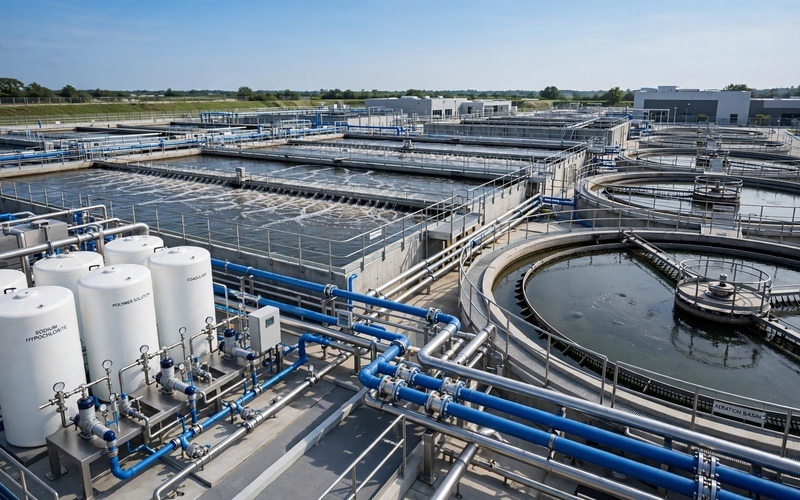
Why Chlorine Is Used in the Treatment of Sewage to Aid Flocculation
Chlorine has been used extensively in municipal and industrial water treatment because of its strong oxidizing and disinfecting properties. Depending on the application, chlorine may be introduced as chlorine gas, sodium hypochlorite, calcium hypochlorite, or other chlorine-releasing compounds.
When chlorine enters water, it produces active chlorine species. A simplified reaction is:
Cl2 + H2O ⇌ HOCl + H+ + Cl−
Hypochlorous acid can then dissociate:
HOCl ⇌ H+ + OCl−
Hypochlorous acid and hypochlorite participate in oxidation and disinfection reactions. Their relative proportions depend strongly on pH.
These reactions are important because wastewater contaminants can affect coagulation and flocculation. Biological slime, reduced compounds, sulfides, some organic substances, and other constituents may influence particle interactions or consume treatment chemicals.
Controlled chlorination can alter some of these conditions before the wastewater reaches the coagulation-flocculation stage. In this sense, chlorine can be considered a supporting pretreatment chemical rather than the principal flocculant.
For organizations evaluating chlorine-based products for water-management applications, additional information is available from vi chlorine.
How Chlorine Aids Flocculation in Sewage Treatment
The phrase “chlorine aids flocculation” should not be interpreted to mean that chlorine itself behaves like conventional alum, ferric chloride, polyaluminum chloride (PAC), or polymer flocculants.
Its contribution is generally indirect and depends on wastewater chemistry and process design.
1. Pre-oxidation of certain contaminants
Chlorine is a powerful oxidizing agent. In sewage containing reactive organic and inorganic substances, chlorine may oxidize some compounds before coagulation occurs.
Pre-oxidation can change the chemical environment in which colloidal particles and coagulants interact. Depending on the wastewater, this may improve subsequent solids separation. In other situations, however, pre-chlorination may provide little benefit or may even be undesirable.
This is why treatment performance should be confirmed through laboratory testing rather than assumed from chlorine concentration alone.
2. Control of biological slime
Wastewater systems can develop biofilms and excessive biological slime in pipes, tanks, channels, and treatment equipment. These biological deposits can interfere with hydraulic performance and contribute to unstable solids behavior.
Controlled chlorination may suppress excessive microbial growth in appropriate process locations. Better control of slime can help maintain more predictable operating conditions for subsequent treatment stages.
3. Oxidation of reduced compounds
Sewage may contain sulfides and other reduced substances, particularly where anaerobic conditions develop. Chlorine can react with some of these compounds.
Reducing their concentration may improve odor control and alter the chemical environment before coagulation and flocculation.
4. Supporting particle removal
The effectiveness of flocculation depends on particle characteristics, surface charge, mixing intensity, coagulant dose, pH, alkalinity, temperature, and the presence of interfering substances.
When chlorination modifies substances that interfere with particle destabilization, the downstream coagulation-flocculation process may operate more effectively. This effect is highly wastewater-specific.
What Is Flocculation in Sewage Treatment?
Flocculation is the process of bringing destabilized fine particles together so they form larger aggregates that are easier to separate from water.
It is important to distinguish coagulation from flocculation.
Coagulation is primarily the destabilization of suspended and colloidal particles. A coagulant neutralizes or reduces the forces that keep particles apart.
Flocculation follows coagulation. Gentle mixing increases contact between destabilized particles, allowing them to form progressively larger flocs.
The resulting flocs can then be separated using sedimentation, dissolved air flotation, filtration, or another solids-removal process.
In facilities requiring chlorine products in larger packaging formats, vi chlorine 45kg may provide an option depending on treatment volume, storage arrangements, dosing requirements, and the product's technical specifications.
Chlorine, Coagulation and Flocculation: What Is the Difference?
Chlorination, coagulation, and flocculation perform different functions and should not be treated as interchangeable processes.
| Process | Main Purpose | Typical Function |
|---|---|---|
| Chlorination | Oxidation and microbial control | Disinfection, oxidation, odor and biological-growth control |
| Coagulation | Particle destabilization | Reduces forces keeping colloids suspended |
| Flocculation | Floc formation | Combines destabilized particles into larger aggregates |
| Sedimentation | Solid-liquid separation | Allows sufficiently dense flocs to settle |
| DAF | Flotation separation | Uses fine air bubbles to float flocs and contaminants |
| Filtration | Polishing | Captures remaining suspended particles |
Therefore, chlorine should not automatically be substituted for a dedicated coagulant or flocculant. Instead, it may be integrated into the overall treatment train where oxidation or microbial control provides a measurable process benefit.
How Pre-Chlorination Can Aid Flocculation in Sewage Treatment
Pre-chlorination means introducing chlorine before one or more major treatment processes rather than applying it only at the final disinfection stage.
A simplified treatment train might look like:
Screening → Pre-Chlorination/Oxidation → Coagulation → Flocculation → Sedimentation or DAF → Biological Treatment → Clarification → Final Disinfection
This arrangement is only illustrative. Actual treatment sequences vary significantly depending on wastewater characteristics and local requirements.
When pre-chlorination is considered, operators should first identify a specific treatment objective. Examples could include controlling sulfide, reducing biological slime, oxidizing selected contaminants, or improving the consistency of downstream treatment.
Adding chlorine without defining the objective can increase chemical consumption while producing little improvement.
Factors Affecting Chlorine-Assisted Flocculation in Sewage
Several factors determine whether chlorination improves or interferes with downstream flocculation.
Wastewater pH
pH affects both chlorine chemistry and coagulation chemistry. It determines the relative proportions of HOCl and OCl− and also affects the performance of aluminum- and iron-based coagulants.
A treatment process should therefore consider the optimum pH ranges of both oxidation and coagulation.
Organic loading
Sewage with high concentrations of organic matter can exert substantial chlorine demand. Chlorine may be consumed by organic compounds before the intended treatment effect is achieved.
Ammonia
Ammonia reacts with chlorine and can form chloramines. This changes chlorine chemistry and influences the available disinfecting or oxidizing species.
Sulfides and other reducing compounds
Reduced substances consume chlorine rapidly. If these contaminants are present at high concentrations, they should be included in chlorine-demand calculations.
Coagulant type
Aluminum sulfate, ferric salts, PAC, and other coagulants behave differently. Their effectiveness depends on pH, alkalinity, contaminant composition, and dosage.
Mixing intensity
Coagulation generally requires rapid chemical dispersion, whereas flocculation requires slower and controlled mixing. Excessive shear during flocculation can break formed flocs into smaller particles.
Contact time
Oxidation reactions need sufficient time to occur. Chlorine contact time before coagulation should therefore be optimized according to the specific treatment objective.
Benefits of Using Chlorine to Aid Sewage Treatment and Flocculation
When correctly applied, chlorine-based pretreatment may offer benefits beyond its indirect influence on flocculation.
Microbial control: Chlorine can reduce selected microorganisms and control excessive biological growth.
Odor control: Oxidation of certain reduced sulfur compounds can contribute to odor management.
Biofilm management: Chlorination can help control slime accumulation in suitable parts of a treatment system.
Process stability: Where interfering contaminants are successfully controlled, downstream physicochemical treatment may become more predictable.
Disinfection: Chlorine remains widely used as a disinfecting agent when applied at an appropriate stage and dose.
Experiences involving chlorine-based water-management practices can also be explored in What Do Local Farmers Say About Vi-CHLORiNE, which provides practical context from another water-intensive sector.
Limitations of Chlorine Used to Aid Flocculation
Chlorine offers useful oxidation capabilities, but its limitations are equally important.
Chlorine is not a conventional coagulant
Chlorine should not normally replace aluminum salts, iron salts, PAC, polymers, or other treatment chemicals specifically selected for coagulation and flocculation.
High chlorine demand can increase cost
Wastewater rich in organic matter, ammonia, sulfides, and reducing compounds can consume large amounts of chlorine. Poorly controlled dosing may therefore be inefficient.
Biological treatment may be affected
Biological sewage treatment depends on microorganisms. Excess chlorine entering an activated sludge tank or other biological reactor can inhibit the organisms responsible for removing biodegradable pollutants.
Potential disinfection by-products
Chlorine can react with organic substances to produce chlorinated reaction products. Their significance depends on wastewater composition, chlorine dose, contact time, downstream treatment, and applicable discharge or reuse requirements.
Corrosion and chemical safety
Chlorine-releasing chemicals are oxidizing substances. Storage systems, pumps, valves, piping, seals, and dosing equipment should be chemically compatible with the product being used.
How to Optimize Chlorine Dosage for Flocculation in Sewage Treatment
There is no universal chlorine dose for improving sewage flocculation. A dosage that works at one treatment plant may be ineffective or excessive at another.
The correct approach is to establish the treatment objective first and then determine dosage experimentally and operationally.
Important parameters include:
- pH;
- COD and BOD;
- total suspended solids;
- turbidity;
- ammonia;
- sulfides;
- organic matter;
- chlorine demand;
- coagulant type and dose;
- mixing intensity;
- contact time;
- floc size and settling behavior;
- residual chlorine.
For difficult wastewater, laboratory jar testing can be particularly valuable. Operators can compare different combinations of chlorine pretreatment, coagulant dose, pH, mixing conditions, and settling time.
The objective should be the lowest effective chemical dose that consistently achieves the required treatment performance, rather than simply maximizing chlorine concentration.
Jar Testing Chlorine-Assisted Coagulation and Flocculation
A jar test is a laboratory-scale method commonly used to evaluate coagulation and flocculation conditions.
Representative wastewater samples are placed in multiple containers. Different chemical doses or process conditions can then be compared under controlled mixing and settling conditions.
For a study involving chlorine pretreatment, one sample can be maintained as a control while other samples receive carefully selected chlorine doses before the coagulant is introduced.
Operators can then compare parameters such as:
- floc formation time;
- floc size and strength;
- settling rate;
- supernatant turbidity;
- color;
- COD removal;
- suspended solids removal;
- residual chlorine;
- coagulant consumption.
Testing is especially important because oxidation can sometimes improve treatment but can also alter organic matter in ways that do not improve coagulation. Real wastewater data should determine the final process configuration.
Chlorine Safety in Sewage Treatment and Flocculation Systems
Chlorine-releasing chemicals should always be handled according to the manufacturer's Safety Data Sheet, operating instructions, facility procedures, and applicable regulations.
Important safety practices include using suitable personal protective equipment, ensuring adequate ventilation, preventing contamination of storage areas, using compatible dosing equipment, providing spill-response procedures, and training personnel responsible for chemical handling.
Chlorine-based chemicals must not be casually mixed with acids or incompatible materials. Acidification of hypochlorite products can release hazardous chlorine gas.
For treatment facilities where a smaller packaging format better matches consumption and storage requirements, Vi chlorine 25kg may provide another option subject to product specifications and application requirements.
Chlorine in Sewage Treatment Compared with Common Flocculation Chemicals
Choosing the correct chemical depends on the treatment objective.
| Chemical/Process Aid | Primary Role | Relationship to Flocculation |
|---|---|---|
| Chlorine | Oxidation and microbial control | May indirectly improve conditions in selected applications |
| Aluminum sulfate | Coagulation | Destabilizes colloidal particles |
| PAC | Coagulation | Promotes particle destabilization and floc formation |
| Ferric chloride | Coagulation | Forms precipitates that capture contaminants |
| Polymer | Flocculation aid | Bridges particles and strengthens flocs |
| Chlorine + coagulant | Oxidation plus coagulation | Can be evaluated where pretreatment improves downstream separation |
This comparison highlights an important point: chlorine and conventional coagulants serve different functions. The question is not necessarily which chemical is “better,” but which combination matches the wastewater and treatment objective.
Applications of Chlorine Beyond Sewage Flocculation
Chlorine chemistry is used in many water-management sectors, including municipal water treatment, wastewater disinfection, sanitation, industrial process water, swimming pools, and aquaculture.
The treatment objective and required residual vary substantially between these applications. Chlorine dosage used for sewage oxidation should therefore never be transferred directly to aquaculture, drinking-water treatment, or another application without appropriate technical assessment.
Water quality is also an important consideration in aquaculture development. Industry perspectives and market context are discussed in Global Shrimp Market Outlook 2025: A Golden Opportunity for Asia.
Best Practices When Chlorine Is Used to Aid Flocculation
A well-controlled treatment program should follow several fundamental principles.
- Analyze the wastewater first. Do not determine chlorine dose without understanding contaminant loading.
- Define the treatment objective. Determine whether chlorine is intended for sulfide oxidation, microbial control, odor management, pretreatment, or final disinfection.
- Run comparative tests. Compare treatment performance with and without pre-chlorination.
- Optimize pH. Both chlorine chemistry and coagulant chemistry are pH-dependent.
- Control mixing. Use rapid mixing for chemical dispersion and gentler mixing for floc growth.
- Monitor residual chlorine. Prevent unwanted carryover into sensitive biological treatment stages.
- Track treatment results. Measure turbidity, TSS, COD, floc quality, settling performance, and other relevant indicators.
- Review chemical consumption. Optimize chlorine and coagulant doses together rather than independently.
These principles help ensure that chlorine is used for a clearly defined process benefit rather than as an uncontrolled addition to the treatment system.
Vi-CHLORiNE for Sewage and Water Treatment Applications
Vi-CHLORiNE provides chlorine-based solutions for water-management applications where controlled oxidation, sanitation, microbial management, and chlorination are required.
When evaluating a chlorine product for sewage treatment, engineers and operators should consider active chlorine specifications, treatment volume, wastewater characteristics, storage conditions, dosing equipment, contact time, chlorine demand, and the required treatment objective.
In coagulation-flocculation systems, chlorine should be viewed as a potential pretreatment or supporting chemical. Dedicated coagulants and flocculants remain responsible for particle destabilization and floc development where those processes are required.
The use of chlorine products in broader water-quality and biosecurity programs is also discussed in AQUADELTA - Dr.Tom Accompanies Vietshrimp 2025: Vi-CHLORiNE Solution Enhancing Biosecurity in Aquaculture.
Vi-CHLORiNE offers practical chlorine product formats for water treatment, sanitation, microbial control, aquaculture biosecurity, and selected wastewater-treatment applications.
Contact the Vi-CHLORiNE team for product specifications, packaging options, application information, and technical guidance based on your water-treatment requirements.
FAQ: Chlorine Is Used in the Treatment of Sewage to Aid Flocculation
1. Why is chlorine used in the treatment of sewage to aid flocculation?
Chlorine may be used as a pretreatment oxidant to modify certain contaminants, control excessive biological growth, oxidize reduced compounds, and improve treatment conditions before coagulation and flocculation. Its effect is generally indirect and depends on wastewater chemistry and process design.
2. Is chlorine a coagulant or flocculant in sewage treatment?
No. Chlorine is primarily an oxidizing and disinfecting agent. Conventional coagulants such as aluminum sulfate, PAC, and ferric salts are specifically used to destabilize colloidal particles, while polymers may be used as flocculation aids. Chlorine can support these processes in selected applications but does not normally replace them.
3. How does chlorine improve flocculation?
Controlled pre-chlorination can oxidize certain interfering compounds, reduce biological slime, and modify wastewater conditions before coagulants are added. Where these changes improve particle destabilization or solids separation, downstream flocculation may become more effective. The result should be verified through jar testing or pilot testing.
4. Can too much chlorine reduce sewage treatment efficiency?
Yes. Excessive chlorine can increase operating costs, affect biological treatment microorganisms, contribute to corrosion, and increase the potential formation of chlorinated by-products. Chlorine dosage should therefore be based on wastewater characteristics, chlorine demand, process objectives, and residual monitoring.
5. Can Vi-CHLORiNE be used in wastewater treatment?
Chlorine-based products may be applied in appropriately designed water and wastewater treatment processes for oxidation, sanitation, and microbial-control objectives. The appropriate product, dosage, injection point, and contact time should be determined according to the wastewater characteristics, treatment process, product specifications, and applicable requirements.
Conclusion: Chlorine Is Used in Sewage Treatment to Support Flocculation
Chlorine plays an important role in water and sewage treatment because of its strong oxidation and microbial-control properties. In selected treatment configurations, controlled chlorination can also aid coagulation and flocculation indirectly by modifying certain wastewater contaminants, controlling biological growth, oxidizing reduced compounds, and creating more favorable conditions for downstream solids separation.
However, chlorine should not be confused with a conventional coagulant or flocculant. Aluminum salts, iron salts, PAC, polymers, and similar chemicals perform the primary functions of particle destabilization and floc formation.
The most effective approach is therefore an integrated one: characterize the sewage, identify the treatment objective, determine chlorine demand, select an appropriate coagulant, optimize pH and mixing, conduct jar testing where necessary, and continuously monitor treatment performance.
When these factors are properly controlled, chlorine can become a valuable component of a broader sewage-treatment strategy while supporting efficient clarification, microbial management, odor control, and overall water-quality improvement.