
Chlorine for Fish Hatcheries & Tanks: Dosage, Time, Safety
- NEWS
- Q&A Chlorine
- 09/10/2026
Chlorine is one of the most practical disinfectants for fish hatcheries and tanks, but only when the dose, contact time and safety routine are right. This guide explains how much chlorine to use for tanks, equipment and hatchery water, how long it needs to act, how to neutralize it before fish return, and how to handle it safely.
A hatchery is where a farm's future is decided. Larvae, fry and fingerlings are far more sensitive to bacteria, viruses and parasites than market-size animals, so a small hygiene failure can wipe out an entire batch. Because hatcheries supply the seed for every grow-out pond downstream, their performance shapes the whole value chain, a trend explored in Global Shrimp Market Outlook: A Golden Opportunity for Asia.
Chlorine remains a core tool for hatchery biosecurity because it is fast, affordable and effective against a wide range of microbes. This article covers chlorine for fish hatcheries and tanks, with clear guidance on dosage, contact time and safety.
Chlorine for Fish Hatcheries and Tanks: Quick Answer
For fish hatcheries and tanks, chlorine is typically used on empty tanks, equipment and water supplies, never on live fish. Empty tanks and tools are commonly disinfected at roughly 50 to 200 ppm of active chlorine for 30 to 120 minutes, while incoming water is often treated at about 10 to 30 ppm for several hours. After treatment, rinse and neutralize the chlorine until a test kit reads zero before any animals are introduced.
The basic workflow is:
- Empty the tank and scrub away biofilm and organic matter.
- Calculate the dose and prepare the chlorine solution.
- Apply and keep surfaces wet for the full contact time.
- Rinse thoroughly and neutralize residual chlorine.
- Test for zero chlorine and refill with clean water.
Why Fish Hatcheries and Tanks Need Chlorine Disinfection
Hatchery tanks are warm, nutrient-rich and heavily stocked, which is ideal for pathogens. Biofilm builds on walls, pipes, airstones and nets, and it can shelter bacteria such as Vibrio, Aeromonas and Streptococcus between production cycles. Without proper disinfection, these microbes carry over to the next batch.
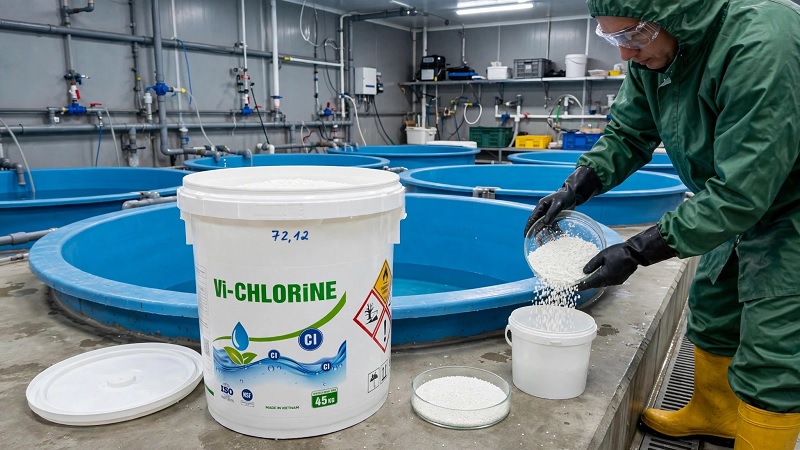
Empty fish hatchery tanks being prepared for chlorine disinfection
Chlorine helps hatcheries by:
- Killing bacteria and many viruses on tank surfaces and equipment.
- Breaking down biofilm when combined with scrubbing.
- Sterilizing incoming water that may carry wild organisms and pathogens.
- Supporting all-in, all-out management with a clean reset between batches.
Why Choose Calcium Hypochlorite for Hatchery and Tank Disinfection?
Hatcheries use several chlorine sources, but granular calcium hypochlorite is especially practical. It is concentrated, stable when stored dry, and easy to weigh and dissolve for precise dosing, which matters when you are working with small volumes. Compared with liquid bleach, it contains far more active chlorine per kilogram, so storage and transport are simpler.
For farms and hatcheries looking for a consistent supply, Vi Chlorine is a granular calcium hypochlorite with a minimum of 70% active chlorine, produced by Viet Tri Chemical JSC and exported through VIETCHEM. It dissolves quickly in water, and its stable chlorine content makes dose calculations reliable from one disinfection cycle to the next.
Chlorine Dosage for Fish Hatcheries and Tanks: A ppm Guide
Dosage is expressed in ppm (mg/L) of active chlorine. The correct level depends on what you are treating and how clean it is. These ranges are commonly used as starting points, so always confirm them against your hatchery's protocol, species requirements and local regulations:
| What you are disinfecting | Typical active chlorine | Typical contact time |
|---|---|---|
| Empty tanks, raceways and concrete surfaces | 100 to 200 ppm | 1 to 2 hours |
| Nets, buckets and small tools | 50 to 200 ppm | 30 to 60 minutes |
| Pipes and water lines (after cleaning) | 50 to 200 ppm | 1 to 2 hours |
| Footbaths and hand-wash stations | 100 to 200 ppm | Replace solution daily |
| Incoming seawater or freshwater | 10 to 30 ppm | Several hours, with aeration |
Because Vi-Chlorine contains 70% active chlorine, divide the required ppm by 0.70 to find the amount of product. Use this table for every 1,000 liters (1 m³) of solution:
| Target active chlorine | 70% calcium hypochlorite per 1 m³ |
|---|---|
| 10 ppm | about 14 g |
| 30 ppm | about 43 g |
| 50 ppm | about 71 g |
| 100 ppm | about 143 g |
| 200 ppm | about 286 g |
Worked example: To disinfect a 5 m³ tank at 200 ppm, you need about 5 × 286 g = 1.43 kg of product. At that rate, one bag of Vi chlorine 25kg would be enough to prepare roughly 87 m³ of 200 ppm solution, which is a practical size for small and mid-size hatcheries.
Chlorine Contact Time in Hatchery Disinfection: What Matters
Disinfection depends on both concentration and time. A lower dose can work if the contact time is longer, and a higher dose can shorten the time needed. This concentration-and-time relationship explains why surfaces must stay wet with the solution for the full period rather than just being rinsed with it.
Contact time is affected by:
- Organic matter. Mucus, feed and algae consume chlorine, so scrub first and rinse.
- Temperature. Warmer conditions generally speed reactions, but also cause chlorine to decay faster.
- pH. Chlorine works best at neutral to slightly alkaline pH, because more of it exists as hypochlorous acid, its most powerful form.
- Turbidity. Cloudy water needs a higher dose or pre-filtration.
- Surface type. Rough or cracked concrete traps microbes and may need longer exposure.
Step-by-Step: How to Disinfect an Empty Fish Tank or Hatchery with Chlorine
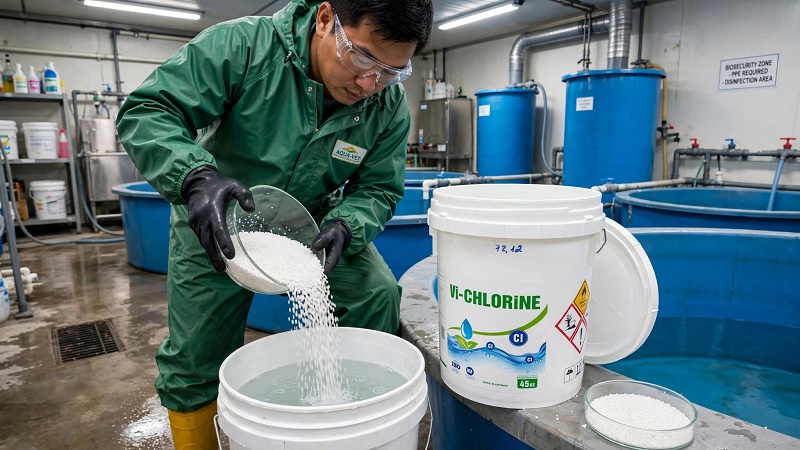
- Remove all animals. Never apply disinfection-strength chlorine to live fish, eggs or larvae.
- Drain the tank and remove debris, sludge and loose biofilm.
- Scrub and rinse. Use a brush and clean water, because organic matter reduces chlorine strength.
- Weigh the product using the dosage table and wear full protective equipment.
- Dissolve in a bucket of water, always adding the granules to the water, never water to the granules.
- Apply the solution to walls, floors, drains, airlines and fittings, or fill the tank to the working level.
- Keep everything wet for the full contact time, and recirculate through pipes where possible.
- Drain and rinse thoroughly with clean water, preferably several times.
- Neutralize and test as described below before refilling for production.
Disinfecting Hatchery Water, Pipes and Equipment
Clean tanks can be re-contaminated by dirty pipes and shared tools. Flush water lines with chlorine solution after cleaning, soak nets and buckets between tanks, and assign dedicated equipment to each room where possible. Water intake systems, reservoirs and filters deserve regular attention too, since they are the main route for wild organisms to enter the hatchery.
For incoming water, many hatcheries filter first, chlorinate at around 10 to 30 ppm with aeration, then neutralize and settle before use. Practical experience matters here, because every site has different water quality. To see how disinfection is applied in real aquaculture operations, you can read What Do Local Farmers Say About Vi-CHLORiNE.
Dechlorination: Making Hatchery Tanks Safe for Fish After Chlorine
Fish and larvae are extremely sensitive to chlorine. Aquatic life guidelines generally place harmful levels at only about 0.01 to 0.02 mg/L, which is far below what simple smell or color can reveal. Disinfected tanks and water must therefore be fully neutralized before animals are introduced.
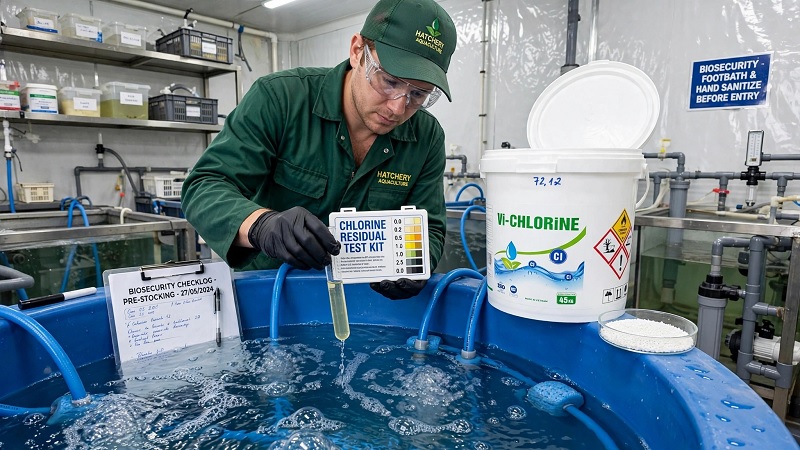
Testing residual chlorine in a hatchery tank before stocking fish
To remove chlorine safely:
- Rinse and aerate. Strong aeration and sunlight help chlorine escape from water naturally.
- Use sodium thiosulfate to neutralize residual chlorine quickly. Start with a low dose, mix well, and retest after 15 to 30 minutes.
- Test with a DPD kit. The target is zero total chlorine, measured at several points in the tank.
- Run a small bioassay. Keep a few healthy animals in the refilled tank for 24 hours before full stocking.
Chlorine Safety in Fish Hatcheries: Handling, Storage and PPE
Calcium hypochlorite is a strong oxidizer, so safety training is essential for every team member who handles it. Follow these rules:
- Wear PPE: chemical-resistant gloves, goggles or a face shield, a respirator or mask, and waterproof clothing.
- Ensure ventilation. Never prepare strong solutions in a closed or confined space.
- Never mix chlorine with acids, ammonia, fuel, oils or other chemicals, because toxic gases or fire can result.
- Store it dry, sealed, cool and away from sunlight, organic materials and fertilizers.
- Keep water available for eye and skin washing, and rinse immediately after any contact.
- Neutralize wastewater before discharge and follow local environmental regulations.
Common Mistakes When Using Chlorine in Fish Hatcheries and Tanks
- Skipping the cleaning step. Chlorine cannot penetrate thick biofilm or organic waste.
- Guessing the dose. Too little leaves pathogens alive; too much corrodes equipment and wastes product.
- Cutting contact time short. Surfaces must stay wet for the full period.
- Refilling before testing. Always confirm zero chlorine, even if the tank smells clean.
- Forgetting pipes and fittings. Hidden biofilm can restart contamination.
- Using old solutions. Prepared chlorine solutions lose strength, so mix fresh batches.
Building a Hatchery Biosecurity Program Around Chlorine
Chlorine works best as one part of a full program: controlled access, footbaths, quarantine for new broodstock, pathogen screening, filtered water and strict all-in, all-out cycles. Disinfection and technical support reinforce each other, as shown in AQUADELTA - Dr.Tom Accompanies Vietshrimp: Vi-CHLORiNE Solution Enhancing Biosecurity in Aquaculture.
Planning Chlorine Supply for Hatcheries and Tank Disinfection
Disinfection days are tightly scheduled between batches, so you should never run short of product. Estimate the total volume of tanks, reservoirs and water lines, choose your target ppm, and keep a safety margin. Larger hatcheries and integrated farms benefit from Vi chlorine 45kg packs, since a single bag can treat about 1,050 m³ of water at 30 ppm and cut down on the number of packages to open and handle.
Conclusion: Safe, Effective Chlorine Use in Fish Hatcheries and Tanks
Chlorine gives hatcheries a quick, affordable reset between production cycles. Clean first, use the correct ppm, allow the full contact time, rinse and neutralize, then test for zero before any animals return. Combined with good biosecurity and safe handling, it protects your most vulnerable and valuable stock.
Need Calcium Hypochlorite 70% for Your Hatchery?
Get a quote, product specifications, and export support from our team. Available 24/7 on WhatsApp: (+84) 981 370 389 or email telesales@vi-chlorine.com.
Request a Quote NowFAQ: Hatchery Disinfection and Shrimp Pond Preparation
1. How does hatchery disinfection relate to shrimp pond preparation?
Both aim to remove pathogens before animals are introduced. Hatcheries disinfect tanks, equipment and water to protect larvae, while shrimp pond preparation disinfects the pond and its water before stocking. Clean seed and a clean pond together give the lowest disease risk.
2. What chlorine dosage is used to disinfect empty fish tanks?
Empty tanks and surfaces are commonly disinfected at about 100 to 200 ppm of active chlorine for one to two hours. With 70% calcium hypochlorite, that equals roughly 143 to 286 g of product per cubic meter of solution.
3. How long should chlorine stay in contact with tanks and equipment?
Most protocols allow 30 to 120 minutes of wet contact, depending on the dose and how clean the surface is. Remove organic matter first, because dirt and biofilm consume chlorine and reduce its effect.
4. How do I make a tank safe for fish after using chlorine?
Rinse thoroughly, aerate, and use sodium thiosulfate if needed. Retest with a chlorine test kit until the reading is zero, then run a small bioassay with a few animals before stocking the full tank, just as you would before shrimp pond preparation ends.
5. Can I use chlorine directly on live fish, eggs or larvae?
No. Disinfection-strength chlorine is only for empty tanks, equipment and water that will be neutralized before use. Even very low residual chlorine can damage the gills of fish and larvae, so confirm zero chlorine before any animals return.