
Can Shrimp Survive in Chlorine Water? Risks & Safe Use
- NEWS
- Q&A Chlorine
- 18/09/2026
Chlorine is widely used in aquaculture because it can help control pathogens, unwanted organisms, and microbial contamination. However, the same chemical properties that make chlorine effective for disinfection can also make it dangerous to shrimp if residual chlorine remains in the water.
This is why the question “Can shrimp survive in chlorine water?” needs a clear answer: shrimp can be harmed by chlorine, and direct exposure to chlorinated water should be avoided unless the residual chlorine level is known to be safe for the species and production system.
In shrimp farming, chlorine should be viewed as a treatment chemical used as part of a controlled biosecurity process—not as something that should remain active in the culture water while shrimp are present.
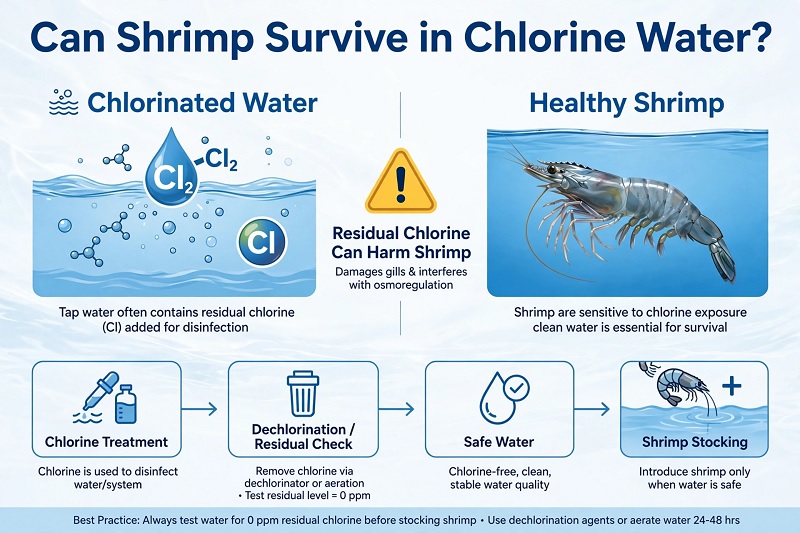
Can Shrimp Survive in Chlorine Water?
Shrimp survival in chlorinated water depends on the concentration of free chlorine, exposure time, shrimp species, life stage, water temperature, salinity, pH, organic matter, and other water-quality conditions.
At sufficiently high concentrations, chlorine can be acutely toxic to shrimp. Even lower concentrations may cause sublethal stress, including reduced activity, abnormal swimming, increased ventilation, gill irritation, reduced feeding, and greater vulnerability to disease.
Juvenile shrimp, post-larvae, and other sensitive life stages may be particularly vulnerable because their gill structures and physiological systems are still developing.
For this reason, farmers should avoid using chlorinated source water directly in stocked ponds or tanks unless the residual chlorine has been properly checked and managed.
For aquaculture operations evaluating chlorine-based products for sanitation and water preparation, additional information about vi chlorine can provide useful product and application context.
Why Chlorine Is Harmful to Shrimp
Chlorine is a strong oxidizing agent. In water, chlorine-based products can produce active chlorine species such as hypochlorous acid and hypochlorite ion.
These compounds are effective against microorganisms because they react with proteins, cell membranes, enzymes, and other biological materials. Unfortunately, they can also react with shrimp tissues.
The gills are one of the most vulnerable organs.
Gill damage
Shrimp rely on their gills for oxygen exchange and ionic regulation. Chlorine exposure can irritate or damage delicate gill tissues, reducing the animal’s ability to breathe efficiently.
When gill function is compromised, shrimp may show rapid ventilation, erratic movement, lethargy, or attempts to escape the water.
Oxidative stress
Chlorine is an oxidant, and excessive exposure can contribute to oxidative damage in tissues. This can affect cell membranes and physiological processes.
Disruption of osmoregulation
Shrimp must maintain a careful balance of salts and water in their bodies. Gill damage can interfere with this regulation, especially when shrimp are already adapting to changes in salinity or temperature.
Reduced feeding and growth
Even when exposure is not immediately lethal, chlorine stress can reduce feeding activity and growth performance.
What Happens If Shrimp Are Exposed to Chlorine Water?
The effects of chlorine exposure can range from mild stress to rapid mortality depending on dose and duration.
Possible signs include:
- rapid or irregular swimming;
- gathering near aeration or water inflow points;
- reduced feeding;
- lethargy;
- loss of balance;
- abnormal gill appearance;
- increased surface activity;
- sudden mortality in severe cases.
These symptoms are not specific to chlorine alone. Low dissolved oxygen, ammonia, nitrite, hydrogen sulfide, salinity shock, temperature stress, pesticides, or other toxic chemicals can cause similar signs.
Therefore, suspected chlorine exposure should be confirmed through water testing rather than diagnosed from behavior alone.
Can Shrimp Survive in Tap Water with Chlorine?
Untreated municipal tap water is not automatically safe for shrimp.
Municipal drinking water may contain free chlorine or chloramine to control microbial growth in distribution systems. Both can be harmful to aquatic animals if present at inappropriate concentrations.
Small aquarium shrimp are particularly sensitive to sudden water-quality changes. Adding untreated tap water directly to a shrimp aquarium can therefore create unnecessary risk.
Water should be appropriately conditioned before use. The correct preparation method depends on whether the water contains free chlorine, chloramine, or both.
Free chlorine may dissipate under suitable conditions, while chloramine is more persistent and generally requires a different treatment approach.
How Is Chlorine Used Safely in Shrimp Farming?
Chlorine can be highly useful in aquaculture when it is applied at the correct stage.
Typical uses include:
- pond preparation before stocking;
- disinfection of incoming water;
- sanitation of tanks and equipment;
- biosecurity control;
- reduction of undesirable microorganisms;
- treatment of water reservoirs before use.
The key principle is timing.
Chlorine is normally applied before shrimp are present, followed by sufficient treatment, monitoring, and conditioning before stocking.
Operations with higher treatment volumes may consider packaging options such as vi chlorine 45kg, depending on product specifications, water volume, storage capacity, and the treatment protocol being followed.
Can Shrimp Survive After Chlorine Treatment of Pond Water?
Yes, shrimp can be stocked into water that was previously treated with chlorine, provided the water has been properly prepared and residual chlorine has been reduced to a level considered safe for the production system.
This distinction is important.
Previously chlorinated water is not the same as water containing active residual chlorine.
In pond preparation, chlorine may be applied to reduce pathogens or undesirable organisms. After treatment, the water is normally allowed to undergo further management before shrimp are stocked.
This may include:
- waiting for residual chlorine to decline;
- testing free chlorine;
- providing aeration;
- adjusting water chemistry if necessary;
- monitoring pH, salinity, temperature, and dissolved oxygen;
- confirming that the pond is biologically suitable for stocking.
Farmers should not rely only on smell or elapsed time. Water testing is a safer approach.
How Long Does Chlorine Stay in Water Before Shrimp Can Be Stocked?
There is no single time period that applies to every pond.
The rate at which chlorine declines depends on:
- initial chlorine dose;
- sunlight exposure;
- water temperature;
- pH;
- organic matter;
- ammonia concentration;
- aeration;
- water depth;
- the specific chlorine compound used.
In water with high organic matter, chlorine may be consumed more quickly because it reacts with organic substances. In cleaner water, residual chlorine may persist differently.
This is why a farmer should not assume that water is safe simply because a certain number of hours have passed.
Testing the residual is more reliable.
How to Remove Chlorine from Water Before Adding Shrimp
Several methods can reduce chlorine, depending on the water source and treatment system.
Natural dissipation
Free chlorine can decline over time due to reaction with organic matter, sunlight exposure, aeration, and natural chemical decomposition.
This method should still be verified with testing.
Aeration
Aeration can support gas exchange and improve overall water preparation, although its effectiveness depends on the type of chlorine species present.
Dechlorination chemicals
Specific dechlorination agents may be used in some systems. These should be selected and dosed carefully to avoid creating new water-quality problems.
Activated carbon
Activated carbon can help remove chlorine and certain organic contaminants in selected water-treatment systems.
Water exchange
In small systems, replacing part of the water with properly conditioned water may help reduce residual chlorine.
Free Chlorine vs Chloramine: Which Is More Dangerous to Shrimp?
Both free chlorine and chloramine can be harmful to shrimp.
Free chlorine is generally more reactive and often more rapidly toxic, while chloramine is more stable and can remain in water longer.
| Characteristic | Free Chlorine | Chloramine |
|---|---|---|
| Reactivity | Higher | Lower |
| Persistence | Generally shorter | Generally longer |
| Aquatic toxicity concern | High | Also significant |
| Removal | Often easier | Can require more deliberate treatment |
Farmers using municipal water should confirm whether the utility uses chlorine or chloramine because treatment methods may differ.
Safe Water Quality Matters More Than Chlorine Alone
Even when chlorine has been fully controlled, shrimp health still depends on overall water quality.
Important parameters include:
- dissolved oxygen;
- pH;
- temperature;
- salinity;
- alkalinity;
- ammonia;
- nitrite;
- hydrogen sulfide;
- microbial balance;
- organic load.
A pond can be free of harmful chlorine but still be unsuitable for shrimp if these other parameters are unstable.
Practical field perspectives on water treatment and shrimp farming can be explored through What Do Local Farmers Say About Vi-CHLORiNE.
Can Shrimp Survive Low Levels of Chlorine?
Shrimp tolerance to chlorine varies, and there is no universal concentration that should be considered safe across all species, life stages, temperatures, and production systems.
This is important because people sometimes look for one “safe ppm” value.
In practice, aquaculture management should aim to avoid unnecessary residual chlorine exposure rather than intentionally maintaining chlorine in culture water.
Sensitivity can be influenced by:
- shrimp species;
- post-larval or juvenile stage;
- water temperature;
- salinity;
- pH;
- exposure time;
- other water-quality stressors.
A concentration tolerated under one set of conditions may cause stress under another.
Can Chlorine Be Used in Shrimp Ponds During Culture?
Direct chlorination of a stocked shrimp pond should be approached with extreme caution because chlorine can harm shrimp, beneficial microorganisms, plankton, and other components of the pond ecosystem.
Chlorine use is generally more appropriate during:
- pond preparation;
- water-reservoir treatment;
- equipment sanitation;
- biosecurity procedures;
- treatment before stocking.
If disease or water-quality problems occur during culture, farmers should first identify the cause rather than automatically adding a strong oxidizing chemical.
Water management is becoming increasingly important as shrimp farming intensifies. Broader market and production context is discussed in Global Shrimp Market Outlook 2025: A Golden Opportunity for Asia.
How to Prepare Chlorinated Water Before Stocking Shrimp
A structured water-preparation process can reduce risk.
- Analyze the source water. Check pH, salinity, turbidity, organic matter, and other relevant parameters.
- Calculate the treatment volume. Accurate pond or reservoir volume is essential for chemical dosing.
- Apply the chlorine product according to the treatment objective and product instructions.
- Provide adequate mixing or circulation.
- Allow the treatment process to proceed.
- Measure residual chlorine.
- Continue conditioning until the water is suitable for shrimp.
- Recheck key water-quality parameters.
- Stock shrimp only after the water is confirmed ready.
This step-by-step approach is safer than relying on a fixed waiting period.
What to Do If Shrimp Are Accidentally Exposed to Chlorine Water
If chlorine exposure is suspected, the priority is to reduce further exposure and stabilize water quality as quickly as possible.
Depending on the system, appropriate actions may include stopping the chlorine source, increasing aeration, introducing properly conditioned replacement water, checking residual chlorine, and monitoring dissolved oxygen, pH, temperature, and shrimp behavior.
In commercial farms, technical staff should follow the farm’s emergency response procedure and use verified water-quality data to guide corrective action.
Because several toxic water-quality events can produce similar shrimp behavior, testing is important before deciding on further chemical treatment.
Can Shrimp Survive in Chlorine-Treated Aquaculture Water?
Yes—if the water was treated earlier and the active chlorine has been appropriately reduced or neutralized before shrimp are introduced.
This is one of the most important distinctions in aquaculture biosecurity.
Chlorine can be highly valuable for disinfecting water before stocking, while residual chlorine can be harmful after stocking.
The success of chlorine treatment therefore depends on:
- correct dosing;
- correct timing;
- adequate contact;
- residual monitoring;
- proper water conditioning;
- stocking only when the water is ready.
For facilities where a more manageable packaging format is useful, Vi chlorine 25kg may be considered according to the required treatment volume and product specifications.
Why Chlorine Is Important for Shrimp Farm Biosecurity
Although chlorine can be dangerous to shrimp when used incorrectly, it remains useful for shrimp-farm biosecurity when properly managed.
Aquaculture facilities must control pathogens entering through water, equipment, vehicles, personnel, and other pathways.
Water treatment can help reduce the microbial load entering a production system, particularly when farms use reservoirs or dedicated water-treatment ponds before water reaches grow-out ponds.
Chlorine treatment may therefore form one part of a multi-barrier biosecurity strategy that also includes filtration, sedimentation, controlled water intake, equipment sanitation, pond preparation, and routine monitoring.
Vi-CHLORiNE for Shrimp Farming and Aquaculture Water Treatment
Vi-CHLORiNE is a chlorine-based product intended for water-treatment, sanitation, and aquaculture biosecurity applications according to product specifications and recommended procedures.
In shrimp farming, chlorine-based products may be considered for applications such as preparing ponds before stocking, treating reservoir water, disinfecting equipment, and supporting farm biosecurity programs.
The most important operating principle is that chlorine should be applied as part of a controlled treatment process. Farmers should determine water volume, treatment objective, water quality, required contact time, residual chlorine, and the appropriate point at which shrimp can safely be introduced.
The role of Vi-CHLORiNE in modern shrimp-farm biosecurity is also highlighted in AQUADELTA - Dr.Tom Accompanies Vietshrimp 2025: Vi-CHLORiNE Solution Enhancing Biosecurity in Aquaculture.
Vi-CHLORiNE provides practical chlorine product formats for pond preparation, water treatment, sanitation, and selected aquaculture biosecurity applications.
Contact the Vi-CHLORiNE team for product specifications, packaging information, storage recommendations, and application guidance for your farm or water-treatment system.
FAQ: Can Shrimp Survive in Chlorine Water?
1. Can shrimp survive in chlorine water?
Shrimp should not be exposed to harmful residual chlorine. Chlorine can damage gills, interfere with respiration, cause oxidative stress, and lead to mortality at sufficiently high concentrations. Chlorine-treated water can be used for shrimp farming only after the water has been properly conditioned and residual chlorine is reduced to an appropriate level before stocking.
2. Is tap water with chlorine safe for shrimp?
Untreated tap water may not be safe for shrimp because municipal water can contain chlorine or chloramine. The water should be appropriately conditioned before use, particularly in aquariums and small culture systems where sudden chemical changes can strongly affect shrimp.
3. How long should chlorinated water sit before adding shrimp?
There is no universal waiting time. Chlorine persistence depends on dose, sunlight, organic matter, pH, temperature, aeration, and water chemistry. Measuring residual chlorine is more reliable than relying only on elapsed time.
4. Can chlorine be used to disinfect shrimp pond water?
Yes. Chlorine-based products can be used for pond preparation, reservoir-water treatment, and sanitation before stocking. The treatment should be carefully managed so that harmful residual chlorine is no longer present when shrimp are introduced.
5. What should farmers check before stocking shrimp after chlorine treatment?
Farmers should confirm residual chlorine, dissolved oxygen, pH, temperature, salinity, alkalinity, and other relevant water-quality parameters. Shrimp should be stocked only when the water has been fully prepared and is suitable for the intended species and production stage.
Conclusion: Can Shrimp Survive in Chlorine Water Safely?
So, can shrimp survive in chlorine water? Shrimp can be seriously harmed by active residual chlorine, and direct exposure should be avoided. Chlorine is a strong oxidant that may damage gills, disrupt respiration, create physiological stress, and cause mortality when exposure is excessive.
At the same time, chlorine is an important tool in shrimp farming when used correctly. It can support pond preparation, water disinfection, equipment sanitation, and aquaculture biosecurity before shrimp are stocked.
The key distinction is between chlorine-treated water and water that still contains harmful residual chlorine. The first can be suitable for aquaculture after proper preparation; the second may pose a direct risk to shrimp.
For reliable management, farmers should calculate treatment volume carefully, follow product instructions, provide adequate contact time, monitor residual chlorine, condition the water, and verify overall water quality before stocking.