
Best Time to Shock a Pool With Chlorine: Complete Guide
- Q&A Chlorine
- 11/09/2026
Pool shocking is one of the most important corrective treatments for maintaining clear and sanitary swimming water. Even when a pool has a normal chlorine residual, contaminants can gradually accumulate. Heavy swimming, rain, leaves, sunscreen, sweat, algae, and other organic matter can increase chlorine demand and reduce water quality.
Adding a sufficiently strong chlorine treatment can help oxidize contaminants and restore effective sanitation. But adding chlorine at the wrong time may reduce treatment efficiency, particularly in outdoor pools exposed to intense sunlight.
This guide explains the best time of day to shock a pool, how often shock treatment may be necessary, when additional shocking should be considered, how sunlight affects chlorine, and what pool owners should check before swimming again.
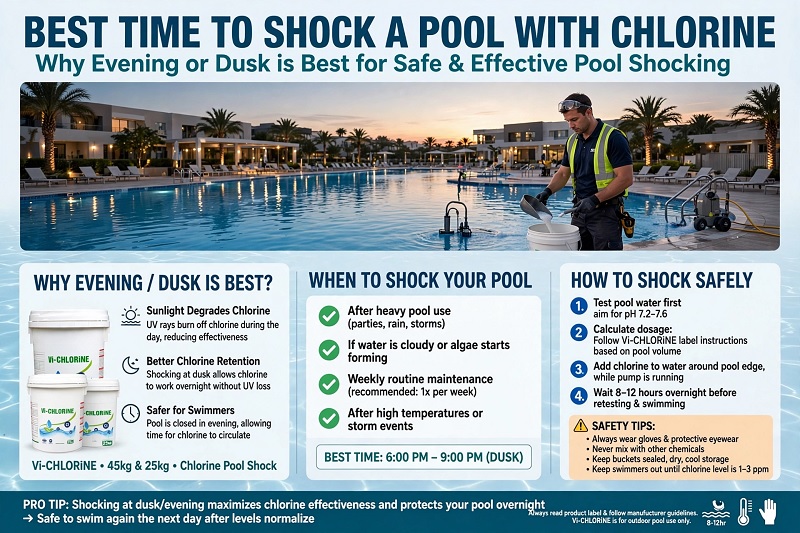
What Is the Best Time to Shock the Pool with Chlorine?
For most outdoor swimming pools, evening or shortly after sunset is the preferred time to shock with chlorine.
The main reason is sunlight. Ultraviolet radiation can degrade free chlorine in outdoor pool water. When a large chlorine dose is added during strong midday sunlight, part of that chlorine may be lost before it has had sufficient time to perform the intended treatment.
Shocking in the evening provides several potential advantages:
- Reduced exposure to direct UV radiation.
- More time for chlorine to react with contaminants overnight.
- Lower likelihood of swimmers entering during treatment.
- More time for filtration and circulation before the next swimming period.
- Easier retesting of the pool the following morning.
This does not mean that chlorine can only be added at night. If immediate corrective disinfection is necessary, treatment should not be delayed simply because it is daytime. However, for routine shock treatment, evening application is generally more efficient for an outdoor pool.
The same principle of controlled chlorine application is important in larger water-treatment operations. vi chlorine provides chlorine solutions for professional disinfection, water treatment, environmental sanitation, and aquaculture biosecurity applications where dosage and operating conditions need to be carefully controlled.
Why Is Evening the Best Time to Shock the Pool with Chlorine?
Chlorine does not remain unchanged after entering pool water. It begins reacting with microorganisms, organic contaminants, nitrogen-containing compounds, and other substances. At the same time, outdoor chlorine can be affected by sunlight.
UV radiation accelerates chlorine loss, particularly when the water has little or no stabilizer. This means that shocking an outdoor pool during intense sunlight can make the treatment less efficient.
By waiting until late afternoon, evening, or after sunset, the shock treatment has several hours without intense solar exposure.
During this period, the pool circulation system can distribute the chlorine throughout the water while the sanitizer reacts with contaminants.
For many residential pools, a practical routine is:
- Test the water in the late afternoon or evening.
- Correct important water-balance problems if necessary.
- Add the appropriate shock treatment after direct sunlight has substantially decreased.
- Keep the circulation system operating as recommended.
- Keep swimmers out of the pool during treatment.
- Retest free chlorine and other relevant parameters before swimming again.
Is Night Always the Best Time to Shock the Pool with Chlorine?
Nighttime is generally advantageous for routine outdoor pool shocking, but it is not an absolute rule.
There are situations where immediate treatment may be more important than waiting for sunset.
Examples include:
- Visible algae growth
- Unexpected contamination
- Extremely low sanitizer residual
- Cloudy water associated with inadequate sanitation
- A significant increase in swimmer load
- Water quality deterioration after severe weather
If contamination creates a potential health concern, swimmers should stay out of the pool and appropriate corrective treatment should begin according to applicable guidance rather than waiting for the most convenient time of day.
In other words, evening is usually the most efficient routine timing, but water safety takes priority over timing.
How Sunlight Affects the Best Time to Shock the Pool with Chlorine
Sunlight is one of the main reasons pool professionals often recommend evening shock treatment.
When chlorine is present in outdoor pool water, UV radiation can contribute to its degradation. The rate of chlorine loss depends on several factors, including water chemistry and the presence of cyanuric acid (CYA), commonly called chlorine stabilizer.
CYA can help protect chlorine from rapid sunlight degradation. However, excessive stabilizer can also change how much free chlorine is required for effective sanitation.
This relationship means pool owners should not focus only on the amount of chlorine added. They should consider the overall water chemistry.
For professional users treating substantially larger water volumes, packaging and chlorine concentration are also important operational considerations. Products such as vi chlorine 45kg are designed for professional-scale water treatment and disinfection rather than casual residential pool dosing.
What Does It Mean to Shock a Pool with Chlorine?
Pool shocking refers to adding a relatively high dose of sanitizer or oxidizing treatment to address contaminants that routine sanitation may not adequately control.
During normal pool operation, chlorine is continuously consumed. Swimmers introduce sweat, body oils, cosmetics, sunscreen, and other contaminants. Outdoor pools also receive leaves, dust, insects, pollen, rainwater, and environmental debris.
As chlorine reacts with certain nitrogen-containing contaminants, combined chlorine compounds known as chloramines may form. Poor water quality can be associated with unpleasant odors and swimmer discomfort.
Shock treatment is commonly used as part of a corrective process to:
- Restore adequate sanitizer conditions.
- Oxidize accumulated contaminants.
- Address some combined chlorine problems.
- Assist in controlling algae.
- Recover water quality after heavy use.
However, shocking should not be viewed as a substitute for filtration, circulation, brushing, debris removal, pH management, or routine chlorine monitoring.
When Is the Best Time to Shock the Pool with Chlorine After Heavy Swimming?
After a pool party or a day of unusually heavy swimming, chlorine demand may increase significantly.
Every swimmer introduces organic material into the water. Sunscreen, perspiration, body oils, cosmetics, and other contaminants all contribute to sanitizer demand.
If testing indicates that corrective treatment is required, the evening after heavy pool use is often an excellent opportunity to shock the water.
This provides an overnight treatment window before the pool is likely to be used again.
A useful post-party routine includes:
- Remove floating debris.
- Empty skimmer baskets.
- Check filtration equipment.
- Test free chlorine and pH.
- Brush surfaces if necessary.
- Apply the appropriate treatment according to the product label.
- Operate circulation as required.
- Retest before reopening the pool.
Practical experience with chlorine is equally important in other water-management sectors. For example, What Do Local Farmers Say About Vi-CHLORiNE provides insights into how chlorine-based water treatment is applied by users working in aquaculture environments.
When Is the Best Time to Shock the Pool with Chlorine After Rain?
Heavy rainfall can significantly change pool conditions.
Rain may introduce airborne contaminants, soil particles, leaves, microorganisms, and other debris. A large volume of rainwater can also dilute pool chemistry and alter pH, alkalinity, and sanitizer levels.
After heavy rain, do not automatically add a random amount of chlorine. Start by inspecting and testing the pool.
A sensible sequence is:
- Remove leaves and visible debris.
- Check the water level.
- Test pH and sanitizer concentration.
- Evaluate water clarity.
- Correct water chemistry where appropriate.
- Shock the pool if testing and conditions indicate that it is needed.
If possible, perform the shock treatment after the weather has stabilized and direct sunlight is low.
After storms, filtration may also need additional operating time because chlorine does not physically remove suspended dirt from water. The filter and circulation system remain essential.
When Is the Best Time to Shock the Pool with Chlorine for Algae?
Visible algae usually indicates that pool sanitation, circulation, filtration, or water balance has not been adequate.
If algae is developing, waiting several days for a routine maintenance schedule is not advisable. Corrective action should begin promptly.
Evening treatment can still provide the advantage of reduced UV degradation, but successful algae treatment normally involves more than simply adding chlorine.
The process may include:
- Testing water chemistry.
- Adjusting pH as required by the treatment protocol.
- Applying an appropriate chlorine dose.
- Brushing pool walls, steps, and floor.
- Maintaining adequate circulation.
- Cleaning or backwashing the filter when necessary.
- Removing dead algae and debris.
- Retesting chlorine levels.
Severe algae problems may require repeated testing and treatment rather than one shock dose.
How Often Should You Shock the Pool with Chlorine?
There is no universal schedule that is correct for every swimming pool.
Some pool owners use periodic shock treatment as part of routine maintenance, while others base treatment primarily on testing and actual water conditions.
The need for shocking depends on:
- Swimmer load
- Water temperature
- Weather conditions
- Sunlight exposure
- Filtration performance
- Free and combined chlorine readings
- Presence of algae
- Amount of organic contamination
- Pool usage patterns
A heavily used outdoor pool in hot weather may require more corrective treatment than a lightly used pool with stable chemistry.
Rather than relying entirely on a calendar, pool owners should test water routinely and respond to measurable conditions.
Should You Test the Water Before the Best Time to Shock the Pool with Chlorine?
Yes. Testing before treatment is one of the most important steps.
Adding chlorine without knowing current water conditions can lead to ineffective treatment, excessive chemical use, or unnecessarily high sanitizer levels.
Important parameters may include:
Free chlorine
Free chlorine indicates the chlorine available for sanitizing the water.
Combined chlorine
Combined chlorine can provide useful information about chloramine formation and chlorine demand.
pH
pH affects swimmer comfort, equipment, water balance, and chlorine chemistry.
Total alkalinity
Total alkalinity helps buffer pH changes and contributes to stable pool chemistry.
Cyanuric acid
For stabilized outdoor pools, CYA affects chlorine's resistance to sunlight and should be considered when managing sanitizer levels.
Testing is also fundamental in commercial and aquaculture water treatment, where changing market requirements have increased the focus on biosecurity and efficient production. The article Global Shrimp Market Outlook 2025: A Golden Opportunity for Asia discusses broader developments influencing Asian aquaculture production.
How Much Chlorine Should You Use When Shocking a Pool?
The correct amount depends on the product, its available chlorine content, pool volume, current chlorine level, water chemistry, and the treatment objective.
There is no responsible universal answer such as "use one bag" or "add one tablet" for every pool.
Before calculating a dose, determine:
- Total pool volume
- Current free chlorine concentration
- Target treatment concentration
- Available chlorine percentage of the product
- Manufacturer's dosing instructions
As a basic chemical principle, 1 ppm in water is approximately equal to 1 milligram per liter.
Therefore, the theoretical active chlorine requirement can be estimated as:
Active chlorine required (mg) = Pool volume (L) × Desired increase (mg/L)
The amount of actual chlorine product must then be adjusted according to its percentage of available chlorine.
This is a theoretical starting point. Real pool water contains contaminants that create chlorine demand, so actual treatment should always be verified through testing.
Should the Pool Pump Run When You Shock with Chlorine?
In most conventional pool systems, adequate circulation is important during shock treatment because the sanitizer needs to be distributed throughout the water.
Poor circulation can create uneven treatment and leave areas where sanitation is less effective.
The exact pump operating period should follow the pool system and chemical manufacturer's recommendations.
During treatment, ensure that:
- Skimmer baskets are not blocked.
- Water can circulate normally.
- The filter is functioning correctly.
- Return jets are operating appropriately.
- Visible debris has been removed where possible.
Remember that chlorine and filtration perform different functions. Chlorine disinfects and oxidizes contaminants, while filtration physically removes suspended particles from the circulating water.
How Long After Shocking a Pool with Chlorine Can You Swim?
Do not rely on a universal waiting period alone.
The correct time to reopen a pool depends on the chlorine product, treatment dose, pool volume, circulation, water chemistry, and resulting free chlorine concentration.
Always follow the product label and test the water before swimmers re-enter.
The pool should meet the appropriate swimming-water parameters applicable to the facility and local regulations.
This is particularly important after a high-dose treatment. Assuming that the pool is safe simply because several hours have passed is less reliable than measuring the actual water conditions.
For professional facilities requiring different packaging options for water-treatment operations, Vi chlorine 25kg is available for professional disinfection and water-management applications.
Can You Shock the Pool with Chlorine During the Day?
Yes. Chlorine can be applied during the day when immediate corrective treatment is necessary.
However, for an outdoor pool, intense sunlight may reduce treatment efficiency by accelerating chlorine degradation. Therefore, if the situation is not urgent, evening application generally provides a longer low-UV treatment window.
If treatment must occur during daylight:
- Follow the chlorine product instructions.
- Keep swimmers out.
- Ensure appropriate circulation.
- Monitor water chemistry.
- Retest after treatment.
Never postpone necessary action merely to achieve an ideal clock time if the water is clearly unsuitable for swimming.
Common Mistakes When Choosing the Best Time to Shock the Pool with Chlorine
Correct timing helps, but several common mistakes can still undermine the treatment.
Shocking without testing
Water testing should guide treatment decisions. Guessing can lead to over-treatment or insufficient sanitation.
Adding chlorine in intense sunlight unnecessarily
For routine outdoor pool treatment, this can increase chlorine loss from UV exposure.
Ignoring pH
Chlorine chemistry is strongly influenced by pH. Adding more chlorine without understanding the water balance may not solve the underlying problem.
Mixing different pool chemicals
Never mix chlorine products with acids, other chlorine formulations, or incompatible chemicals. Dangerous reactions may occur.
Adding water directly to concentrated chlorine
Follow the product label exactly for handling and dilution. Do not improvise chemical-mixing procedures.
Assuming strong chlorine odor means too much free chlorine
A strong "pool smell" can be associated with chloramines and poor water quality rather than simply an excess of properly managed free chlorine.
Allowing swimmers back too soon
Use test results and product guidance rather than guessing based on elapsed time.
Ignoring filtration and brushing
Shock treatment cannot replace physical pool maintenance.
Best Time to Shock the Pool with Chlorine: Step-by-Step Checklist
For routine outdoor pool treatment, the following sequence provides a useful framework:
- Inspect the pool: Look for algae, cloudiness, debris, or unusual contamination.
- Remove debris: Remove leaves and other visible materials.
- Test the water: Measure free chlorine, pH, and other relevant parameters.
- Calculate the treatment: Determine the required product quantity according to pool volume and manufacturer instructions.
- Wait until evening when practical: Reduced sunlight helps limit UV-related chlorine loss.
- Add the product correctly: Follow label instructions and use appropriate personal protective equipment.
- Maintain circulation: Operate the pool system as recommended.
- Keep swimmers out: Prevent access during treatment.
- Retest the water: Confirm that water conditions are suitable before reopening the pool.
- Investigate recurring problems: Repeated algae or high chlorine demand may indicate filtration, circulation, contamination, or water-balance issues.
The Best Time to Shock the Pool with Chlorine Depends on Water Conditions
Although evening is generally the preferred time for routine outdoor pool shocking, the most effective treatment strategy is based on water conditions rather than the clock alone.
Think of pool shock treatment as a combination of five factors:
Correct timing + correct dose + correct water chemistry + adequate circulation + verification through testing.
If any one of these elements is ignored, treatment may be less effective.
For example, adding chlorine after sunset may reduce UV loss, but the treatment can still fail if the pool contains a heavy algae load and the surfaces are never brushed. Similarly, adding a large amount of chlorine will not solve a damaged or poorly functioning filtration system.
Effective water treatment therefore requires a systematic approach rather than simply adding more chemicals.
Why Chlorine Treatment Is Important Beyond Swimming Pools
The chemistry that makes chlorine useful for swimming pool sanitation also supports many professional water-treatment and biosecurity applications.
In aquaculture, controlling microorganisms in water, equipment, ponds, and production environments can be an important component of farm biosecurity. Treatment effectiveness depends on factors such as water quality, organic load, concentration, contact time, and operating procedures.
Industry initiatives increasingly combine chemical treatment with broader biosecurity strategies. One example can be found in AQUADELTA - Dr.Tom Accompanies Vietshrimp 2025: Vi-CHLORiNE Solution Enhancing Biosecurity in Aquaculture, which highlights the role of Vi-CHLORiNE solutions within aquaculture biosecurity practices.
Vi-CHLORiNE for Professional Chlorine Water Treatment
Understanding the best time to shock the pool with chlorine demonstrates an important principle of water treatment: chlorine effectiveness depends not only on how much chemical is applied but also on when, where, and under what water conditions it is used.
Vi-CHLORiNE provides chlorine solutions for professional water-treatment and disinfection applications, with a particular focus on aquaculture and biosecurity.
Depending on the specific application, chlorine-based treatment may support:
- Water disinfection
- Aquaculture water preparation
- Pond treatment
- Equipment and surface sanitation
- Biosecurity programs
- Environmental disinfection
- Professional water-management processes
Vi-CHLORiNE is available in commercial packaging options to support different operational requirements. Professional users should always determine dosage according to water volume, water quality, treatment objective, available chlorine concentration, and technical guidance.
For swimming pools, always select a chlorine product specifically labeled and approved for that intended use. Professional bulk chlorine products should not be substituted for consumer pool products without appropriate technical evaluation and application guidance.
Discover Vi-CHLORiNE solutions for aquaculture, water disinfection, sanitation, and professional water-management applications.
Explore Vi-CHLORiNE ProductsFAQ About the Best Time to Shock the Pool with Chlorine
1. What is the best time to shock the pool with chlorine?
For most outdoor pools, the best time to shock with chlorine is in the evening or after sunset. Lower UV exposure gives chlorine more time to react with contaminants before sunlight begins accelerating chlorine degradation. If immediate corrective sanitation is necessary, however, treatment should not be delayed solely to wait for nighttime.
2. Is it better to shock a pool at night or in the morning?
Night is generally preferable for outdoor pools because chlorine can work for several hours without strong sunlight. Morning treatment can also be performed, but chlorine may soon face increasing UV exposure as sunlight intensifies. Evening treatment therefore usually provides a longer low-UV treatment period.
3. Can I shock my pool during the day?
Yes. You can shock a pool during the day when treatment is necessary, but strong sunlight may accelerate chlorine loss in outdoor water. For routine maintenance, evening is generally more efficient. Regardless of timing, follow the product instructions, maintain appropriate circulation, keep swimmers out during treatment, and retest the water afterward.
4. How long should I wait to swim after shocking a pool with chlorine?
There is no universal waiting time for every product and treatment. The safe reopening time depends on the chlorine formulation, dose, water volume, circulation, and final free chlorine concentration. Follow the chemical manufacturer's instructions and test the water before swimming rather than relying only on a fixed number of hours.
5. Should I run the pool pump after adding chlorine shock?
For most conventional swimming pools, circulation is important after shock treatment because it helps distribute chlorine throughout the water and allows the filtration system to remove suspended contaminants. Follow the recommendations for your specific pool system and chlorine product regarding pump operating time.
Conclusion: For routine outdoor pool maintenance, evening or shortly after sunset is generally the best time to shock the pool with chlorine because reduced sunlight limits UV-related chlorine loss and provides an extended treatment period overnight. However, successful shocking depends on more than timing. Test the water, calculate the correct dose, maintain circulation, follow the chlorine manufacturer's instructions, keep swimmers out during treatment, and verify water chemistry before reopening the pool.
Disclaimer: This article is intended for general educational purposes. Chlorine products vary in composition and concentration. Always follow the product label, Safety Data Sheet (SDS), pool equipment manufacturer's instructions, and applicable local swimming-pool and water-treatment regulations.